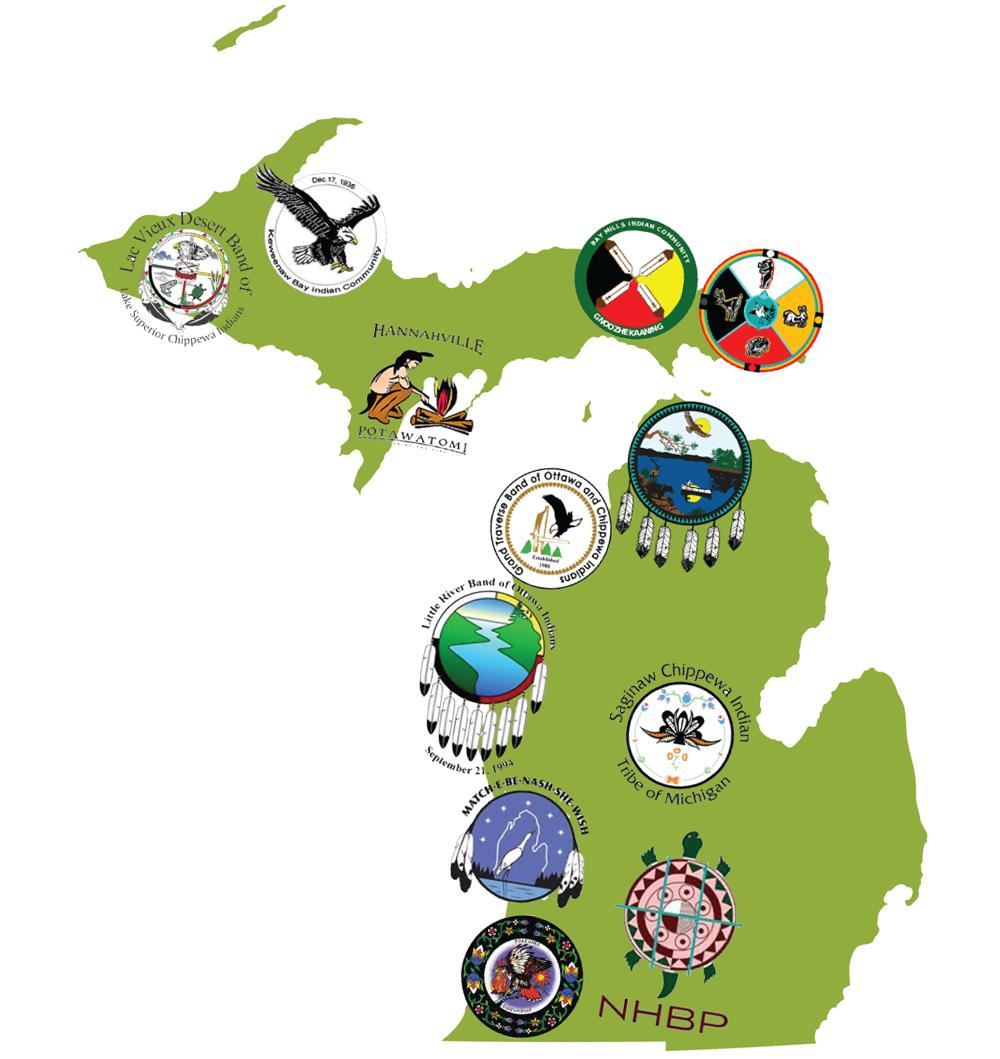
Today is Michigan Indian Day, designated by Michigan law as the fourth Friday of every September.
In honor of the day, I’m offering a snapshot of what Tribal sovereignty looks like in Michigan. It includes:
Land Back • Treaty Rights • Citizenship • Education • Child Welfare • Health Care • Policing • Courts • Utilities • Economic Regulation • Manoomin • Culturally Grounded Governance
Below are 12 recent examples, one drawn from each Michigan Tribe.
It looks like bringing ancestral land home, and deciding what happens next. At the end of 2024, 188 acres along West Grand Traverse Bay were returned to the Grand Traverse Band of Ottawa and Chippewa Indians. GTB named the land Mashkiigaki, “place of the medicines,” reflecting its significance for hunting, fishing, gathering, medicines, wetlands, and coastal habitat. Since then, GTB has begun reconnecting Tribal citizens with the land and laying the groundwork for ecocultural restoration. The Tribe has surveyed citizens about their memories and aspirations for Mashkiigaki, initiated bird and invasive species surveys, planned a study of creek and wetland hydrology, and begun mapping sensitive habitat and possible public access routes. In 2026, GTB received approximately $1.3 million from NOAA, part of the federal grant approved in 2024, to support restoration and community engagement at Mashkiigaki. The planning remains Tribal-led, with elders, citizens, and government staff helping determine the land’s future. GTB’s announcement on the return of Mashkiigaki
It looks like leading a fight to protect treaty-protected waters. Bay Mills Indian Community has been a central leader in the Tribal campaign against both the existing Line 5 dual pipelines and Enbridge’s proposed tunnel beneath the Straits of Mackinac. Its opposition is grounded in the 1836 Treaty of Washington, treaty-protected fishing and gathering rights, and the Tribe’s sovereign responsibility to protect Michilimackinac, a sacred place at the heart of Anishinaabe creation traditions. Bay Mills formally called for Line 5’s decommissioning in March 2015, supported Michigan’s 2020 revocation and termination of Enbridge’s 1953 easement, and in 2021 formally banished Line 5 from Tribal lands, including the Straits. The Tribe also helped bring the dispute before the U.N. Permanent Forum on Indigenous Issues, which in 2023 recommended that the United States and Canada decommission Line 5. In litigation over the existing crossing, Bay Mills filed amicus briefs supporting the State’s efforts to keep its shutdown cases in state court, including a 2023 Sixth Circuit brief in Nessel v. Enbridge on behalf of a coalition that NARF describes as more than 60 Tribal Nations and First Nations.
Bay Mills has simultaneously challenged the proposed tunnel before the Michigan Public Service Commission, EGLE, the Michigan courts, and the U.S. Army Corps of Engineers. It intervened in the MPSC proceeding and introduced Tribal and expert testimony on treaty rights, fisheries, climate impacts, alternatives, and tunnel explosion risks. It also challenged EGLE’s 2021 wetlands permit and participated in the Army Corps’ federal review as a cooperating agency. In March 2025, Bay Mills and other Tribes withdrew as cooperating agencies after the Corps moved to fast-track approval under the asserted national “energy emergency.” The MPSC approved the tunnel in December 2023, and the Court of Appeals affirmed in February 2025. In July 2026, the Michigan Supreme Court vacated the MPSC’s approval. It remanded for a new analysis of the project’s environmental effects, feasible alternatives, and impacts on public trust resources (In re Application of Enbridge Energy to Replace & Relocate Line 5, No. 168335 (Mich. July 31, 2026)). EGLE had approved wetlands and bottomlands permits for the tunnel two weeks earlier. The Army Corps issued its record of decision in August notwithstanding the ruling, and Bay Mills condemned the federal decision as a breach of treaty and trust responsibilities. In September 2026, after Governor Whitmer announced that EGLE would re-review its permits, Bay Mills and three other Tribal Nations petitioned for a contested case hearing to overturn them. Bay Mills’ Line 5 information portal Michigan Supreme Court decision
It looks like deciding who belongs to the political community. In March 2026, Hannahville Indian Community amended its Tribal Enrollment Ordinance, governing membership applications, the Enrollment Committee, appeals, records, relinquishment, and loss of membership. Few exercises of governmental authority are more foundational than determining the citizenship of the political community. Hannahville’s 2026 Tribal Enrollment Ordinance
It looks like reshaping a regional education system. Keweenaw Bay Indian Community is leading a five-year Promise Neighborhood covering the L’Anse Reservation and surrounding Baraga County. The cradle-to-career initiative links local schools with early childhood, family, college, and career supports; KBIC cultural advocates and Ojibwe language instructors also work with area schools to bring Ojibwe language, history, and culture into classrooms. KBIC Promise Neighborhoods U.S. Department of Education project profile
It looks like exercising responsibility for Tribal children under Tribal law. The Saginaw Chippewa Indian Tribe governs child protection through its own Children’s Code and institutions. Tribal law provides for Children’s Court jurisdiction, child protection proceedings, foster care and child care regulation, adoption, and other matters affecting Tribal children, while Anishnaabeg Child and Family Services carries out child and family services within that Tribal governmental and legal framework. Saginaw Chippewa Children’s Code Anishnaabeg Child and Family Services
It looks like building a health system across the Upper Peninsula. The Sault Ste. Marie Tribe of Chippewa Indians operates nine health clinics or centers across its 7-county service area, providing varying combinations of medical, dental, behavioral health, pharmacy, and other services. Earlier this week, the Tribe broke ground on a major expansion and renovation of its Sault Health Center, designed to improve patient care while maintaining connections to Anishinaabe spiritual and cultural beliefs. Sault Tribe Health Division September 22 groundbreaking announcement
It looks like making jurisdiction work across borders. In October 2025, the City of Petoskey formally swore in Little Traverse Bay Bands of Odawa Indians Tribal Police under a cross-deputization arrangement allowing LTBB officers to assist within city jurisdiction. Petoskey officers, in turn, were to be sworn in by LTBB so they could respond where the Tribe has primary jurisdiction. The arrangement is especially striking given that shortly after LTBB’s federal reaffirmation, local officials once accused its officers of “impersonating police officers.” Today, Tribal and local governments extend law enforcement authority to one another. Petoskey Department of Public Safety 2025 Annual Report Frank Ettawageshik recounts LTBB’s earlier cross-deputization history
It looks like a Tribal court telling another branch of Tribal government what the Constitution requires. In Romanelli v. Tribal Council, the Little River Band of Ottawa Indians Tribal Court ruled in May that the Ogema’s proposed FY2026 budget had become the Tribal budget by operation of the Constitution and issued a writ of mandamus requiring the Tribal Council to appropriate the funds. That’s Tribal constitutional law in action, with a Tribal judiciary resolving a separation of powers dispute within Tribal government. Romanelli v. Tribal Council order
It looks like making sure the drinking water is safe and the sewer system works. In March, the Match-E-Be-Nash-She-Wish Band of Pottawatomi Indians (Gun Lake Tribe) enacted a new Water and Sewer Act. The law creates a Tribal regulatory system covering utility connections, permits, inspections, industrial discharges, water use restrictions, enforcement, fines, and Tribal Court proceedings. Sometimes sovereignty looks like constitutional litigation, and sometimes it looks like the sewer code. Gun Lake Tribe Water and Sewer Act
It looks like regulating a new market, and mobilizing government to protect citizens. In 2025, the Lac Vieux Desert Band of Lake Superior Chippewa Indians entered a Tribal-State cannabis compact allowing a Tribally regulated cannabis business to participate in Michigan’s regulated market. Then, in January, amid concerns about ICE activity affecting Native people, the Tribal Council issued formal guidance to citizens, waived fees for replacement Tribal IDs, and directed citizens to Tribal enrollment, law enforcement, leadership, and legal offices for assistance. LVD–Michigan cannabis agreement LVD Tribal Council statement regarding ICE activity
It looks like making law for a relative rather than merely regulating a commodity. In September 2025, the Nottawaseppi Huron Band of the Potawatomi enacted a Mnomen (Wild Rice) Code. The law recognizes Mnomen as the Tribe’s official grain and a protected Tribal resource, creates a Mnomen Wgema composed of Tribal citizens, regulates harvesting and transplantation, authorizes enforcement by Tribal conservation officers, and provides penalties for violations. The Code also recognizes Mnomen as a living spirit, medicine, and part of the Tribe’s migration story. Environmental regulation, cultural responsibility, and Indigenous law operate here in the same legal framework. NHBP Mnomen (Wild Rice) Code
It looks like designing governmental institutions on Indigenous terms. Under the Pokagon Band of Potawatomi Indians’ Elders Council Code, the Elders Council is a governmental instrumentality that provides guidance to the membership and to the Band’s legislative, executive, and judicial institutions on matters of history, traditions, and culture. Pokagon law also permits one of the seven Tribal Council seats to be held by an Elders Council representative, who carries all the rights and responsibilities of a Tribal Councilperson. Pokagon Elders Council Code, current through May 2026
Every day across the state, each of Michigan’s 12 Tribes exercises governmental authority over lands, resources, institutions, services, and citizens.


You must be logged in to post a comment.