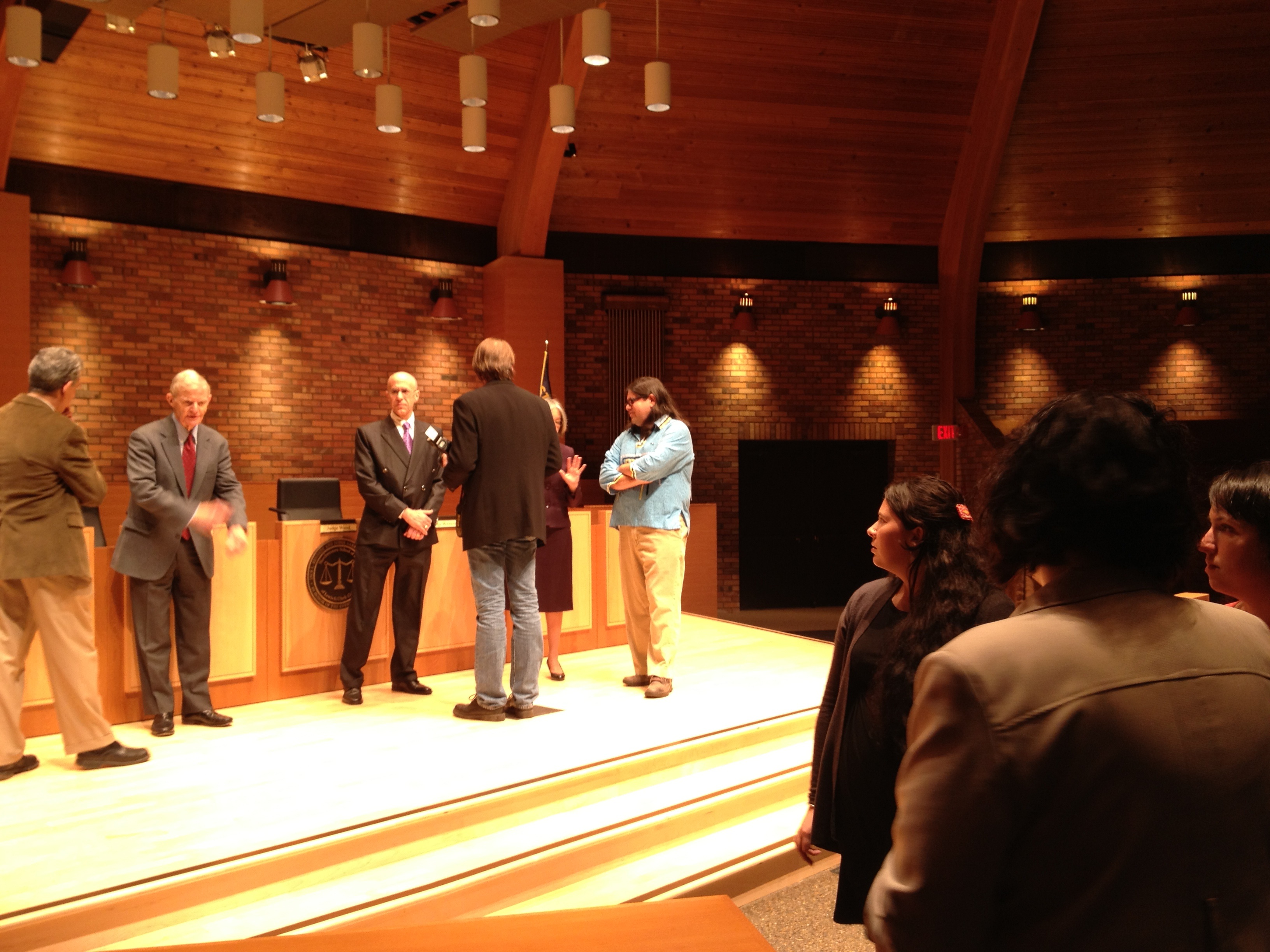

The final teams are from Columbia and University of Hawaii. An all women final!! Congratulations to both teams.
The final teams are from Columbia and University of Hawaii. An all women final!! Congratulations to both teams.
We are attempting to allow our posts to show up on our Facebook feed as well as Twitter. This is a test of the system.
Opinion here (or here: 11-393c3a2).
The law includes the Indian Health Care Improvement Act, which apparently still stands as well. Tribal amicus brief is here.
Please ignore–attempting to prevent all of the recent double tweets.
Petition for Bankruptcy filed in the U.S. Bankruptcy Court, Northern District of Illinois.
Indian Country Public Safety News
Open Source Intelligence Report by the DOJ Office of Tribal Justice
December 12, 2011
National
Two Habitual Domestic Violence Cases From Indian Country Head to US Supreme Court
DOJ Publishes Rule for Assumption of Concurrent Federal Criminal Jurisdiction on
PL-280 Reservations
http://www.courthousenews.com/2011/12/09/42091.htm
FEMA Supports Legislative Change to Allow Tribes to Directly Request Presidential Disaster Declarations
We’ve posted on this before here. Here is an oddly written article on this case in the Miami Herald via McClatchy News Service. An excerpt:
By Tim Johnson
McClatchy NewspapersWATERSMEET, Mich. — If any Indian tribe could ill afford to lose money in a Mexico casino scam, it is the disadvantaged Lac Vieux Desert Band of Lake Superior Chippewa.
Anchored in rolling woodlands of Michigan’s Upper Peninsula, the tribe’s 600 members have faced constant hardship for more than a century.
As recently as the mid-1970s, the median income per household for the tribe was only $2,300, and fully half of its working age members were unemployed.
When the tribe opened a bingo hall with a few slot machines in 1988, the year it was recognized as a separate nation, the new income allowed some members to move from overcrowded, rundown houses into better dwellings.
Over the past two decades, the tribe built the Lac Vieux Desert Casino Resort, the 76-room Dancing Eagles Hotel and a nine-hole golf course, earning enough to finance 30 new homes, a cultural-recreation center, a clinic, childcare facilities, a police force and water and wastewater treatment facilities.
But there were still too few jobs, and the loss of a $6.5 million casino investment in Mexico and ensuing legal fees have kept the tribe in crisis, unable to upgrade the casino’s aging slot machines or build new attractions.
In many ways Senior Day 2011 at the Michigan Law School was like any other commencement ceremony. Graduates donned caps and gowns. They discussed their time together and their plans for the future. Families asked passersby to snap photos of themselves with the new lawyer in the clan. Graduates and guests laughed politely at Dean Evan Caminker’s attempts at humor. It was a day of celebration.
But it was also a time for protest.
As families and friends entered Hill Auditorium they were handed a pamphlet explaining how this year’s Senior Day ceremony would be a little bit different than normal. The pamphlet explained the students’ plans to walk out during Senator Rob Portman’s commencement address.
Portman, a 1984 alum of the law school, was a six-term congressman before being tapped by President George W. Bush in 2005 to serve as the U.S. Trade Representative and, later, director of the Office of Management and the Budget, both cabinet-level positions. He was elected to the U.S. Senate in November 2010.
Portman came under fire for his voting record. He has opposed gay adoption in Washington, D.C. and opposes gay marriage. A number of students who took part in the protest said that such views are incompatible with basic, human dignity.
As reported on Indianz and Pechanga the last few days, the State of Alabama’s retained expert, D. Robert Sertell, on technical gaming issues took issue with the NIGC’s determination that Poarch Band of Creek Indians gaming operations are legal. Here’s a quote from a news article titled “FBI could raid Alabama’s Indian casinos, says gambling expert,” that quotes Sertell extensively:
Sertell visited Poarch Creek gaming operations and concluded in a 2004 report that their machines did not qualify as Class II gaming and were therefore illegal.
In a telephone interview this month, Sertell questioned the competence and integrity of the national commission, saying Stevens’ letter “ignores federal law so hard, it’s almost laughable.”
“NIGC’s executives are all members of Indian tribes,” he said of the commission. “This is Indians regulating Indians.”
In addition to not wanting to “alienate their Indian relatives and friends,” the agency is also inclined to ignore illegal gambling operations because increased Indian gambling revenue means more funding for the commission, Sertell said.
As Sertel’s CV (Sertell CV, not sure how old this is) notes, he has worked for many, many Indian tribes on technical issues. He even wrote an expert report for Shingle Springs Miwok years ago (Shingle Springs Declaration). Also, he consulted with the NIGC from 1998-2001, during a period of time in which NIGC’s position was that virtually all electronic bingo should be classified as Class III, a position rejected by two federal circuits (Tenth Circuit and Eighth Circuit).
Andrea Smith reviews both Frank Pommersheim’s Broken Landscape and Kevin Bruyneel’s The Third Space of Sovereignty: The Postcolonial Politics of U.S. – Indigenous Relations.
 Turtle Talk
You must be logged in to post a comment.