The tribe I worked for decided to “bring the children home” through a focus on children in their community and ensuring resources to support that work. Many strategies were employed, depending on case specifics. Ensuring the tribal children were closer to home, both in proximity and culturally, was the goal. Some cases achieved the goal through reunification with the natural parents, others by placement within kinship care from stranger foster care. One of the primary practices was the transfer of cases to tribal court when the parents were amenable. In the end we brought all but one child back into tribal custody with an over 75 percent kinship placement rate.
Author: Kate Fort
Federal Oklahoma ICWA Case Dismissed as Moot
This lawsuit challenged the sections of the Oklahoma state ICWA statute (OICWA) concerning notice and intervention of tribes in voluntary proceedings. This case was first filed back in the summer of 2015. On March 31st, the Court agreed with Cherokee Nation’s most recent motion to dismiss as moot. All documents are here.
This means that of the federal lawsuits filed in the summer of 2015, only one currently survives (the sister suit to this one in Minnesota). It also means we have not received an adverse decision in any of them. This is great news, and a testament to the work of the tribal, federal, and state attorneys who had to defend against these suits.
However, it is also true that the Goldwater Institute has inserted itself into a growing number of state ICWA cases, and those cases are multiplying rapidly at the state level. The stated end goal of the Institute–to have ICWA found unconstitutional–remains, and they have not stopped working towards it.
We will be giving case status updates at both NICWA (Matt Newman, NARF) and the Federal Bar conference (Kate Fort) this year.
Published Notice Case out of the Colorado Court of Appeals
The Court uses the federal regulations and guidelines to determine each participant’s role in inquiry and notice, and remands for proper notice.
Unfortunately, the Court then goes on to hold that the higher standard of proof for a foster care placement under ICWA does not need to be made at adjudication (interestingly, Colorado is one of the few states that still has jury trials for child welfare proceedings). While the Court is correct that ICWA is “silent” on adjudicatory hearings, it does not make clear when the lower court should make the higher burden of proof finding. This is one of the issues in applying the federal law to individual state proceedings–adjudication with a jury makes the most sense for applying all of the protections of ICWA. Adjudication is where the judge (or jury) decides whether the state has the evidence that “warrants intrusive protective or corrective state intervention into the familial relationship” Id. at 22. While it might not be the point where the child is put into foster care, it is often AFTER the child has been placed in foster care. So if the higher standard for foster care placement isn’t applied at the emergency/24/48/shelter care hearing, and it’s not applied at the adjudicatory hearing, when, exactly, is it applied?
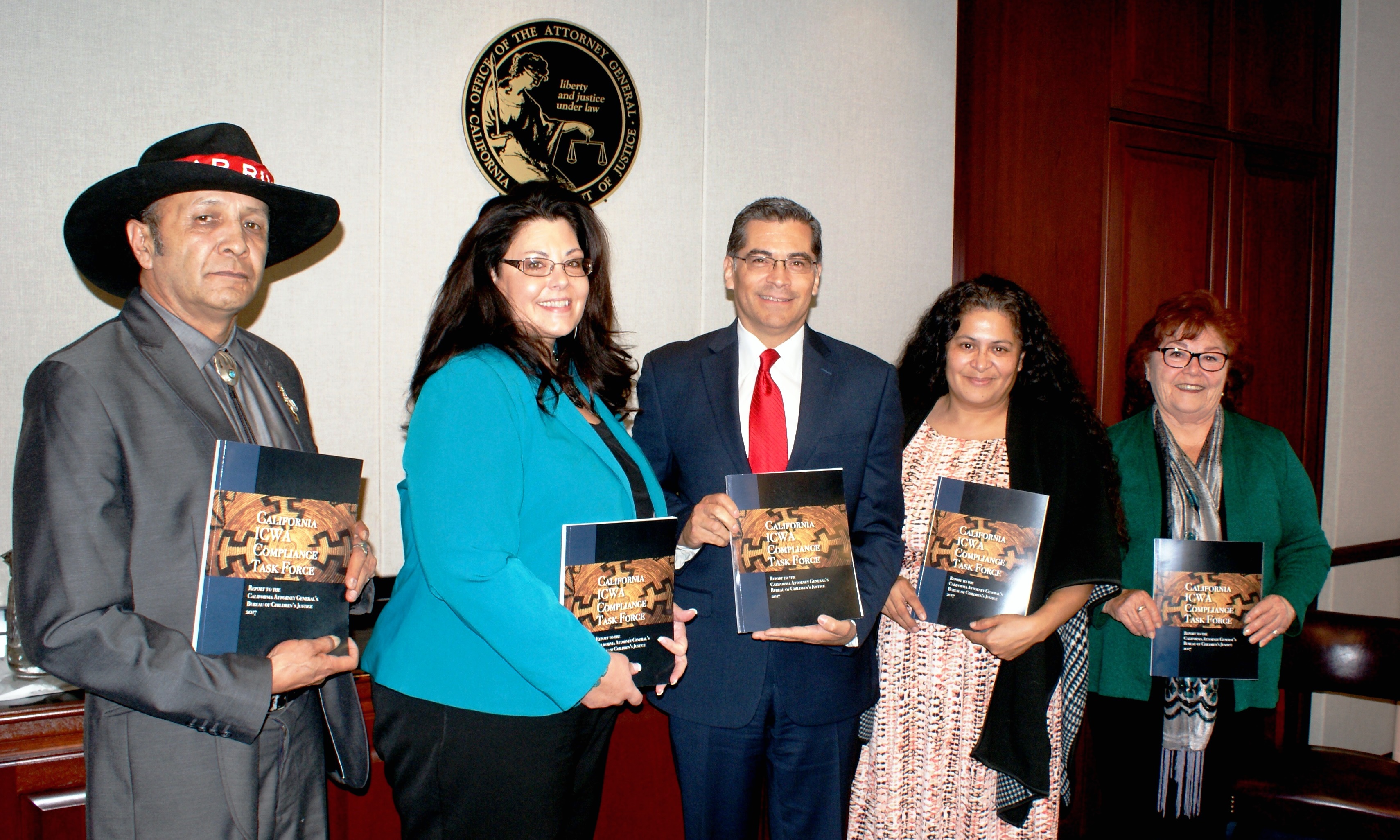
Final Report of the California ICWA Compliance Task Force
Goldwater Litigation on the Constitutionality of ICWA Dismissed Without Prejudice
This is the attempted class action litigation claiming ICWA violated the Constitution.This is a big win for ICWA and the legal advocates who worked on this case at the state, federal, and tribal levels.
Here is the Order.
The legal questions Plaintiffs wish to adjudicate here in advance of injury to themselves will be automatically remediable for anyone actually injured. The very allegations of wrongfulness are that such injuries will arise in state court child custody proceedings, directly in the court processes or in actions taken by state officers under the control and direction of judges in those proceedings. Any true injury to any child or interested adult can be addressed in the state court proceeding itself, based on actual facts before the court, not on hypothetical concerns. If any Plaintiffs encounter future real harm in their own proceedings, the judge in their own case can discern the rules of decision. They do not have standing to have this Court pre-adjudicate for state court judges how to rule on facts that may arise and that may be governed by statutes or guidelines that this Court may think invalid.
Here is the joint press release from the ICWA Defense Project.
New Article on Structural Racism and Court Appointed Special Advocates
If you sat in on a class I taught last week, you’d know this is my new favorite article:
Here.
This paper turns attention away from discussions of the race and economic poverty of the families most affected by the system, and instead looks at the impact of the race and privilege of these volunteer child advocates on child welfare decision-making
Court Appointed Special Advocates (CASA) are volunteers appointed by the court in child welfare cases to argue for a child’s best interests. There are many issues with this system, and I have been in many loud arguments about it (some of you have witnessed them). This article identifies many of those concerns and grounds them in the history of state child welfare systems–including how those systems affect Indian children.
As a side note, I know people personally who have worked hard to develop Tribal CASA programs. Those programs are particularly sensitive to ensuring their volunteers understand the culture of the tribe and their children, which counters the issues inherent in state systems. This article is specifically discussing the issue of CASAs in state systems.
Michigan Superintendent of Schools Seeks to Fine Schools That Don’t Drop Mascots
Article here.
This is primarily in response to the most recent action of the Paw Paw School Board to retain their racist mascot (after a particularly contentious Board meeting). Article here.
This is also after the Michigan Department of Civil Rights (under the leadership of Matt Wesaw) attempted to file a complaint with the U.S. Department of Education, which was dismissed.
2017 Indigenous Law & Policy Center Fellowship Announcement
The Indigenous Law & Policy Center welcomes applications for the 2017–2018 Fellow position.
Position Summary
The ILPC Fellowship is a flexible position that offers one new law grad each year the chance to work in a setting that is both academic and clinical in nature. Depending on the particular interests of the Fellow, there may be more time spent developing academic articles, researching and writing briefs, interacting with students and legal professionals, or attending conferences centered on Indian law. Continue reading
Bringing Native History to Mackinac Island
Here.
This has been the result of years of hard work and relationship building. Eric Hemenway has done amazing work on this.
“We want to show in the Biddle House that the tribes were not just these passive participants in history. They were making their own decisions, their own moves.”
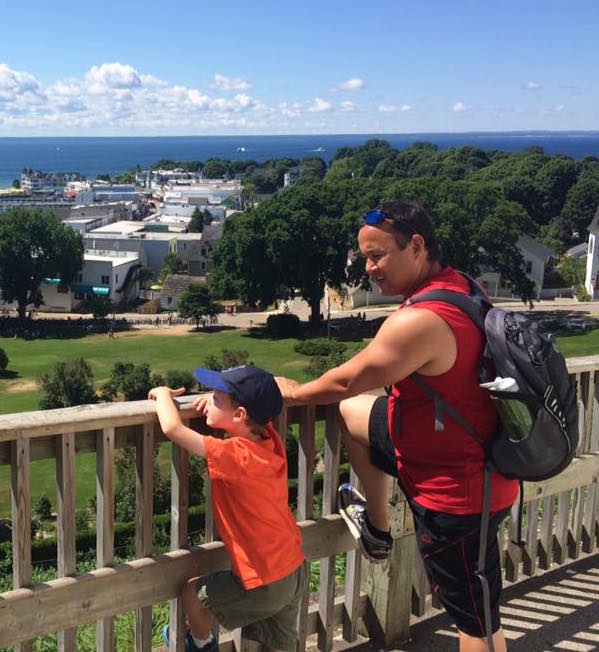
And here’s a kid of TurtleTalk lucky enough to get a proper history lesson from Eric on Mackinac Island before the signs went up:
Sixth Circuit Decision on Title IV-E Maintenance Payments to Kinship Placements
Here.
Not an ICWA/Indian child case, but one that is important nonetheless given its ruling ensuring Title IV-E maintenance payments. The lack of these payments sometimes make kinship care very difficult on relative placements–Title IV-E maintenance payments cover, among other things, the child’s food, clothing, and shelter. 42 U.S.C. 675(4)(A). After determining that the aunt/foster parent established a cause of action, the court held that:
The family argues that the Cabinet approved R.O. [child’s aunt] to be a foster parent. Prior to placement, the Cabinet verified that R.O. met relevant non-safety standards by conducting a home evaluation and a background check. After determining that her home was safe, the family court moved the children from another foster provider to her care. R.O. therefore argues that the Cabinet “approved” her as a foster parent for the children.
Kentucky offers several arguments in response. Kentucky distinguishes between “foster care” and “kinship care.” According to Kentucky, “foster care” refers to licensed foster family homes. “Kinship care,” by contrast, refers to relative caregivers. Although the Cabinet must remit maintenance payments to foster parents, the Cabinet need only pay kinship care providers “[t]o the extent funds are available.” Ky. Rev. Stat. Ann. § 605.120(5) (West 2016). Due to inadequate appropriations, Kentucky ceased funding its kinship care program.
To the extent the Cabinet’s failure to make maintenance payments turns on the distinction between relative and non-relative foster care providers, it plainly violates federal law. In Miller v. Youakim, 440 U.S. 125 (1979), Illinois placed two children with their older sister, Linda Youakim, and her husband. Id. at 130. “The Department investigated the Youakim home and approved it as meeting the licensing standards established for unrelated foster family homes . . . .” Id. Yet, “[d]espite this approval, the State refused to make Foster Care payments on behalf of the children because they were related to Linda Youakim.” Id. The Court reviewed the definition of “foster family home.” Id. at 130–31. After noting that the statute “defines this phrase in sweeping language,” the Court found that “Congress manifestly did not limit the term to encompass only the homes of nonrelated caretakers. Rather, any home that a State approves as meeting its licensing standards falls within the ambit of this definitional provision.” Id. at 135.
UPDATE (2/22/17 10:46AM) Download(PDF) Briefs: Brief of Appellants, Brief of Defendant-Appellee Vickie Yates Brown Glisson, Reply Brief of D.O., A.O. and R.O.
 Turtle Talk
You must be logged in to post a comment.