Montana Law School Summer Indian Law Program

Here. From the site:

2015 Course Information

All courses are offered for 1 academic credit.

Indian Law Research

Professor: Stacey Gordon
Dates: June 1 – 5
Days/Times: TBA
Law 611, Sect. 00

Because tribes are sovereign governments, the field of Indian Law encompasses distinct legal issues and legal sources. Researching both federal Indian law (the law of the relationship between tribal governments and the U.S. government) and tribal law (the law of individual tribes) requires an additional set of tools and research skills to those students are introduced to in a basic legal research course. In this course, students will learn the skills and sources necessary to research general Indian law issues as well as the very specialized skills and sources used in researching the legal history of a tribe, including reserved treaty rights. The course will cover researching treaties, Indian land claims, statutory and case law, and tribal law. Students will actively participate in creating a tribal legal history throughout the course.

Voting Rights in Indian Country

Professor: Jim Taylor
Dates: June 8 – 12
Days/Times: TBA
Law 000, Sect. 00

The purpose of this course is familiarize students with the voting issues in Indian country. The course will look at problems and remedies under tribal, state and federal systems. Following completion of the course, students will be familiar with voting rights issues and the options for addressing equity in representation issues within Indian country. This course will cover general Voting Rights issues; problems associated with voting rights in Indian country; and legislation and litigation concerning voting rights in Indian country.

Indian Child Welfare Act

Professor: Maylinn Smith
Dates: June 15-19
Days/Times: TBA
Law 691, Sect. 00

This course looks at past federal policies that resulted in the removal of Indian children from their families and led to Congress passing the Indian Child Welfare Act. The course discusses the legal requirements of the Indian Child Welfare Act, various aspects of working with Indian families, potential conflicts with state and other federal laws, and the difficulties in getting compliance with the Act.

Criminal Jurisdiction in Indian Country

Professor: Danna Jackson
Dates: June 22 – 26
Days/Times: TBA
Law 000, Sect. 00

This course provides information about crime and criminal jurisdiction in Indian Country. Topics include an overview of the laws affecting criminal jurisdiction, some of the unique criminal problems affecting Indian Country, traditional methods of resolving unacceptable behavioral problems within tribal communities, and the evolution of current responses to crime within Indian Country. Following completion of the course, students should have a basic understanding of the foundational principles relating to crime and law enforcement in Indian Country.

Indigenous Cultural Preservation

Professor: Maylinn Smith
Dates: June 29- July 3
Days/Times: TBA
Law 000, Sect. 00

This course is to familiarize students with Indigenous cultural preservation issues. Following completion of the course, students should be familiar with various legal and social efforts to promote and protect indigenous cultures around the world. The course will cover general information about impacts of colonization practices on Indigenous cultures; tribal, national and international efforts to addressing cultural preservation; U.S. federal laws and cases addressing cultural preservation issues; and remedies for protecting and promoting indigenous cultures.

American Indian Natural Resource Law

Professor: Del Laverdure
Dates: July 6 – 10
Days/Times: TBA
Law 000, Sect. 00

American Indian Natural Resources is a growing, dynamic, exciting area of the law, involving important resources. The field includes transcendent issues, such as compensation for or restoration of lost resources, as well as pragmatic concerns, such as the ability to site or maintain major facilities, the allocation of water supplies and pollution control. Students will examine the unique contours of natural resource matters that arise in Indian country, specifically focusing on: land, environmental protection, natural resource development and water rights.

Indian Property Law

Professor: Deb Dumontier
Dates: July 13-17
Days/Times: TBA
Law 000, Sect. 00

The purpose of this course is familiarize students with the unique issues relating to Indian lands and rights associated with the land. Following completion of the course, students will be familiar with various aspects of Indian lands and the restrictions and regulations governing these lands. This course will cover general information about Indian lands; regulation of Indian lands; limitations of Indian lands; probate issues; and land consolidation issues.

Constitutional and Code Drafting Issues Related to Indian Law

Professor: Maureen White Eagle
Dates: July 20-24
Days/Times: TBA
Law 000, Sect. 00

The purpose of this course is to introduce students to distinct constitutional issues arising from and affecting Indian country. As extra-constitutional entities, the effect of the federal Constitution in Indian country is unique. The course will look at federalism issues in Indian country and discuss development and interpretation of tribal constitutions and codes. Following completion of the course, students will be familiar with the unusual relationship between tribal nations and the federal Constitution and the challenges associated with drafting constitutions and codes for tribal governments. This course will cover issues related to the Commerce Clause, Equal Protection, the Tenth Amendment and development of tribal constitutions and codes.
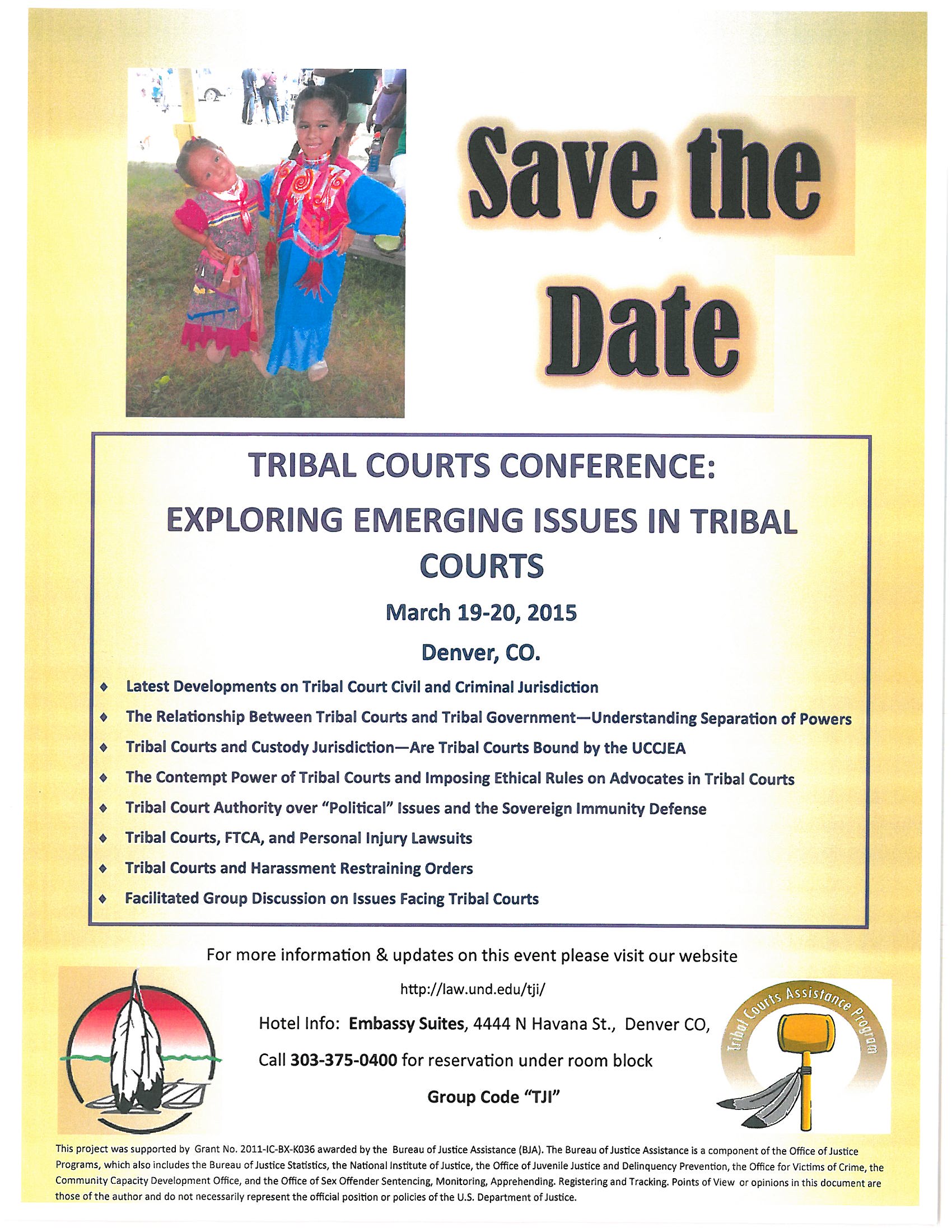
Tribal Courts Conference — Denver — March 19-20, 2015

Here (PDF):

SKMBT_28315020517090_Page_1

Eighth Circuit Holds Lacey Act Does Not Bar Minnesota Chippewa Tribe Members from Fishing on Leech Lake Reservation

Here is the opinion in United States v. Brown.

An excerpt:

Appellees Michael Brown, Jerry Reyes, Marc Lyons, and Frederick Tibbetts were indicted under the Lacey Act which makes it unlawful to “sell . . . any fish . . . taken, possessed, transported, or sold in violation of . . . any Indian tribal law.” 16 U.S.C. § 3372(a)(1). The indictments alleged that appellees had netted fish for commercial purposes within the boundaries of the Leech Lake Reservation in violation of the Leech Lake Conservation Code, then sold the fish. Appellees are Chippewa Indians, and they moved to dismiss the indictments on the ground that their prosecution violates fishing rights reserved under the 1837 Treaty between the United States and the Chippewa. The district court granted the motions to dismiss. The 1 United States appeals, arguing that its application of the Lacey Act did not infringe on appellees’ fishing rights. We affirm.

Briefs:

US Opening Brief

Appellees Brief

US Reply Brief

Lower court materials here

Saginaw Chippewa Indian Tribe Complaint for Contract Support Costs from IHS

Here is the complaint in Saginaw Chippewa Indian Tribe v. Burwell (E.D. Mich.):

1 Complaint

An excerpt:

This is a suit against the United States for breach of contract and statute by the Indian Health Service (“IHS”), an agency of the Department of Health and Human Services (“HHS”) (collectively “Defendants”). The Saginaw Chippewa Indian Tribe of Michigan (“Tribe”) seeks money damages under the Indian Self Determination and Education Assistance Act, 25 U.S.C. §§ 450 – 458ddd-2 (“ISDEAA”) and the Contract Disputes Act, 41 U.S.C. §§ 7101 – 7109 (“CDA”) for the Defendants’ continued and repeated violation of the Tribe’s contractual and statutory right to the payment of full contract support costs (“CSC”) for fiscal year 2006.

Bakken Shale Allotment Owners’ Class Action against US for Trust Breach Dismissed

Here are the materials in Two Shields v. United States (Fed. Cl.):

1 Complaint

6-1 US Motion for Summary J

11 Two Shields Opposition

12 Two Shields Motion for Discovery

14 US Reply in Support of Motion for Summary J

15 US Opposition to Motion for Discovery

16 Two Shields Reply in Support of Motion for Discovery

17 US Request for Judicial Notice

17-1 Cobell Fairness Hearing Transcript

18 Two Shields Response to Request for Judicial Notice

19 US Reply in Support of Request for Judicial Notice

20-1 Two Shields Surreply in Opposition to Request for Judicial Notice

25 DCT Order

An excerpt:

This case is one of the myriad of breach of trust claims brought by Native Americans against various federal agencies.1 Paradoxically, the parties present very little in common. Like the proverbial two ships passing in the night,2 plaintiffs and defendant here present the court with two competing narratives that raise entirely different legal issues.

Plaintiffs Ramona Two Shields and Mary Louise Defender Wilson claim that the Bureau of Indian Affairs (“BIA”) breached its fiduciary duty to prudently manage their mineral rights, which are held in trust by the United States. Plaintiffs include a detailed narration of the depredations experienced by their tribes, and characterize the BIA’s alleged breach as “the latest chapter of United States mismanagement or outright abuse regarding the members of the Three Affiliated Tribes.” Compl. ¶ 24. Plaintiffs seek damages on behalf of themselves and their purported class.

Defendant presents an entirely different story. Defendant does not dispute plaintiffs’ characterization of the BIA’s actions; in fact, defendant barely mentions them at all. Rather, defendant argues that the BIA’s alleged misdeeds are immaterial because plaintiffs’ claims have already been litigated and settled. Specifically, defendant argues that plaintiffs’ claims were subsumed by the Cobell class action suit against the United States Department of the Interior (“DOI”), and that plaintiffs’ claims have already been settled pursuant to the $3.4 billion settlement (“Settlement Agreement”) that brought the Cobell suit to a close in 2011, after more than a decade of litigation. According to defendant, plaintiffs forfeited any right to pursue their claims by failing to opt out of the class action Settlement Agreement. Plaintiffs, in contrast, hardly mention Cobell at all in their complaint, and argue in their opposition brief that their claims are entirely unrelated to the Cobell litigation. It is the role of the court to determine which of these two narratives prevails.

This litigation has given rise to a myriad of claims and motions.  Before the court are defendant’s motion for summary judgment as to plaintiffs’ breach of fiduciary claim (Count I), defendant’s motion to dismiss for lack of subject matter jurisdiction plaintiffs’ alternate breach of fiduciary duty claim (Count II), and defendant’s motion to dismiss for failure to state a claim plaintiffs’ legislative takings claim (Count III). Also before the court are plaintiffs’ motion for discovery, defendant’s motion for judicial notice and plaintiffs’ motion for a sur-reply concerning defendant’s motion for judicial notice.

For the following reasons, as fully explained below, the court shall grant defendant’s motion for summary judgment regarding Count I, as well as defendant’s motion to dismiss Counts II and III. Furthermore, the court will deny plaintiffs’ motion for discovery, yet will grant their motion for sur-reply. Finally, defendant’s motion for judicial notice will be granted-in-part.

Interior Solicitor — Indian Affairs Division Seeks Environmental Lawyer

Here. The description:

Providing legal advice to the Assistant Secretary – Indian Affairs and the Director of the Bureau of Indian Affairs and their staff on a range of Indian law matters, but with a particular focus on Federal environmental law as it applies to Indian lands. This attorney will analyze complex legal issues and provide oral and written legal advice on the application of several Federal environmental laws, including, but not limited to, the National Environmental Policy Act, the Comprehensive Environmental Response, Compensation, and Liability Act, and the Clean Water Act. This attorney will also work on legal issues involving reservation boundaries, land-into-trust, forestry and grazing, and rights-of-way. Attorney-Advisors in the Branch of Environment and Lands draft legal memoranda and review and comment on client documents, including correspondence, policy papers, draft decisions, regulations, and handbooks. Attorney-Advisors also engage in administrative litigation before the Interior Board of Indian Appeals and work closely with the Department of Justice on litigation in federal district and appellate courts.

Navajo Civil Jurisdiction over Deceased Tribal Member’s Body at Issue

Here is “California woman battles Navajo Nation over husband’s body.“

CTAS Funding and Domestic Violence Courts for Special Domestic Violence Criminal Jurisdiction

CTAS Funding and Domestic Violence Courts for Special Domestic Violence Criminal Jurisdiction

Join us for a webinar on Feb 06, 2015 at 2:00 PM EST.

Register now!

https://attendee.gotowebinar.com/register/609568511130919169

NCAI, NCJFC, and TLPI are hosting this webinar for tribes considering exercising the Special Domestic Violence Criminal Jurisdiction under VAWA 2013. One way to meet the equal protection requirements is to establish a Domestic Violence Court/Docket. Under the current CTAS RFP purpose area #5 tribes (who do not currently have a CTAS grant from OVW) can apply for funding to support a Domestic Violence Court/Docket.

Presenters:
Honorable Steven D. Aycock, (Ret.), Judge-in-Residence, National Council of Juvenile and Family Court Judges
Kelly Gaines Stoner, Victim Advocacy Legal Specialist, Tribal Law & Policy Institute
Ginger Baran Lyons, Program Specialist, Office on Violence Against Women

Moderators:
Virginia Davis, Senior Policy Advisor, National Congress of American Indians
Chia Halpern Beetso, Tribal Court Specialist, Tribal Law & Policy Institute

Below are some possible resources relevant to creating a domestic violence court:

1)       Tribal Code Development,  tribal domestic violence case law resource, tribal protection orders, and other articles found at http://www.tribal-institute.org/lists/domestic.htm


2)       Article on Protecting Sovereignty : The Role of Tribal Courts at http://law.und.edu/tji/_files/docs/protecting-sovereignty-tribal-courts-2013.pdf

3)       Articles on protocols on prosecuting sexual assaults in Indian Country at www.swclap.org

4)       Tribal Code Checklist for Implementing Special Domestic Violence Criminal Jurisdiction at http://www.ncai.org/tribal-vawa/getting-started/tribal-code-development-checklist-for-implementation-aug-20142.pdf

5)       Domestic Violence Courts Key Principles (non-tribal specific) at http://www.courtinnovation.org/research/key-principles-domestic-violence-court-accountability

6)       History of Domestic Violence Courts (non-tribal specific) at http://www.courtinnovation.org/topic/domestic-violence

7)       Tulalip’s DV Court at http://www.tulaliptribes-nsn.gov/Home/Government/Departments/TribalCourt/DomesticViolence.aspx
After registering, you will receive a confirmation email containing information about joining the webinar.

Federal Court Denies Western Sky-Related Debt Collector’s Arbitration Claims; Class Action under Fair Debt Collection Practices Act May Proceed

Here are the materials in Bopp v. Zenith Financial Network Inc. (D. Ariz.):

25 Zenith Motion to Dismiss

26 Bopp Opposition

28 Zenith Reply

35 DCT Order Denying Motion to Dismiss

(Likely) Fake Indian Claim Dismissed by Detroit Federal Court

Here are the materials in El Nefertit v. Powelson (E.D. Mich.):

1 Complaint

5 DCT Order Dismissing Complaint