Author: Kate E. Fort
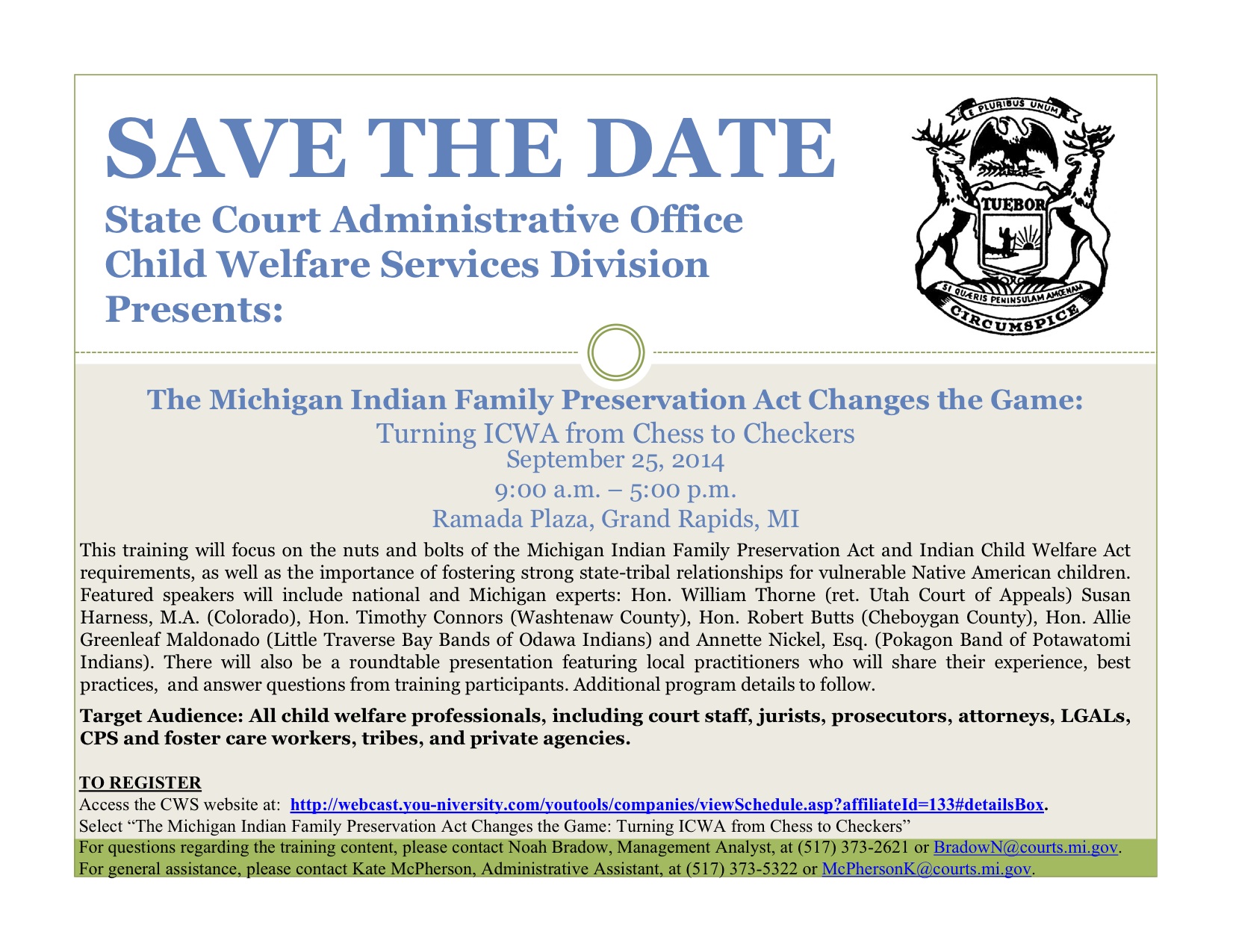
State Court Training on the Michigan Indian Family Preservation Act
Canadian Supreme Court Issues Decision in Tsilhqot’in First Nation Land Claim
Decision here
Held: The appeal should be allowed and a declaration of Aboriginal title over the area requested should be granted. A declaration that British Columbia breached its duty to consult owed to the Tsilhqot’in Nation should also be granted.
***
In finding that Aboriginal title had been established in this case, the trial judge identified the correct legal test and applied it appropriately to the evidence. While the population was small, he found evidence that the parts of the land to which he found title were regularly used by the Tsilhqot’in, which supports the conclusion of sufficient occupation. The geographic proximity between sites for which evidence of recent occupation was tendered and those for which direct evidence of historic occupation existed also supports an inference of continuous occupation. And from the evidence that prior to the assertion of sovereignty the Tsilhqot’in repelled other people from their land and demanded permission from outsiders who wished to pass over it, he concluded that the Tsilhqot’in treated the land as exclusively theirs. The Province’s criticisms of the trial judge’s findings on the facts are primarily rooted in the erroneous thesis that only specific, intensively occupied areas can support Aboriginal title. Moreover, it was the trial judge’s task to sort out conflicting evidence and make findings of fact. The presence of conflicting evidence does not demonstrate palpable and overriding error. The Province has not established that the conclusions of the trial judge are unsupported by the evidence or otherwise in error. Nor has it established his conclusions were arbitrary or insufficiently precise. Absent demonstrated error, his findings should not be disturbed.
APTN story here.
CBC here.
Michigan Supreme Court Issues Order to Create Tribal-State Forum
Order here.
The Michigan Tribal State Federal Judicial Forum is established. The membership of the forum shall consist of: the chief tribal judge of each of Michigan’s 12 federally recognized tribes, or their designated alternate judges, with membership to be expanded to accommodate any new federally recognized tribes; and 12 state court judges (or the same number as there are tribal judges), who will be appointed by the Michigan Supreme Court from among a pool of currently serving or retired Michigan judges or justices. In making appointments, the Court will consider geographic proximity to the tribes, Indian Child Welfare Act and MIFPA case load dockets, and current involvement with tribal court relations. The forum shall then pursue participation from federal judges and officials.
State bar post here.
NPR Piece on Aaron Carapella’s Maps
Here.
Minnesota Adopts an ICWA Best Practice in its Comments to Court Rules
Here.
2014 Advisory Committee Comment
With respect to [Rule 34.03] subdivision 1(j) and (l), in cases where the application of the Indian Child Welfare Act (ICWA) is unclear, such as when it is not yet known whether the child is or is not an Indian child, it is advisable to proceed pursuant to the requirements of the ICWA unless or until a determination is otherwise made in order to fulfill the Congressional purposes of the ICWA, to ensure that the child’s Indian tribe is involved, and to avoid invalidation of the action pursuant to 25 U.S.C. § 1914 and Rule 46.03.”
A court can’t go back and apply heightened standards after the fact. Makes more sense to do so from the beginning. No child is hurt by applying higher standards to their case, even if it ends up ICWA ultimately does not apply.
Thanks to AS.
Federal Judge Allows U.S. Intervention in Agua Caliente Water Rights Case
Michigan Foster Care Review Board Annual Report Addresses Areas of “Significant Concern” Relating to LGALs
Report here(pdf). LGAL portion starts on page 15.
In spite of such improvements, the quality of representation reported to and observed by our citizen review board members remains less than adequate, at best, and possibly fraudulent at times.
The FCRB is highly concerned with the fact that in Michigan, children and youth are rarely encouraged to participate in scheduled court hearings, despite the fact that these children are identified as parties to the case. This is unfortunate, as their present and future safety and well-being is addressed at these hearings, and the children often know best what has taken place in their own families and whether the system is functioning well for them or not. Therefore, the need to provide competent and dedicated legal representation is essential, as the LGAL is the one entrusted with the responsibility of objectively representing the child’s views and best interests before the court.
 Turtle Talk
You must be logged in to post a comment.