Indian Law Resource Center Accepting Applications for 2017 Fellowships

From the announcement:

The Indian Law Resource Center is a non-profit legal advocacy organization that provides legal advice, assistance, and representation to Indian tribes and indigenous communities throughout the Americas. We are also committed to developing new attorneys in the fields of Indian law and international human rights law.

We offer fellowship and clerkship opportunities in both our Helena, Montana and Washington, D.C. offices. These fellowship and clerkship opportunities require a minimum eight week commitment and entail legal research and writing on major Indian rights issues related to current projects of the Indian Law Resource Center. The Lewis and Sidley Fellowships both offer a stipend of $3,000 for the term of the Fellowship. Applicants are welcome to supplement this stipend with additional financial support through their law school’s public interest programs or through other public interest scholarships.

Complete details available here: lewis-and-sidley-fellowships-2017

DOJ is Expanding the TAP Program

The Department of Justice is expanding the Tribal Access Program (TAP) for National Crime Information which provides federally-recognized tribes access to national crime information databases for both civil and criminal purposes.  Tribes interested in participating in TAP must submit a letter or resolution from the tribe’s governing body by December 2, 2016.

Full announcement and application details: tpa-phase-1-announcement-final

National Indigenous Women’s Resource Center is Hiring for New Native Helpline

The National Indigenous Women’s Resource Center (NIWRC) in partnership with the National Domestic Violence Hotline (NDVH), is excited to announce that the StrongHearts Native Helpline, to be staffed by Native advocates, is scheduled to launch on January 4, 2017. The goal of the StrongHearts Native Helpline is to ensure that Native victims of domestic violence can access safety in a culturally relevant manner and eventually live their lives free of abuse.

As a result of an unexpected acceleration of our development timeline, NIWRC has agreed to house StrongHearts in Austin, Texas with the National Domestic Violence Hotline, to allow StrongHearts staff to receive direct support and mentoring from the NDVH. This is important in building a strong base aimed at enhancing services and outreach to tribal communities and Alaska Native villages. New Hires are expected to live in Austin, TX for initial start up time frame, then relocate to permanent Helpline office in Tulsa, OK. 

Available on our website are the current vacancies as well as attached to this email are the job announcements and NIWRC job application forms. Please feel free to forward these on!

NIWRC’s positions available are:

Strong Hearts Advocate

Strong Hearts Assistant Director

Strong Hearts Communications Manager

Strong Hearts Data Specialist

Strong Hearts IT Coordinator

*Please review individual job announcements for details. To submit your application electronically you must first DOWNLOAD THE PDF.

Please contact Tang Cheam if you have any questions at tcheam@niwrc.org

Judge Richard Blake Honored as Justice Innovator of the Year

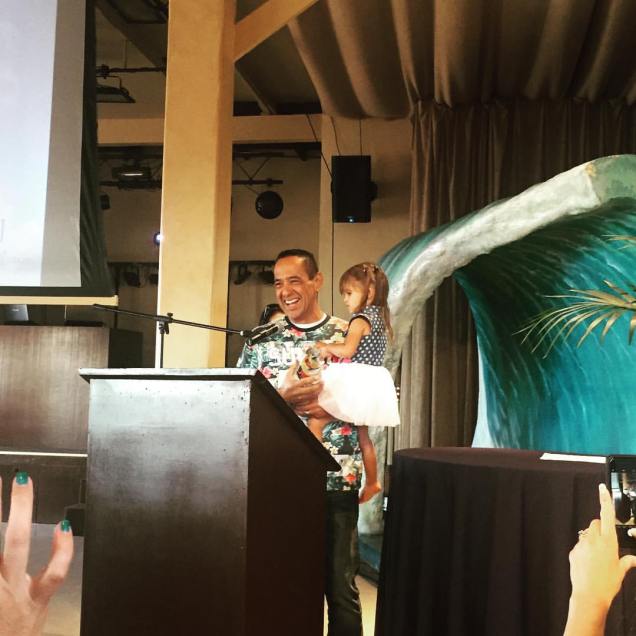
Judge Richard Blake, Chief Judge of Hoopa Valley Tribal Court and Board of Directors President of the National American Indian Court Judges Association, was honored at the NCJFCJ Annual Conference as Justice Innovator of the Year.

The Innovator of the Year Award honors someone who has inspired, sponsored, promoted, or led an innovation or accomplishment of national significance in juvenile justice, child abuse and neglect, family law, and/or domestic violence.

Judge Blake has been a tireless advocate for tribal court judges and has been involved in amazing work in his own Tribe, leading the way in innovative practices in all areas of the law. The work he has done and the sacrifices he has made have been inspirational to many. It is great to see him being recognized on a national level for his efforts.

Congratulations Judge Blake (and his gorgeous daughter who stole the show).

H/T to Nikki Campbell for the picture.

13701142_10106498427336421_6836082684401349210_o

Judge Ron Whitener and Kate Fort Presentations at NCJFCJ Annual Conference

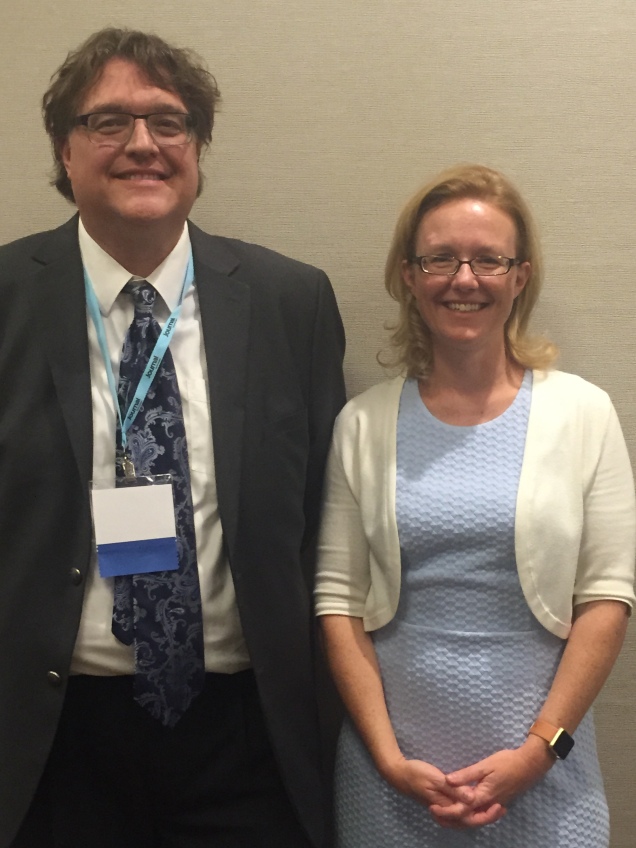
Judge Ron Whitener, Chief Judge of the Tulalip Tribal Court, was the first ever Native plenary speaker at NCJFCJ’s Annual Conference. He gave a presentation entitled “How State and Tribal Court Judges Can Work Together to Improve Outcomes.” Judge Whitener’s presentation was very well-received by the judges, and he received a standing ovation from the audience.

In addition, Kate Fort presented a well-attended session entitled “What State Court Judges Need to Know About ICWA.” Kate gave a brief update on recent court activity around ICWA and then summarized some key provisions in the new ICWA regulations. The judges were thrilled to receive this brand new and important information.

Thanks to both of them for their contributions to the conference and to NCJFCJ for its continuing commitment to tribal courts, tribal issues, and tribal-state collaborations.

IMG_4492

Kellogg Foundation Funds Tribal Model Food Code Project

Here is the link to the article published by the University of Arkansas School of Law link

From the article:

The Kellogg grant will allow the project to establish a model legal framework that tribal governments may adopt to regulate and support food and agricultural systems. Code sections may include provisions for food safety, land use, water, sustainability principles, organic production, seed protections and protection of traditional foods among other subjects. . . .

Tribal governments possess the inherent authority to enact laws affecting the lands, natural resources, communities and people within their jurisdiction. By helping to secure food and agricultural policy within the actions of tribal self-governance, the project hopes to ensure that tribes can reclaim the health of their people and long term food security in their communities.

White Earth Descendant Selected for Minnesota Supreme Court

Congratulations Judge Anne McKeig

Link to full article here

From the article:

Gov. Mark Dayton has selected Fourth Judicial District Judge Anne McKeig as the next Supreme Court justice, giving the state’s highest court its first American Indian jurist, as well as the first female majority since 1991.

McKeig, 49, a descendant of White Earth Nation, has specialized in child protection and Indian welfare issues. She was first appointed to the bench in 2008 by GOP Gov. Tim Pawlenty. She will replace retiring Justice Christopher Dietzen, also a Pawlenty appointee.

The selection means that Dayton has made a majority of appointments on the 7-member court, likely ensuring his legacy on the bench long after he leaves office. He has now appointed five justices, though former Justice Wilhelmina Wright joined the federal bench earlier this year.

In his two terms, Dayton has made diversifying the state’s courts a priority. He praised McKeig’s legal experience, and he also emphasized her biography, reading a passage from her application as he announced his pick.

“I grew up in rural Minnesota in challenging circumstances surrounded by poverty,” McKeig wrote. “The lessons I learned as a young woman from Federal Dam, Minn. planted in me a strong desire to make a difference for my community. My passion for public service comes from seeing the enormous need matched against the limited resources on the reservation.”

McKeig delivered an emotional speech Tuesday to reporters, members of her family and other Minnesota dignitaries, including the state Supreme Court. She called her appointment a “historic day” for American Indians. She thanked trailblazing Judge Robert A. Blaeser for paving the way for other American Indians pursuing legal careers.

“I didn’t know him, but he was a White Earth member,” McKeig said, recalling the impression his 1995 swearing-in ceremony left on her. “And, I, a proud descendant of the White Earth nation, knew that if he could do it, than maybe I could.”

She added: “It is people like him and his wife who have led the way that have allowed for others like me to dare to dream. So today is a historic day, not only for myself and for my family, but for all native people.”
Job Announcement: Juvenile Justice Program Coordinator – Juneau

Juvenile Justice Program Coordinator  – Juneau; $25.99 – 32.18

 A complete application packet must include: Cover Letter, Employment Application and Resume.

Submit to CCTHITA – HR Department

Mail: 320 W. Willoughby Ave. Juneau, AK 99801 | Fax: 888.510.3816 | E-mail: humanresources@ccthita.org | Please visit www.ccthita.org for more information.

Submit by  CLOSE OF BUSINESS, 4:00P JULY 1, 2016


Job Announcement: Tribal Child Support Unit Attorney – Juneau

Tribal Child Support Unit Attorney – Juneau; $34.59 – 42.83

A complete application packet must include: Cover Letter, Employment Application and Resume.

Submit to CCTHITA – HR Department
Mail: 320 W. Willoughby Ave. Juneau, AK 99801 | Fax: 888.510.3816 | E-mail: humanresources@ccthita.org<mailto:humanresources@ccthita.org> | Please visit www.ccthita.org<http://www.ccthita.org> for more information.

Submit by Close of Business, 4:00p – July 29, 2016

Full announcement available here:  Tribal Child Support Attorney.

Article, “The Timbisha Decision – A Familiar Story and Dangerous Precedent”

Christopher Foley, attorney at The Indian Law Resource Center, has published an article criticizing the most recent court decision in the Death Valley Timbisha Shoshone case.

Link to article here

From the article:

The Death Valley Timbisha Shoshone Tribe was dealt another setback last week in its ongoing efforts to preserve its constitutional government in the face of persistent federal interference.

On May 27, 2016, the United States Court of Appeals for the Ninth Circuit issued a disappointing decision in the Tribe’s federal lawsuit asserting that the Interior Department’s installation of a new Timbisha government was illegal. The court did not rule on the claims of the Tribe that the Bureau of Indian Affairs had acted illegally. Instead, the court simply said that the case was moot, that deciding those issues would make no difference. The court erroneously found that a tribal constitution that was purportedly adopted in 2014 should retroactively govern this case, and it decided all this without any factual record and no trial at which to present evidence.

This is a familiar story. The United States government claims to support tribal sovereignty and to respect self-government, but when it wants to overrule or take over a tribe it simply does so. It is rarely stopped or restrained by the courts.

Previous coverage here