Article on the Disparity Between the States Regarding Termination of Parental Rights

Here. Not ICWA-specific, but an interesting article on the wide difference of the states in terminating parental rights.

Across the country, the availability of effective support services is viewed as crucial in helping reduce the need for foster care placements and parental rights terminations, both of which are considered undesirable outcomes for most children.

Professor Martin Guggenheim, a child welfare expert at New York University School of Law, is among those contending that too many parents lose their rights and too many children go into foster care. Parents’ legal prospects vary widely from state to state when it comes to challenging termination, he says; many who are indigent are represented by court-appointed lawyers with heavy caseloads.

Too often, Guggenheim said, terminations produce “legal orphans” — young people who are separated from their parents, then do not receive a successful adoption placement, and eventually age out of the foster care system on their own.

“They’ve lost their family and gained nothing in return,” he said.

Nationwide, according to federal figures, the number of children affected by parental rights terminations declined from 85,525 to 64,398 between 2005 and 2014, mirroring a broader drop in the number of children placed in foster care. Arizona and Texas were among a handful of states bucking the trend, with more terminations and more children in care.

Figures from Arizona show how difficult it is for a parent to block a termination order once it’s requested by child-welfare officials. In a six-month period last year, 2,232 termination petitions were granted and seven were denied.

As a side note, Professor Guggenheim was one of the lead attorneys on the ICWA/Gold Standard Baby Girl amicus brief.

Two Recent State Supreme Court Oral ICWA Arguments

Here is the argument for In re B.B. case in the Utah Supreme Court, where the unmarried Native father appealed the trial court’s decision denying him intervention in a voluntary adoption case, primarily based on Utah’s definition of paternity. Father is asking the state to interpret “acknowledge and establish” under ICWA broadly. The Utah Court of Appeals sent it on directly to the Supreme Court with no decision.

Here is the argument for In re T.A.W. in the Washington Supreme Court, addressing the issue of applying WICWA to step-parent adoption proceedings, particularly the requirement of active efforts. Here is the decision being appealed.

Determination of Application of ICWA from Oregon Court of Appeals

We are getting a lot of questions about when the standards of ICWA apply if a child or parent is enrolled after the initiation of the child welfare case. Here’s a not particularly helpful or clear decision out of the Oregon Court of Appeals:

Parents’ position depends on a selective understanding of the record before the juvenile court. Specifically, as noted, testimony at the August 22, 2014, hearing established that the “Karuk Tribe” notation for mother in DHS’s database had been entered, as a preliminary matter, in 2004, but that, in response to subsequent, contemporaneous inquiries from DHS, the tribe had explicitly denied that mother or her children met the requirements for tribal membership. See 278 Or App at 431-32. That negative response—a response within DHS’s constructive knowledge in 2011—negated the 2004 preliminary notation. Further, the record established that, while that notation automatically “popped up,” there was no evidence that it had ever been renewed or supplemented based on any subsequent information. Similarly, parents’ reliance on mother’s reference to having a tribal membership card does not engage with the complete context that, at the same time mother made that remark in February 2011, she was adamantly refusing to complete ICWA-related forms provided by DHS. Indeed, mother did not obtain a tribal membership card until May 2012—and, even then, did not so inform DHS.15 Given the totality of the circumstances, the juvenile court did not err in denying parents’ motions to dismiss. See State ex rel Juv. Dept. v. Tucker, 76 Or App 673, 677, 10 P2d 793 (1985), rev den, 300 Or 605 (1986) (affirming juvenile court’s denial of petition to “invalidate” foster care placement based on purported ICWA noncompliance; record did not establish that, as of the time the child was placed, ICWA applied, and subsequent determination that the child was an Indian child did not render ICWA retroactively applicable to prior actions of the juvenile court).

Burden of Proof ICWA Case out of South Dakota

Here.

In this case, Mother challenged the QEW and the burden of proof requirement for termination of parental rights. The concurrence is particularly useful:

The circuit court in this case found many of the facts beyond a reasonable doubt where that was not the correct standard of proof and failed to find certain facts beyond a reasonable doubt where applying that high standard is required. This may indicate that confusion exists on the applicable standards of proof in abuse or neglect proceedings, including those where ICWA applies. I write specially to clarify the standards of proof by which the court must issue certain findings.

The concurrence also explains that South Dakota is a state that requires active efforts to be proven beyond a reasonable doubt in a termination of parental rights. Contra State of New Mexico v. Yodell. B. (N.M. Ct App. 2015) 

Call for Presentations: 15th National Indian Nations Conference

The Office for Victims of Crime and the Tribal Law and Policy Institute are extending this invitation to participate as a presenter at the 15th National Indian Nations Conference. Workshop presentations should demonstrate methods and strategies to improve safety, as well as promote justice and healing for crime victims through cooperation, and collaboration between Tribal, Federal, State, local and private entities in American Indian and Alaska Native communities. Target Audience: The target audience is all persons interested in assisting victims of crime in Indian country including:

Indian Country Service Providers (Tribal, State, and Federal):

  • Child Advocates
  • Child Protection Case Workers
  • Social Services
  • Elder Services
  • Victim Advocates
  • Medical Personnel
  • Law Enforcement
  • Judges & Prosecutors
  • Probation/Corrections
  • Substance Abuse Counselors
  • Traditional Healers

Tribal Community Members:

  • Tribal Leaders
  • Victims/Survivors of Crime
  • Tribal Elders & Youth
  • Tribal College Faculty & Students

We welcome presentation ideas for all levels of experience/knowledge. Presenters must demonstrate expertise in working with Native American communities. Selection Criteria for Workshops will include:

  • Relevance to the target audience
  • Fits into conference theme/goals
  • Presenters demonstrate expertise in working with Native American communities.
  • Encourages interdisciplinary coordination and cooperation
  • Highlights promising practices
  • Introduces innovative strategies
  • Honors and supports victims of crime
  • Workshop demonstrates clear connection to crime victimization

Workshops must conform to the Conference Theme “Harnessing Our Collective Wisdom: Strengthening the Circle of Safety, Justice and Healing” and one or more of the Conference Goals (below):

  • Honoring & Listening to Victim/Survivor Voices: Creating victimcentered/
    sensitive responses; being inclusive of victim/survivors particularly those from un‐served or underserved populations, including LGBTQ victims; and promoting peer to peer learning opportunities.
  • Promoting Safety, Justice and Healing: Justice for victims/justice for all; understanding jurisdictional issues; exercising tribal sovereignty to promote safety & justice; highlighting the resiliency of spirituality & healing in tribal communities.
  • Honoring the Wisdom of the Past: Understanding historical trauma; enlisting tribal elders as keepers of our tribal histories; and embracing traditional teachings.
  • Promoting Traditional Values: Promoting traditional values and incorporating traditional skills in crime victim services; upholding wellness, mentally, physically, spiritually and emotionally; and framing victim services around tribal traditions.
  • Ensuring Safety, Justice & Healing for Seven Generations of Children: Addressing child sexual abuse & education on developing programs for victims; emphasis on victims within the juvenile justice system; support for keeping youth within.
  • Working in Harmony: Building partnerships with federal agencies; supporting partnerships between tribes; education on the importance of networking and working together in collaboration to strengthen services; supporting multidisciplinary
    teams; and networking with Native men to address domestic violence & sexual assault.
  • Supporting and Educating Tribal Leaders: Educating and supporting efforts of tribal leaders to achieve accountability and responsibility to victims of crime.
  • Sustaining our Legacy: Developing skills and incorporating cultural approaches to enhance sustainability and measurability; increasing the accuracy of victimization research; and developing capacity within victim services.
  • Healing the Healers: Ensuring safety and support for service providers.

Formal Justice Department Conference Approval Pending.

Questions: Tribal Law and Policy Institute, P: 3236505467 ~ F: 3236508149
Email: Conference@TLPI.org, Website: http://www.OVCINC.org

Mailing address:
Tribal Law and Policy Institute
8235 Santa Monica Blvd., Suite 211
West Hollywood, CA 90046
Developments in Carter v. Washburn (Goldwater Litigation)

Here is the latest in the class action lawsuit arguing that ICWA is unconstitutional:

In the past month, the plaintiffs were granted leave to file an amended complaint with new named class representatives. Both the federal and state government again filed motions to dismiss.

Gila River then filed a motion to ask the court to make a decision on their motion to intervene, which the court denied in a particularly aggravating order.

Finally, in one of the strangest and most unprecedented actions in the case, the Ohio AG filed an amicus brief in support of Goldwater and against the Arizona AG’s motion to dismiss. For those who have contacts in their state AG’s offices, we continue to encourage you to be in touch with them and offer to provide information regarding ICWA and this case.

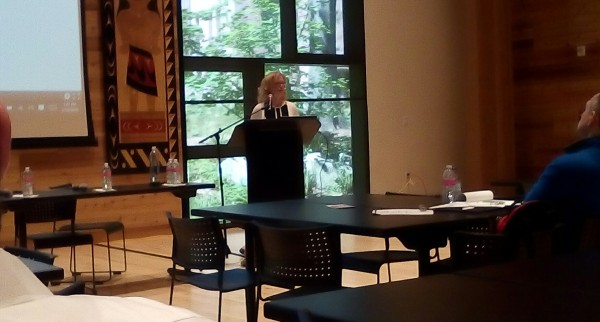
Kate Fort Speaking on Challenges to the ICWA Guidelines

IMG_20160512_173651_138 crop

AFCARS Comments Due May 9

As we previously posted, for the first time, the federal government is proposing to collect data on state ICWA cases. If you, or your employer, or your tribe are willing to let the feds know you think this is a good idea, please submit comments by MAY 9 over here.

Want to submit something but aren’t sure what to write or don’t have time to research all of these acronyms? We have you covered:

Model comment for in-house counsel from MSU

Model comment for tribes from NARF

Model comment for tribes/tribal social services from NICWA.

ICWA Guidelines Presentation to Utah Juvenile Judges

IdahoJudges

Just got to the hard part when they took the picture!

Minneapolis ICWA Law Center Video

One of our very favorite groups we get to work with has a beautiful new video up:

Password: icwa

The Minneapolis ICWA Law Center represents parents in ICWA cases, among other things.