DOJ Amicus Brief in SD ICWA Class Action Case

The United States came in strongly on the side of the tribes and tribal families for both the enforcement of ICWA and meaningful due process.

Here.

Thus, from the very start of an emergency removal, Section 1922 requires state courts, agencies, and officials to actively investigate and evaluate whether the emergency situation has ended. Given the statutory requirements for oversight and โ€œimmediateโ€ action, this ongoing obligation cannot be deferred for weeks or months until the next scheduled hearing occurs.

***

The interest that parents have in the custody of their children is not to be lightly interfered with, even following an emergency situation. While an emergency proceeding such as the 48- hour hearing may not permanently deprive parents of their custody rights, even a temporary deprivation of physical custody requires a prompt and meaningful hearing.

Memorandum in support of leave to file amicus here.

Motion for Leave to File here.

Update — The court granted the motion the next day:

123 DCT Order Granting US Motion

Previous coverage here.
Article on Native Adoptees

One of the greatest challenges that many of us encounter when trying to encourage better ICWA compliance is the lack of understanding of the impact of governmental policies on Native communities. In particular, people do not comprehend how many Native children have been adoptedย by families with no connection to their tribal communitiesย nor do they understandย the impact this has had on these children.
Al Jazeera America published a very nice article on this called “Lost Birds”.

For more than one hundred years, U.S. policies and practices separated Native American children from their families. Prior to 1978, when the Indian Child Welfare Act went into effect, Native American children were regularly plucked from their homes and sent to live with non-Natives. Some children grew up surrounded by love; others suffered enormous hardships. Many had a powerful desire to reconnect with the culture that they had lost.

In “Lost Birds,” we profile four adopted women who sought out their Native American roots

The link to the entire article is here.

Two Additional Links of Interest Regarding the Nebraska ICWA Truancy Case

Here is the audio of the oral arguments for the case we posted on here.

And here is a UCLA Law Review Discourse (online) article on the problematic framing of truancy in general.

Nebraska Court of Appeals Overturns Lower Court Removing Child for Truancy Under ICWA

Opinion here (from June 24).

On February 26, 2013, the juvenile court ordered Mischa to be placed into foster care and the case plan was modified to allow for liberal visitation of Mischa with her family. In reaching this decision, the court noted the parentsโ€™ argument that Neb. Rev. Stat. ยง 43-1505(5) (Reissue 2008) provides that foster care placement may not be ordered in the absence of a determination by clear and convincing evidence includ- ing testimony of qualified expert witnesses that continued custody by the parent or Indian custodian is likely to result in serious emotional and physical damage to the child. The court found that serious emotional damage would result to Mischa as a result of insufficient education. The court found, however, that even in the absence of such proof, the statute is unconstitutional as applied in this case, stating that โ€œIndian children are entitled to no less educational opportunity than other children and accordingly, as applied in this particular case, such statute is unconstitutional to the extent that it would deny Mischa educational opportunity even in the absence of serious emotional and physical damage . . . .โ€ The order was silent on whether active efforts had been provided to prevent the breakup of this family. Deanna and Chris subsequently perfected their appeal to this court.

Unpublished California ICWA Opinion Reversing for Non-Compliance

A long and sad opinion here, but a few things of note:

-as usual, Jay Treaty arguments are brushed aside.

-the State’s assumption that a claim of tribal membership is vague doesn’t mean ICWA might apply. And families might involve many tribes, from geographically diverse areas.

-there is or was a dedicated ICWA court or docket in Los Angeles County.

-the foster parents were not interested in helping with reunification in the slightest.

ACLU Blog Post on Oglala Sioux Tribe v. Van Hunnik

Here.

Previous coverage here.

Training Annoucement from NICWA

Join us for our upcoming training institutes. These interactive and energetic courses are taught by dynamic trainers who are experts in the field of Indian child welfare. Led by those with an extensive experience working with tribal communities, participants will also enjoy the opportunity to network with other attendees from tribal, state, and national agencies located throughout the country. For more information visit www.nicwa.org/training/institutes/. Contact Lauren Shapiro at lauren@nicwa.org with any questions. Choose from one of the following trainings:

Virtual Classroom: Enhancing Basic Skills for Tribal Child Welfare Workers
Tuesdays, July 15โ€“August 12, 2014, 9:00 a.m.โ€“10:30 a.m. PDT
Wednesdays, October 1โ€“29, 2014, 9:00 a.m.โ€“10:30 a.m. PDT

September 8โ€“10, 2014: Portland, Oregon
Positive Indian Parenting
ICWA Basics and Advanced ICWA

December 1โ€“3, 2014: San Diego, California
Positive Indian Parenting
ICWA Basics and Advanced ICWA

April 23โ€“24, 2015: Portland, Oregon
Positive Indian Parenting
ICWA Basics

Positive Indian Parenting
Positive Indian Parenting prepares tribal and non-tribal child welfare personnel to train American Indian and Alaska Native parents using a culturally specific approach. This two- or three-day train-the-trainer class will draw on the strengths of historic Indian child-rearing patterns and blend traditional values with modern skills.

ICWA Basics & Advanced
ICWA Basics is a two-day training that provides participants with information about the basic legal requirements of the Indian Child Welfare Act of 1978 (ICWA) and the practice issues involved with its implementation. Stay for Advanced ICWA which will provide participants with advanced strategies for implementing ICWA.

Enhancing Basic Skills for Tribal Child Welfare Workers
NICWA is bringing our training institutes to the virtual classroom! New to tribal child welfare? Want to brush up on your tribal child welfare skills? This five-part webinar series is geared toward tribal child welfare workers who want to improve their basic skills.

Two Motions for Partial Summary Judgment in Oglala Sioux Tribe v. Van Hunnik

Brief in Support of First Motion (July 2014)

Statement of Undisputed Facts (First Motion)

As a result of the fact that (a) Defendants allowed no testimony at 48-hour hearings, (b) Defendants allowed no cross-examination at 48-hour hearings, (c) often the only questions asked of the parents in a 48-hour hearing were for purposes of identification and to see if they understood their rights, and (d) Defendants never conducted the inquiries required by 25 U.S.C. ยง 1922, Defendantsโ€™ 48-hour hearings were completed rather quickly. Judging from the length of the transcripts that were produced, the average length of time it took to complete a 48-hour hearing, Plaintiffs estimate, was under four minutes. A number of these hearings appear to have been completed in about sixty seconds.

The brief goes on to describe the many, many individual hearings where children were kept in DSS care for 45 or 60 days with absolutely to no evidence or testimony as to why.

Due Process Motion (Second PSJ)

Due Process Undisputed Facts

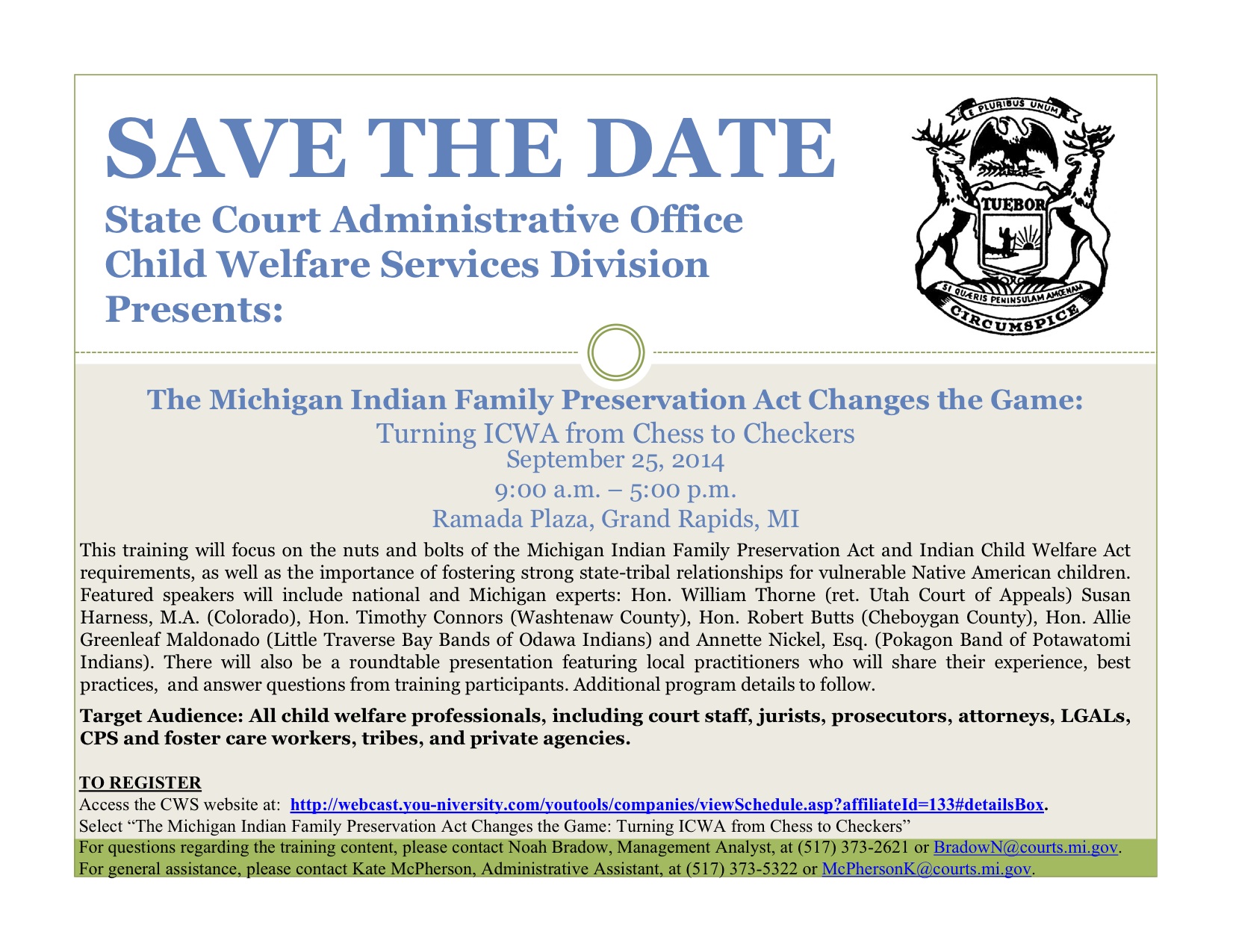
State Court Training on the Michigan Indian Family Preservation Act

092514_Save_the_Date_Final

Minnesota Adopts an ICWA Best Practice in its Comments to Court Rules

Here.

2014 Advisory Committee Comment
With respect to [Rule 34.03] subdivision 1(j) and (l), in cases where the application of the Indian Child Welfare Act (ICWA) is unclear, such as when it is not yet known whether the child is or is not an Indian child, it is advisable to proceed pursuant to the requirements of the ICWA unless or until a determination is otherwise made in order to fulfill the Congressional purposes of the ICWA, to ensure that the child’s Indian tribe is involved, and to avoid invalidation of the action pursuant to 25 U.S.C. ยง 1914 and Rule 46.03.โ€

A court can’t go back and apply heightened standards after the fact. Makes more sense to do so from the beginning. No child is hurt by applying higher standards to their case, even if it ends up ICWA ultimately does not apply.

Thanks to AS.