Unpublished California ICWA Opinion Reversing for Non-Compliance

A long and sad opinion here, but a few things of note:

-as usual, Jay Treaty arguments are brushed aside.

-the State’s assumption that a claim of tribal membership is vague doesn’t mean ICWA might apply. And families might involve many tribes, from geographically diverse areas.

-there is or was a dedicated ICWA court or docket in Los Angeles County.

-the foster parents were not interested in helping with reunification in the slightest.

ACLU Blog Post on Oglala Sioux Tribe v. Van Hunnik

Here.

Previous coverage here.

Training Annoucement from NICWA

Join us for our upcoming training institutes. These interactive and energetic courses are taught by dynamic trainers who are experts in the field of Indian child welfare. Led by those with an extensive experience working with tribal communities, participants will also enjoy the opportunity to network with other attendees from tribal, state, and national agencies located throughout the country. For more information visit www.nicwa.org/training/institutes/. Contact Lauren Shapiro at lauren@nicwa.org with any questions. Choose from one of the following trainings:

Virtual Classroom: Enhancing Basic Skills for Tribal Child Welfare Workers
Tuesdays, July 15–August 12, 2014, 9:00 a.m.–10:30 a.m. PDT
Wednesdays, October 1–29, 2014, 9:00 a.m.–10:30 a.m. PDT

September 8–10, 2014: Portland, Oregon
Positive Indian Parenting
ICWA Basics and Advanced ICWA

December 1–3, 2014: San Diego, California
Positive Indian Parenting
ICWA Basics and Advanced ICWA

April 23–24, 2015: Portland, Oregon
Positive Indian Parenting
ICWA Basics

Positive Indian Parenting
Positive Indian Parenting prepares tribal and non-tribal child welfare personnel to train American Indian and Alaska Native parents using a culturally specific approach. This two- or three-day train-the-trainer class will draw on the strengths of historic Indian child-rearing patterns and blend traditional values with modern skills.

ICWA Basics & Advanced
ICWA Basics is a two-day training that provides participants with information about the basic legal requirements of the Indian Child Welfare Act of 1978 (ICWA) and the practice issues involved with its implementation. Stay for Advanced ICWA which will provide participants with advanced strategies for implementing ICWA.

Enhancing Basic Skills for Tribal Child Welfare Workers
NICWA is bringing our training institutes to the virtual classroom! New to tribal child welfare? Want to brush up on your tribal child welfare skills? This five-part webinar series is geared toward tribal child welfare workers who want to improve their basic skills.
Two Motions for Partial Summary Judgment in Oglala Sioux Tribe v. Van Hunnik

Brief in Support of First Motion (July 2014)

Statement of Undisputed Facts (First Motion)

As a result of the fact that (a) Defendants allowed no testimony at 48-hour hearings, (b) Defendants allowed no cross-examination at 48-hour hearings, (c) often the only questions asked of the parents in a 48-hour hearing were for purposes of identification and to see if they understood their rights, and (d) Defendants never conducted the inquiries required by 25 U.S.C. § 1922, Defendants’ 48-hour hearings were completed rather quickly. Judging from the length of the transcripts that were produced, the average length of time it took to complete a 48-hour hearing, Plaintiffs estimate, was under four minutes. A number of these hearings appear to have been completed in about sixty seconds.

The brief goes on to describe the many, many individual hearings where children were kept in DSS care for 45 or 60 days with absolutely to no evidence or testimony as to why.

Due Process Motion (Second PSJ)

Due Process Undisputed Facts

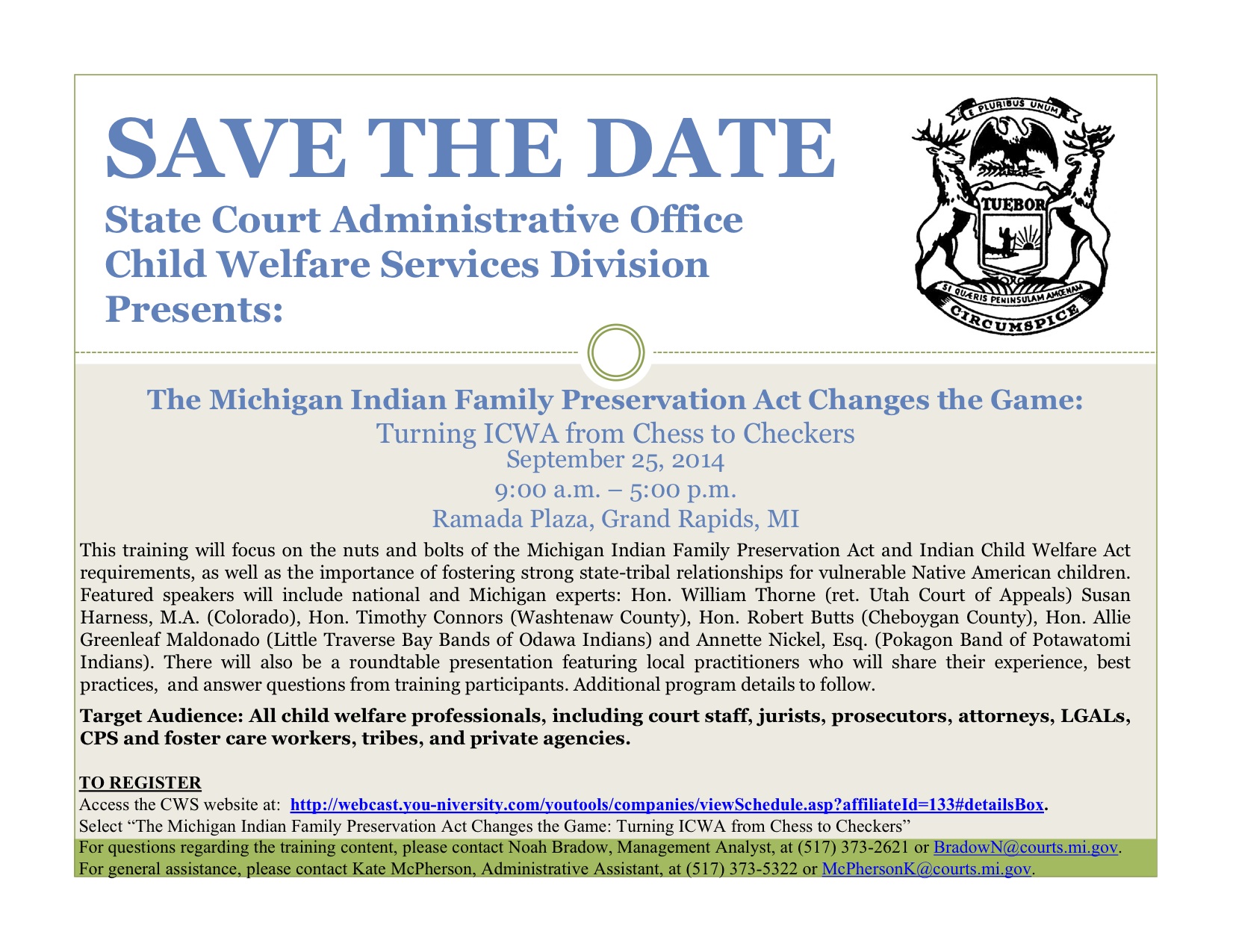
State Court Training on the Michigan Indian Family Preservation Act

092514_Save_the_Date_Final

Minnesota Adopts an ICWA Best Practice in its Comments to Court Rules

Here.

2014 Advisory Committee Comment
With respect to [Rule 34.03] subdivision 1(j) and (l), in cases where the application of the Indian Child Welfare Act (ICWA) is unclear, such as when it is not yet known whether the child is or is not an Indian child, it is advisable to proceed pursuant to the requirements of the ICWA unless or until a determination is otherwise made in order to fulfill the Congressional purposes of the ICWA, to ensure that the child’s Indian tribe is involved, and to avoid invalidation of the action pursuant to 25 U.S.C. § 1914 and Rule 46.03.”

A court can’t go back and apply heightened standards after the fact. Makes more sense to do so from the beginning. No child is hurt by applying higher standards to their case, even if it ends up ICWA ultimately does not apply.

Thanks to AS.

Michigan Foster Care Review Board Annual Report Addresses Areas of “Significant Concern” Relating to LGALs

Report here(pdf). LGAL portion starts on page 15.

In spite of such improvements, the quality of representation reported to and observed by our citizen review board members remains less than adequate, at best, and possibly fraudulent at times.
The FCRB is highly concerned with the fact that in Michigan, children and youth are rarely encouraged to participate in scheduled court hearings, despite the fact that these children are identified as parties to the case. This is unfortunate, as their present and future safety and well-being is addressed at these hearings, and the children often know best what has taken place in their own families and whether the system is functioning well for them or not. Therefore, the need to provide competent and dedicated legal representation is essential, as the LGAL is the one entrusted with the responsibility of objectively representing the child’s views and best interests before the court.


California Appeals Court Finds Court Rules about Indian Children Inconsistent with Legislative Intent

Decision (a rare published ICWA decision for CA).

The children were eligible for membership at Cherokee Nation of Oklahoma. The trial court ordered DHHS to help enroll the children as active efforts. DHHS appealed. The appellate court found that both ICWA and California state law limited the definition of Indian child (member, or bio child of a member and eligible), and if the children did not fit in that definition, the laws did not apply. As such, the rules were beyond the scope of the Judicial Counsel to pass.

The rules:

Rule 5.482(c) states, “If after notice has been provided as required by federal and state law a tribe responds indicating that the child is eligible for membership if certain steps are followed, the court must proceed as if the child is an Indian child and direct the appropriate individual or agency to provide active efforts under rule 5.484(c) to secure tribal membership for the child.”
Rule 5.484(c) states, “In addition to any other required findings to place an Indian child with someone other than a parent or Indian custodian, or to terminate parental rights, the court must find that active efforts have been made, in any proceeding listed in rule 5.480, to provide remedial services and rehabilitative programs designed to prevent the breakup of the Indian family, and must find that these efforts were unsuccessful.
“(1) The court must consider whether active efforts were made in a manner consistent with the prevailing social and cultural conditions and way of life of the Indian child’s tribe.

(2) Efforts to provide services must include pursuit of any steps necessary to secure tribal membership for a child if the child is eligible for membership in a given tribe, as well as attempts to use the available resources of extended family members, the tribe, tribal and other Indian social service agencies, and individual Indian caregivers.”


NCJFCJ Disproportionality Report of Children in Foster Care for FY 2012

Page 9 of the report has Native American Disproportionality Rates by State. 21 states have overrepresentation of Native kids in care, including Michigan (1.3, and 1.9 in entries to care), Wisconsin (4.1), Minnesota (13.9)and Iowa (4.5). Michigan, Wisconsin, and Minnesota have worse numbers than 10 years ago (page 3).

Report Disproportionality Rates for Children of Color in Foster Care for Fiscal Year 2012 (pdf). Website here.

As a side note, anytime anyone would like to talk about what they think is happening in Illinois/Chicago (no disproportionality shown, almost no ICWA cases pop up on appeal, but with a large urban Native population), we are all ears.


NCJFCJ 77th Annual Conference, July 13-16, 2014

Join us in Chicago, Illinois for this year’s 77th Annual Conference featuring a wide range of juvenile and family law topics including child abuse and neglect, trauma, custody and visitation, judicial leadership, juvenile justice, sex trafficking of minors, family violence, drug courts, psychotropic medications, children testifying in court, detention alternatives, substance abuse, and the adolescent brain.

In addition, this year we are offering a preconference workshop, Special Consideration for Working with Adolescents with Substance Abuse Issues, designed for professionals working with juvenile justice involved youth who also have mental health, substance abuse, or trauma issues. Any juvenile court judges, juvenile drug court coordinators, attorneys, probation officers, case managers, and substance abuse treatment counselors are encouraged to attend.

Information available here.