
Yale NALSA Brackeen Oral Argument Discussion — Wednesday, Nov. 16 @ Noon
Here.
Each side presented their oral arguments Wednesday to the U.S. Supreme Court for the most serious challenge to the Indian Child Welfare Act in recent memory. The decision in Haaland v. Brackeen will be a major force in the future of ICWA and the scope of tribal sovereignty. Today on Native America Calling, Shawn Spruceanalyzes the legal debate from a Native perspective with Matthew Fletcher (Grand Traverse Band of Ottawa and Chippewa Indians), law professor at the University of Michigan Law School and author of the Turtle Talk blog; independent journalist Suzette Brewer (citizen of the Cherokee Nation); and Dr. Sarah Kastelic (Alutiiq), director of the National Indian Child Welfare Association.
Posted an earlier draft of this before, but here is the all-but-final version, now available on SSRN here.
Here is “Preemption, Commandeering, and the Indian Child Welfare Act,” published in the Wisconsin Law Review.

“ICWA doesn’t prevent an individualized assessment of the best placement for each child,” says Kathryn Fort, director of the Indian Law Clinic at Michigan State University. State courts do this type of assessment “every day,” she says, adding, “I personally don’t know a state court judge who would be comfortable being told that they weren’t allowed to do an individualized assessment.”
But for an Indian child, Fort says, that individualized assessment includes consideration of the child’s relationship with her relatives, her language, her religion, and her tribal tradition.
“A child isn’t separate from her tribe,” she adds. “That child is sacred to that tribe.”
WaPo (check out Fred Urbina’s picture!)
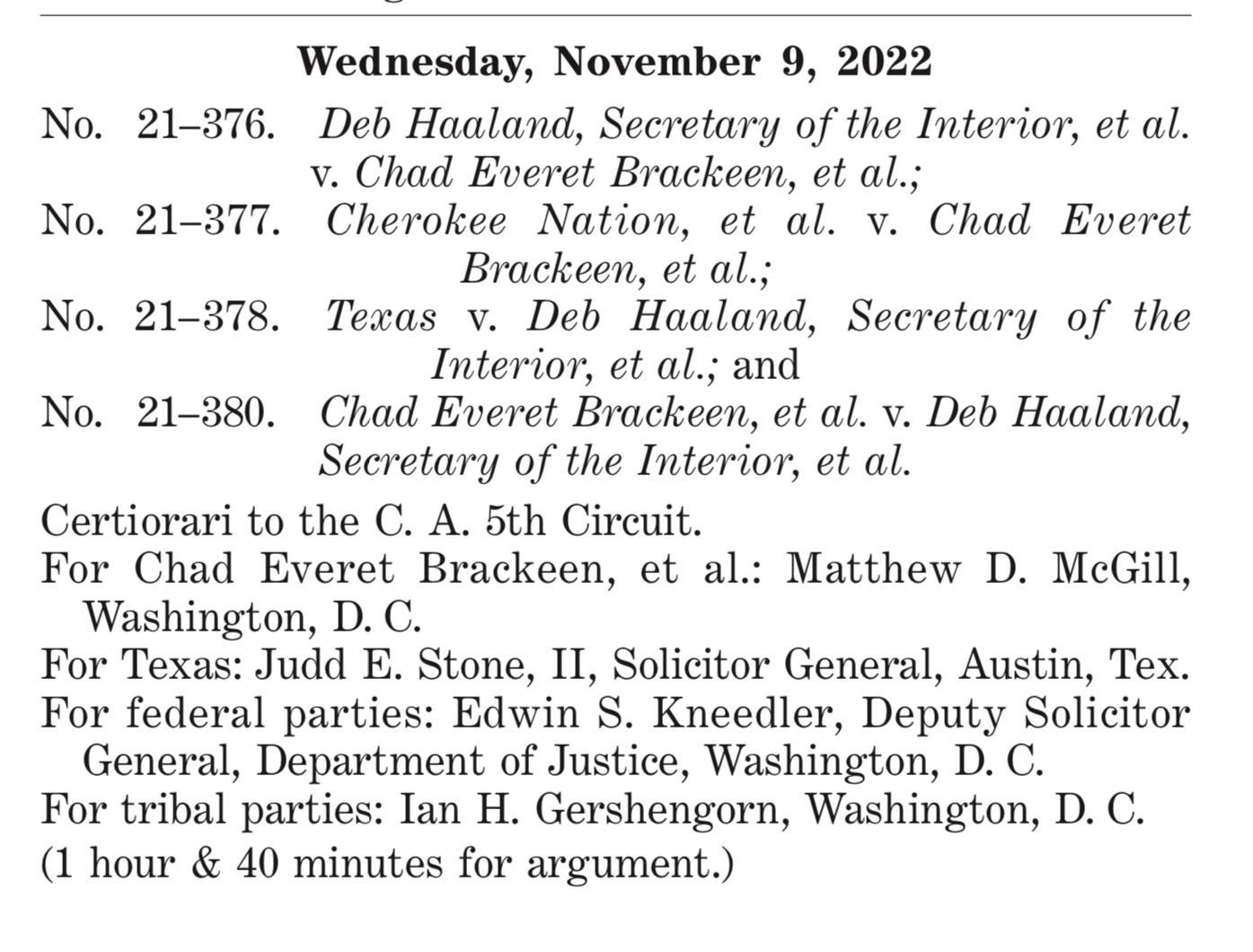
Oral arguments in the case are tomorrow (11/9) at 10am. Live audio can be streamed here.
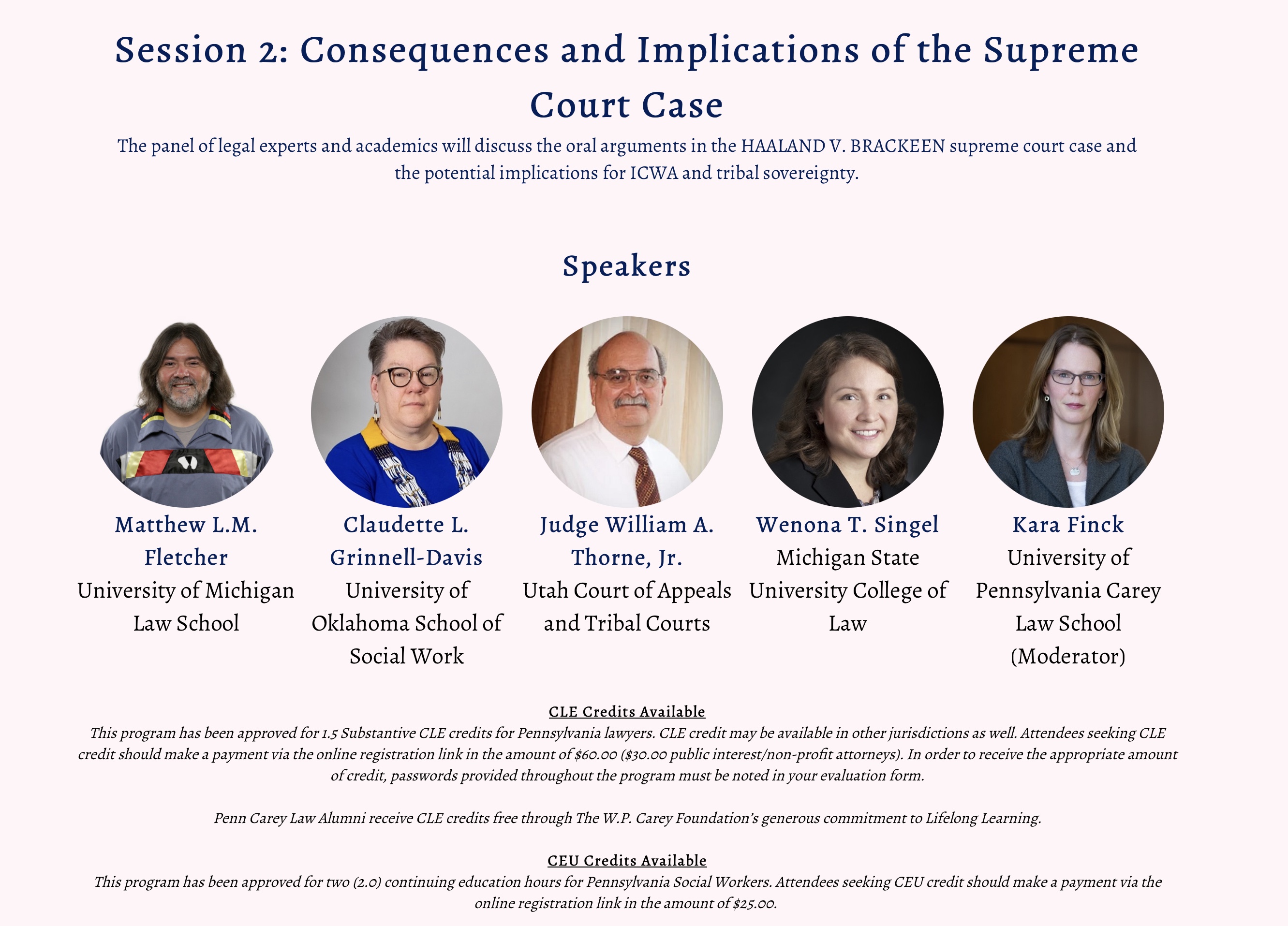
Please join the Indigenous Law and Policy Center this Wednesday, November 9, at 6:00 p.m. ET for a post-oral argument discussion of Brackeen over Zoom. Wenona Singel will be moderating this conversation with speakers Matthew L.M. Fletcher, Melody McCoy and April Youpee-Roll.
The link to register is here. Please see the below flyer for more information.
Ann Estin has posted “Equal Protection and the Indian Child Welfare Act: States, Tribal Nations, and Family Law,” forthcoming in the Journal of the American Academy of Matrimonial Lawyers, on SSRN.
Here is the abstract:
Congress has long exercised plenary power to set the boundaries of federal, state and tribal jurisdiction, and Supreme Court precedents have required that such legislation be tied rationally to the fulfillment of Congress’s unique obligation to Indian tribes. Exercising this power, Congress set parameters for state and tribal jurisdiction in child welfare and adoption cases with the Indian Child Welfare Act of 1978 (ICWA). In response to the recent Equal Protection challenge to ICWA by a small number of states in Haaland v. Brackeen, many more states have argued in support of the legislation, which addressed longstanding problems in the states’ treatment of Indian children and provided an important framework for cross-border cooperation in child welfare cases. Looking beyond ICWA, this article points to unresolved jurisdictional and conflict of laws challenges in other types of family litigation that crosses borders between states and Indian country. Arguing that citizens of tribal nations should have the same right to bring family disputes to courts in their communities that other Americans enjoy, the article argues for greater cooperation and comity between states and tribes across the spectrum of family law.
Colorado is the most recent state to add a pro hac rule for ICWA cases. This rule is pretty narrow, and only applies for attorneys representing tribes where the tribe has moved to intervene in the case on behalf of their child. This would not apply to any attorneys representing individuals (like a grandma or auntie) in an ICWA case, nor to any appellate work on behalf of tribes filing amicus briefs. However, the rule only requires a verified motion to avoid both fees and local association, which is great for tribal attorneys.
Here is the decision. sp7628
The facts of this case were a little unusual, where a foster family attempted to have a child in their care made a member of one tribe when he was already a citizen of another. The holdings, however, are useful both for clarity in the regulations for the determination of an Indian child’s tribe, and for keeping state courts out of tribal citizenship decisions.
Court decisions reflect the same rule of deference to the tribe’s exercise of control over its own membership. The U.S. Supreme Court has long recognized tribes’ “inherent power to determine tribal membership.” In John v. Baker we recognized that “the Supreme Court has articulated a core set of [tribes’] sovereign powers that remain intact [unless federal law provides otherwise]; in particular, internal functions involving tribal membership and domestic affairs lie within a tribe’s retained inherent sovereign powers.” We have also “long recognized that sovereign powers exist unless divested,” and “ ‘the principle that Indian tribes are sovereign, self-governing entities’ governs ‘all cases where essential tribal relations or rights of Indians are involved.’ ”
Chignik Lagoon’s argument would require state courts to independently interpret tribal constitutions and other sources of law and substitute their own judgment on questions of tribal membership. This argument is directly contrary to the directive of 25 C.F.R. § 23.108.
The Indian Law Clinic at MSU College of Law provided research and technical assistance to the Village of Wales in this case.

 Turtle Talk
You must be logged in to post a comment.