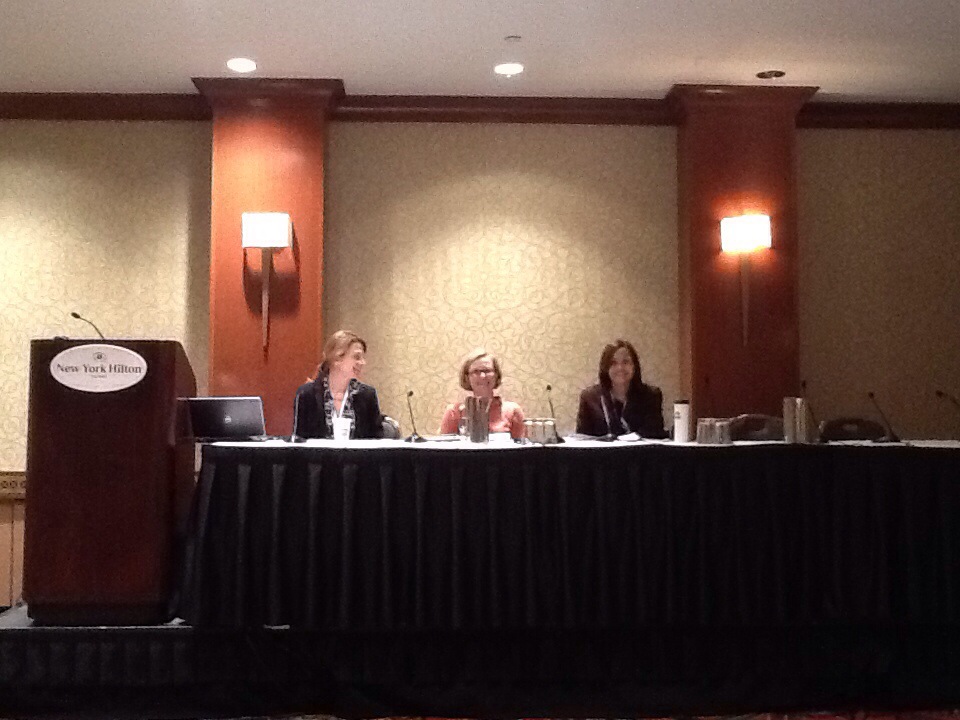
Bethany Berger, our own Kate Fort, and Solangel Maldonado
40.762006
-73.979036
Bethany Berger, our own Kate Fort, and Solangel Maldonado
Here.
We conclude that Cameron and Amanda failed to timely
appeal from the orders denying the motions to transfer the cases to tribal court. As such, this court is without jurisdiction to address Cameron and Amanda’s argument that the juvenile court erred in that respect. Upon our de novo review, we find that the State presented clear and convincing evidence that termination of Cameron’s and Amanda’s parental rights to S, L, H, and J was in the children’s best interests. Accordingly, we affirm the orders of the juvenile court.
Here is the opinion in Philip J. v. State of Alaska.
Adoptive Couple v. Baby Girl: At the Intersection of Family Law, Indian Law, and Civil Rights
On June 15, 2013, the Supreme Court decided Adoptive Couple v. Baby Girl, its first case on the Indian Child Welfare Act in 24 years. The case raises conflicting visions of child welfare, race, adoption, fatherhood, and the status of Indian tribes. The 5-4 decision turns on divided views of the statute, with a controlling interpretation that may decimate the rights of birth fathers in ICWA cases and even the scope of ICWA itself. Conflicting amicus briefs from the National Council for Adoption (the trade group for private adoption agencies) and the 18 leading child welfare organizations in the country raise equally divided questions of the connection between the law and the best interests of children. Finally, with claims by the adoptive couple and their amici of race-matching and equal protection concerns, and claims by the birth father and Indian tribes of an adoption industry illegally preying on Indian children, perspectives on the role of race in adoptions and even the constitutional status of Indian tribes are placed in conflict as well. This panel explores these questions with scholars of federal Indian law, family law, constitutional law, and critical race theory.
Panelists:
Kathryn Fort (Michigan State University-College of Law)
Solangel Maldonado (Seton Hall Law School)
Gerald Torres (University of Texas Law School; Visiting Cornell Law School)
Bethany Berger (University of Connecticut School of Law)
Thanks to Bethany for sending this along.
Here. Child was from White Earth, and both tribal counsel and expert witness argued for relative placement. Department argued mother did not have standing and forfeited the relative placement issue even though child was “not suitable for adoption” and ICWA applied. Court disagreed but still dismissed:
Here, although A.C. had earlier requested assessment as a caregiver for the children, she withdrew her request in May 2012. She was again referred to the relative assessment unit on June 19. The record does not indicate whether that referral, only one month before the hearing on review, had yet been finalized. The orders appealed from do not address that issue. Because the assessment was still pending at the time of the hearing, we conclude the issue is not ripe for appellate review.
Kate Fort and I published a short paper for a Boston University Law Review mini-symposium on Adoptive Couple v. Baby Girl: “Indian Children and Their Guardians ad Litem.”
An excerpt:
One of the primary goals of the Indian Child Welfare Act (ICWA) is to limit the influence or bias of state workers in decisions placing American Indian children out of their home and community.1 While this focus usually concerns state social workers, the officials who most often seek removal of a child, or the courts, the body that issues the orders and opinions, guardians ad litem (GALs) receive less attention.2 Despite this lack of attention, GALs exert a similar level of influence as state social workers. In Adoptive Couple v. Baby Girl,3 the role of the GAL was unusual but critical – the GAL, while officially appointed by the court, was handpicked by the adoptive parents.4 The role of the GAL remains understudied in the ICWA literature, though GALs continue to exert enormous influence in the courts. Unfortunately, many GALs throughout the nation subvert the national policy embodied by the ICWA by advocating against the implementation of the statute in case after case.5
There are three other papers in the symposium:
Perspective I by Professor Barbara Ann Atwood is available here,
Perspective II by Professor James G. Dwyer is available here, and
Perspective III by Professors Naomi Cahn and June Carbone is available here.
Here is the opinion (Cal. App.):
An excerpt:
This appeal challenges an order terminating the parental rights of mother Patricia M. and father Bryan K. to their daughter Autumn K. and placing the child for adoption. Because Autumn was of Chickasaw descent and thus an Indian child, the dependency proceeding fell within the provisions of the Indian Child Welfare Act, 25 U.S.C. section 1901, et seq. (ICWA). As such, there were particular substantive requirements with which the juvenile court was obligated to comply when selecting a permanent plan for Autumn. Most significantly, absent good cause to deviate from this requirement, ICWA obligated the court to place Autumn with a member of her extended family, a member of her tribe, or another Indian family. (25 U.S.C. § 1915.) Here, there were two potentially viable, ICWA-compliant placements: maternal grandmother Teresa, who had custody of Autumn’s six siblings and had sought placement of Autumn from the outset of the dependency case, and maternal aunt Beatrice. Despite that, the court, relying on a conclusion by respondent Del Norte County Health and Social Services Department (Department) that Autumn could not be placed in her grandparents’ home, placed Autumn in a non-Indian home with a distant relative.
On appeal, the parents contend the juvenile court erred for a multitude of reasons. We agree with one argument that necessitates reversal: the Department erred in determining maternal grandfather José had a nonexemptible criminal conviction such that Autumn could not be placed with her grandparents. We conclude two different statutory provisions instructed that the conviction was in fact exemptible, and the Department was thus obligated to evaluate the request for an exemption on its merits. We therefore reverse.
Here.
An excerpt:
It is this very inability to escape uncertainty, qualification, and conflict that ultimately situates Adoptive Couple in the Court’s parental rights canon and that suggests its ongoing significance. Like its predecessors, Adoptive Couple is another deeply divided and closely fought decision, which refuses to wholly deny the power of biology even as it insists upon proactive parenting and affective relationships. The conditions and disclaimers embedded in the case’s holding, taken together with the equal conviction and fervor of both opposing opinions, thus serve as proof of the interminability of such judicial debates about the family.94 Further, the Court’s very willingness to engage in a stark contest over biology versus family in a case that by no means required it — and to engage vigorously, even viciously — seems a harbinger of things to come: in an age of momentous changes in the composition of the family, alluded to both in the decision and in other decisions of the Term, questions regarding which relationships and nontraditional ties warrant judicial protection promise to appear with ever more frequency and complexity. As Adoptive Couple shows, however, the Court remains mired in the same disputes it first unleashed forty years earlier, still grappling with the fundamental tension between nature and nurture. Yet this irresolution and ongoing struggle may well be a cause for comfort rather than concern, a sign that the essential questions about the most essential ties and relationships remain open for investigation and reinvestigation.
Here is the opinion in In re Guardianship of D.W.
An excerpt:
The record in the present case discloses that from the outset of these proceedings until respondent was appointed the minor‟s guardian, appellant consistently informed the court that the minor had Indian ancestry, and that his father was an enrolled member of the Yurok or Karuk tribes. “Because „biological descendance‟ is often a prerequisite for tribal membership . . . [a relative‟s] suggestion that [the child] „might‟ be an Indian child [is] enough” to satisfy the minimal showing required to trigger the statutory notice provisions. (Antoinette S., supra, 104 Cal.App.4th at p. 1408, fn. omitted.) In carrying out its obligation under the ICWA to provide notice, the court incorrectly assigned appellant, the party objecting to the guardianship, the responsibility of providing notice to the possible Indian tribes.
 Turtle Talk
You must be logged in to post a comment.