Designed to find white families for Indian kids:
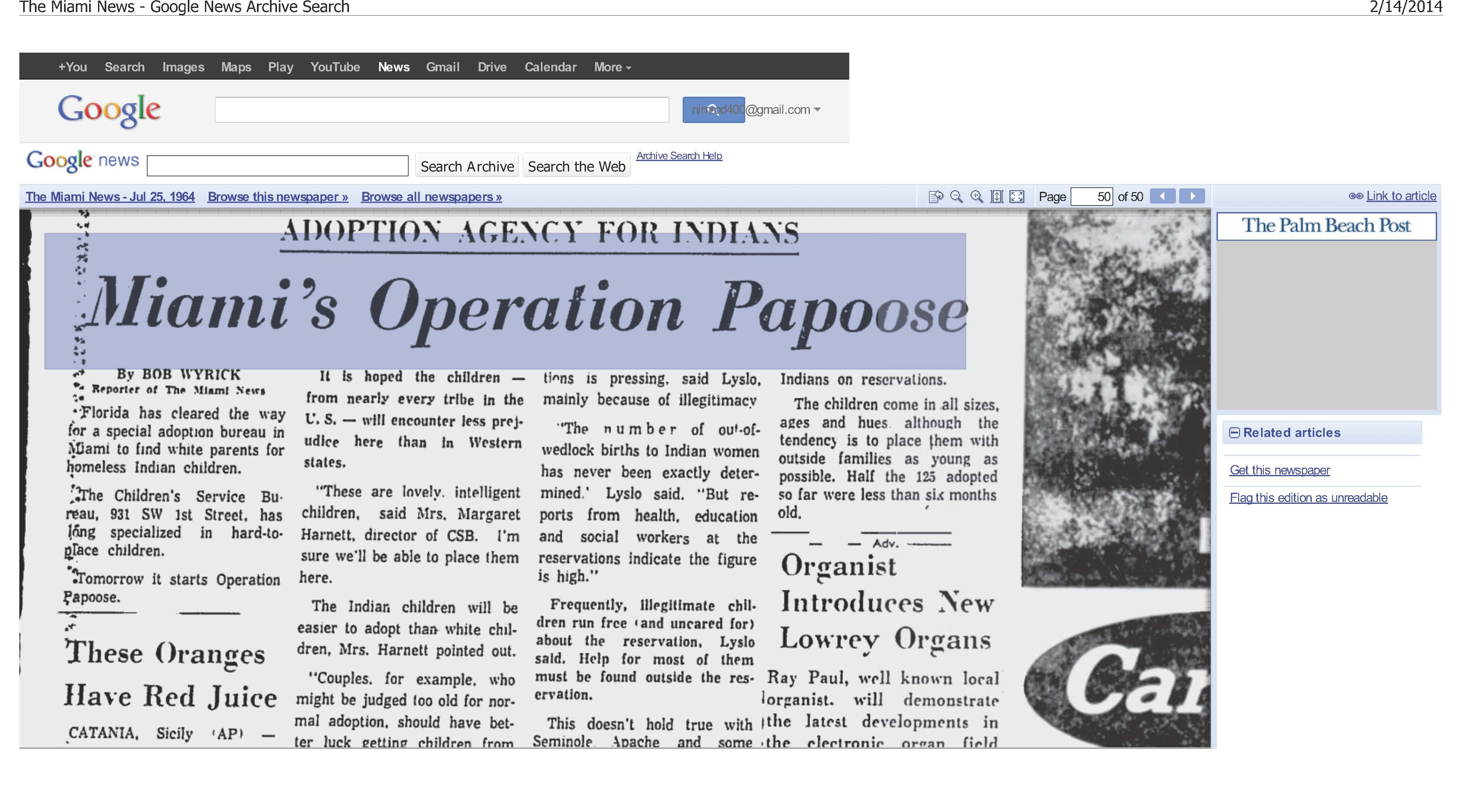
Designed to find white families for Indian kids:
Here.
It is clear from the record that the trial court had information, however slight, “suggesting that [a] child, a parent of [a] child, or members of a parent’s family are tribal members,” which was one of the five situations the Supreme Court listed as “sufficient to trigger tribal notice.” In re Morris, 491 Mich at 108 n 18. Specifically, respondent’s attorney informed the court that “there might be some [Indian ancestry] on the grandmother’s side.” Because it is for the tribes to determine a child’s eligibility for membership, In re Fried, 266 Mich App 535, 540; 702 NW2d 192 (2005), the trial court clearly erred when it found that the possibility of Indian heritage in a great-grandmother of one or more of the minor children was too remote to justify the notice required by the ICWA and MCL 712B.9(1).
Here, from NICWA, NCAI, NARF, and AAIA:
The undersigned American Indian and Alaska Native (AI/AN) organizations request that the Civil
Rights Division of the Department of Justice commences a prompt investigation into the unlawful treatment of
AI/AN children in the private adoption and public child welfare systems throughout the United States.***
Yet, despite all the protections provided by ICWA, each year thousands of parents, grandparents, aunties,
uncles, and child advocates reach out to the National Indian Child Welfare Association (NICWA) desperate for
help. Their rights under ICWA and the Constitution continue to be violated by state child welfare and private
adoption systems. NICWA frequently hears stories of adoption agencies ignoring the tribal membership of
children, of state attorneys failing to provide notice to a tribe when a child is taken into custody, of child
welfare workers sometimes knowingly placing children outside ICWA’s placement preferences, and of judges
denying tribal representatives a presence in the court room. NICWA also often hears stories of Guardians ad
Litem scoffing at the importance of Native culture, state workers demeaning AI/AN parents and traditional
ways of parenting, and attorneys using professional networks to encourage other attorneys to purposefully
circumvent the “ridiculous” or “unnecessary” adoption requirements of ICWA.
Here are the materials in Oglala Sioux Tribe v. Van Hunnik (D. S.D.):
Order Denying Motions to Dismiss (Jan 28, 2014)
Order Granting Class Certification (Jan. 28, 2014)
Order Granting Expedited Discovery (Jan. 28, 2014)
Here.
Here, respondent-father indicated to the referee that his great-grandmother was a member of the “Blackfoot” tribe. Although petitioner argues that there is no such tribe as “Blackfoot,” the BIA’s list of federally recognized Indian tribes includes “the Blackfeet Tribe of the Blackfeet Indian Reservation of Montana.” See http://www.ncsl.org/research/state-tribal-institute/list-of- federal-and-state-recognized-tribes.aspx (last visited December 30, 2013). Respondent-father points out that the name “Blackfoot” was used by the federal government in the Treaty with the Blackfeet of 1855, which recognized the existence of a Blackfoot Tribe and Blackfoot Nation. See Treaty with the Blackfeet, 11 Stat 657 (October 17, 1855). Thus, mindful of our Supreme Court’s statement that “[i]f there must be error in determining whether tribal notice is required, let it be on the side of caution[,]” Morris, 491 Mich at 108, we hold that respondent-father provided sufficient indicia of Indian heritage to the trial court to require tribal notice. If the identity of the tribe is uncertain, 25 USC § 1912(a) allows notice to be given to the Secretary of the Interior. Here, the record does not indicate that any notice was given.
***
We therefore conditionally reverse the trial court’s termination of respondent-father’s parental rights, and remand to the trial court for resolution of the notice issue. On remand, the trial court shall ensure that notice is properly made to the appropriate entities. If the children are not Indian children or the properly noticed tribes or government entities do not respond within the allotted time, the trial court’s termination of respondent-father’s parental rights is reinstated. If, however, the trial court concludes that the ICWA does apply to the proceedings, the trial court’s termination of respondent-father’s parental rights to his four children must be vacated and proceedings begun anew in compliance with the procedural and substantive requirements of the ICWA.
More than the usual troubling CA notice cases, that is. Particularly the part about not having to do *any* notice, regardless of the court’s confusion about the history and location of the Pascua Yaqui Tribe.
Here.
The social worker reported Audrey said her father, Luis H., has some Yaqui Indian heritage, but she had not spoken with him and did not have sufficient information to fill out the form. When the social worker telephoned Luis, he said his mother was born in Sonora, Mexico,and mother’s father was Yaqui. He said he did not know if any family member was registered with a tribe, but reported no family member practiced any tribal customs.
***
At the contested jurisdictional/dispositional hearing on July 30, Audrey again indicated her only potential Indian heritage was from the Yaqui Tribe in Mexico. County Counsel said as a precautionary measure the Agency would provide ICWA notice to the Yaqui Tribe in the United States and, on August 1, it sent notice to the Pascua Yaqui Tribe in Arizona. The court, however, found ICWA notice was not required because there was no reason to believe Mason is an Indian child in that Audrey had indicated her only potential Indian heritage is through the Mexican Yaqui Tribe, and the Mexican Yaqui Tribe is not a federally recognized tribe governed by ICWA.
Here:
2014 ICWA Designated Tribal Agents (PDF)
Online version here, and always available by one click (Kathryn E. Fort) at the top of Turtle Talk here.
Article here.
The tribal resolution, which passed unanimously, states: “In any adoptive placement of a Cherokee child under state law, a preference shall be given, in the absence of good cause to the contrary, to a placement with a biological parent or parents; a member of the child’s extended family; other members of the Cherokee Nation; or other Indian families.”
Here is the opinion in In re Jayden D.
An excerpt:
Because the State did not meet its burden of establishing good cause to deny transfer to tribal court, the juvenile court abused its discretion in denying Yolanda’s motion to transfer. We reverse the order of the juvenile court and remand the cause with directions to sustain the motion to transfer.
But does not require contemporaneous active efforts when ordering one.
Here is the opinion.
Given our conclusion that the guardianship was a “foster care placement” under ICWA, we now consider whether the juvenile court was required under ICWA to make an “active efforts” finding at the proceeding in which that guardianship was established. Mother argues that, because the guardianship is a foster care placement, the juvenile court was required to include an active efforts finding in the guardianship judgment. Although we disagree with DHS’s argument that the guardianship was not a “foster care placement,” we conclude nonetheless that DHS satisfied ICWA’s “active efforts” requirement at the 2011 permanency hearing. Therefore, the juvenile court was not required to make an “active efforts” finding in the guardianship judgment.
 Turtle Talk
You must be logged in to post a comment.