MSU Extension Webinars for Tribal Leaders

Here.

RSVP here.

Department of Human Services, Native American Affairs &
Tribal Services: How We Work Together to Improve Lives
March 12th
– Stacey Tadgerson, Director of the Office of Native
American Affairs, Michigan Department of Human Services (DHS)
Congress enacted the Indian Child Welfare Act (ICWA) to eliminate the
wholesale state removal of abused/neglected Indian children from their tribes
and culture. Participants in this session will learn about the history of ICWA,
Native American Affairs, and resources available to youth in care, tribal
governments, and urban Indian organizations from the DHS that will assist
tribal youth in becoming self-sufficient while reaching for their dreams.

Baby Veronica & Inside the Michigan Indian Family
Preservation Act – April 2nd
– Kate Fort, Staff Attorney and Adjunct
Professor – MSU Indigenous Law & Policy Center
The United States Supreme Court decided only the second case on the
Indian Child Welfare Act since its passage. This presentation will give the
basic facts and holding of the case, as well as its potential implications for
ICWA cases in the future. It will also address the way the Michigan Indian
Family Preservation Act helps to limit the application of the Baby Girl case.

Making Smart Choices for Health Insurance – April 16th

Brenda Long, Educator – MSU Extension
To help people navigate the complex and confusing health insurance
landscape, MSU Extension is teaching people how to take control of their
health insurance situation through webinars and in-person presentations.
Those who participate will be able to analyze their insurance needs, learn
important terms and concepts, compare health insurance plans, and figure
out what fits in their budget. People will also become more confident
Kristen Carpenter and Lorie Graham on Human Rights and Adoptive Couple v. Baby Girl

Kristen Carpenter and Lorie Graham have posted a very compelling and powerful paper about the Supreme Court’s decision in Adoptive Couple v. Baby Girl. It is required reading for anyone interested in the case, and is destined to be the definitive paper on the international human rights aspects of the case.

The article is titled Human Rights to Culture, Family, and Self-Determination: The Case of Adoptive Couple v. Baby Girl. Here is the abstract:

The well-being of indigenous children is a subject of major concern for indigenous peoples and human rights advocates alike. In 2013, the U.S. Supreme Court decided in Adoptive Couple v. Baby Girl that the Indian Child Welfare Act did not prevent the adoption of a Cherokee child by a non-Indian couple. This occurred over the objections of her Cherokee biological father, extended family, and Tribal Nation. After the decision, Baby Girl’s father and the adoptive couple contested the matter in a number of proceedings, none of which considered the child’s best interests as an Indian child. The tribally-appointed attorney for Baby Girl, as well as the National Indian Child Welfare Association and National Congress for American Indians, began examining additional venues for advocacy. Believing that the human rights of Baby Girl, much like those of other similarly situated indigenous children, were being violated in contravention of the United Nations Declaration on Indigenous Peoples Rights, and other instruments of international law, they asked us to bring the matter to the attention of the United Nations Special Rapporteur for Indigenous Peoples Rights (“UNSR”). We prepared a “statement of information” to alert the UNSR of the human rights violations occurring in the case. With the permission of the attorneys and organizations involved, this chapter introduces the Baby Girl case, contextualizes the claims in international human rights law, and then reproduces the statement of information, and portions of the UNSR’s subsequent public statement. It concludes with an update on the Baby Girl case and broader discussion about the potential for using international law and legal forums to protect the human rights of indigenous children.

Michigan COA Reverses ICWA Notice: Casual Disregard of ICWA/MIFPA by Wayne County Court and State Workers/Attorney

Here is the opinion in In re Harrell/Harrell-Marls:

In re Harrell

An excerpt:

At a pretrial hearing, the assistant attorney general, respondent’s attorney, and the trial court discussed whether one of the parties was of American Indian heritage for the purposes of the ICWA:

The Court: All right, the petition is authorized. The children have been placed with relatives. What else? I guess—is that it? Did anyone ever ask is there any . . . American Indian heritage in this family? American Indian heritage?

Ms. Safran (attorney for respondent): Do you have any Indian heritage in your family?

The Court: Cherokee, Chippewa.

Ms. Safran: There might be some grand—on the grandmother’s side, what was it? Some time—some type; attenuated.

Ms. Trott (attorney for petitioner): Ms. Topp was told no at the other—

Ms. Safran: Well, we didn’t have all the parties.

Ms. Topp (case worker): I talked to [respondent], as well, in the police station[,] and I was told no.

Ms. Safran: She doesn’t think—

The Court: You don’t have any kind—are you sure it’s American, or, any idea what we’re talking about? I mean, what kind of Indian? Cherokees, Chippewa? I mean, there’s a whole bunch.

Unidentified speaker: I don’t—I don’t know; I can ask.

The Court: And . . . what relative? Grandma? Great-grandma?

Ms. Safran: Your Honor, can we get a date because . . . they want me in [Judge] Slavens[’ courtroom] and I can’t believe it.

The Court: You’ve got to wait just one second. All right, you can investigate and see. That’s pretty distant; great-grandma is pretty far back. So, I’m not gonna demand that we send  notice.

Ms. Trott: This is on the paternal side? Or maternal? Of which father?

The Court: On the mother’s side or father? It better be a maternal because right now—all right. You have the right to have this heard by a referee as to all the children . . . or by a judge with or without a jury, and, of course, continued right to an attorney at all hearings.  We’re setting this for trial?

Ms. Trott: Yes.

It is clear from the record that the trial court had information, however  slight, “suggesting that [a] child, a parent of [a] child, or members of a parent’s family are tribal members,” which was one of the five situations the Supreme Court listed as  “sufficient to trigger tribal notice.” In re Morris, 491 Mich at 108 n 18. Specifically, respondent’s attorney informed the court that “there might be some [Indian ancestry] on the grandmother’s side.” Because it is for the tribes to determine a child’s eligibility for membership, In re Fried, 266 Mich App 535, 540; 702 NW2d 192 (2005), the trial court clearly erred when it found that the possibility of Indian heritage in a great-grandmother of one or more of the minor children was too remote to justify the notice required by the ICWA and MCL 712B.9(1).

Conditional Reversal on Notice Case from Michigan COA

Here.

We acknowledge that there was an effort to comply with the notice requirements. On October 14, 2011, petitioner sent a notification for each child, identifying the children’s tribal affiliation as Sault Ste. Marie Tribe of Chippewa and/or Blackfoot, to respondents, the Sault Ste. Marie Tribe of Chippewa, and the Midwest Bureau of Indian Affairs in Fort Snelling, Minnesota. The notices state that they were sent by registered mail, return receipt requested. However, there is no return receipt in the record before us.

Unpublished Active Efforts Decision from the Michigan COA

Here.

With some troubling language, given this was an abuse and neglect case:

fn 4
In this appeal, the parties have not directly addressed whether respondent father ever had “custody” of the children, or whether respondent father is part of an “Indian family” within the meaning of ICWA or MIFPA. For purposes of this appeal only, we assume that respondent father was a parent from whose custody the Indian children were removed, within the meaning of 25 USC 1914 and MCL 712B.39. We further assume that mother, respondent father, and the children comprise an “Indian family” within the meaning of ICWA and MIFPA. Cf. In re SD, 236 Mich App 240, 244; 599 NW2d 772 (1999) (holding that no “active efforts” were required when the family had already been broken up at the time the proceedings began); Adoptive Couple v Baby Girl, ___ US ___; 133 S Ct 2552, 2563-2564; 186 L Ed 2d 729 (2013) (same).

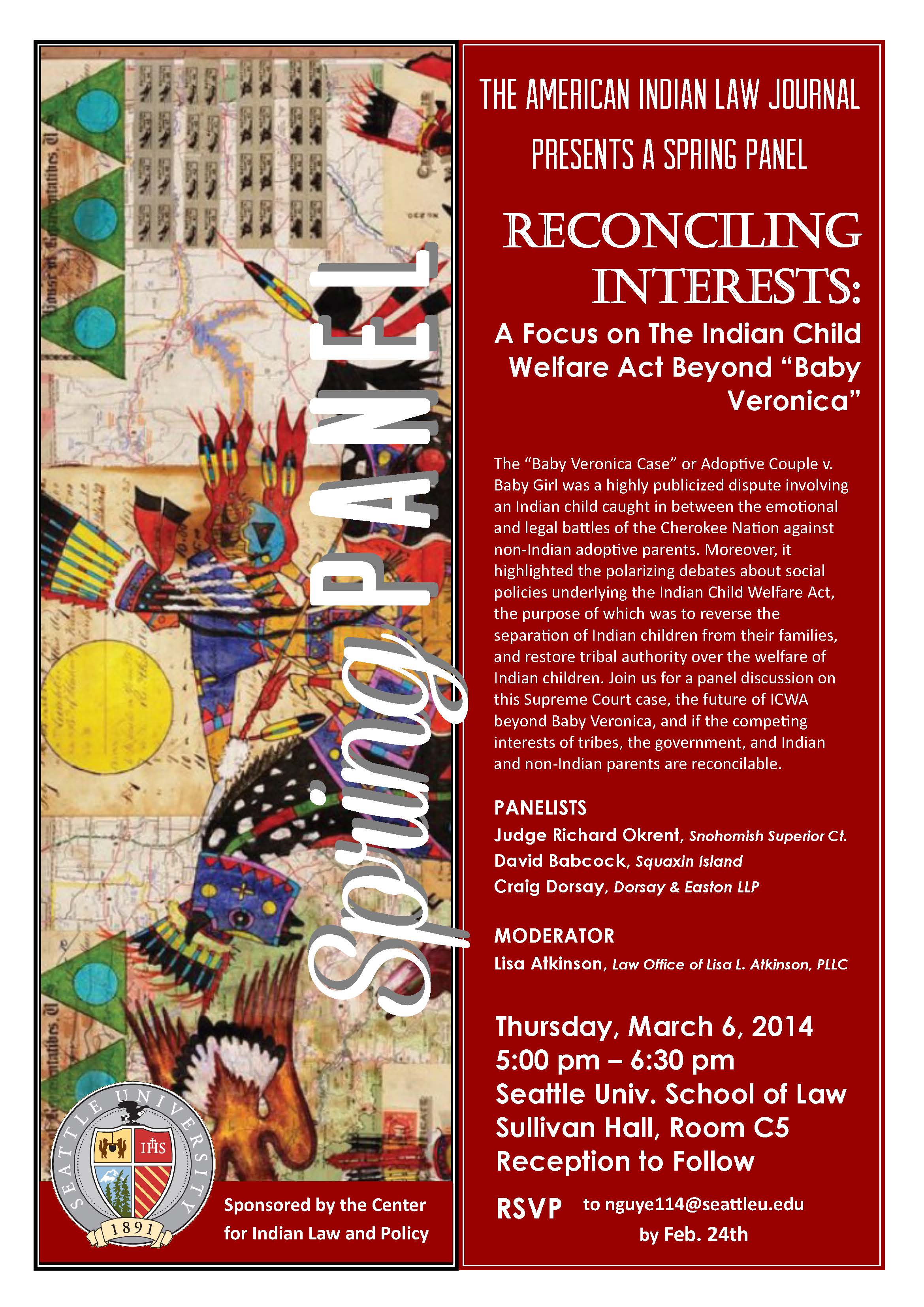
Two Events at Seattle U. Law School — Storytelling (Feb. 26) and ICWA (March 6)

Spring Panel 2014 Poster_A3i Final

Fernades event git-hoan3 February26

Continue reading

13th Annual Indian Child Welfare and Wellness Conference Ongoing

News coverage here.

Judge Thorne speaking:

Judge Thorne

Investigation into Tulsa Adoption Agency

Story here.

Oklahoma’s Department of Human Services is looking into a Tulsa adoption agency.

Heritage Family Services and its director Mike Nomura are contracted with the state to administer a report that’s done for every case where a child is adopted across state lines.

The chairman of the board for Heritage Family Services is the attorney who represented Matt and Melanie Capobianco as they fought for custody of Veronica Brown.

North Dakota ICWA Eligibility Case

Here.

46] The ICWA director of the Round Valley Indian Tribes explained the father’s relationship with the tribe:

[The father] and his children are eligible for enrollment with the Round Valley Indian Tribes.
When the children were removed from the care of the parents [the father] was not an enrolled member with the Round Valley Indian Tribes, ICWA did not apply.
[The father] is still not an enrolled member with the Round Valley Indian Tribes, ICWA does not apply.
. . . .
This is the parent(s) responsibility to apply for enrollment with the Round Valley Indian Tribes during open enrollment.

Briefs in Alaska ICWA/Tribal Jurisdiction Case — Simmonds v. Parks

Here they are (well, most of them anyway):

Alaska Tribal Amici

[Simmonds Principal Brief]

Parks Brief

Stearman Brief

Simmonds Reply

Prior post here.

NARF case update page here.