Here. The event will be Wednesday, Feb. 15th at 7pm. The person giving the talk, Dr. Lindquist, used to be the director of the Lenawee County Historical Society, which I mentioned here. He was also my first supervisor when I interned there, and a great mentor.
Michigan Indian
NPR Interview with Prof. Tiya Miles on Slavery and American Indians
Here.
Professor Miles, welcome back to the program. Thanks so much for joining us and, of course, congratulations again on the McArthur. And I’d like to ask you, when you first encountered stories of African-Americans and Native American slaves in Michigan, in the Michigan territory. I think it’s a surprise to many people to know or to even think about the fact that slavery existed that far north.
TIYA MILES: Well, I first encountered this when I took a class to the Ypsilanti Historical Museum, and we also took a local Underground Railroad tour. And we learned about an abolitionist here in southeast Michigan named Laura Haviland, who did work in Detroit and also in Ontario.
And she taught a school for escaped slaves in Canada, and there were blacks, as well as native people at that school. So that, for me, was the first clue that there was something between black people and native people in Detroit history regarding slavery, as well as in the Southeast.
MARTIN: Well, what have you been able to piece together about the slave experience in Michigan for both African-Americans and Native Americans? And I realize that the research is in its early stages. I know we want to stress that. But what have you been able to piece together?
MILES: Well, the first thing that strikes me about this research is that Detroit is a very unusual place. It was a major settlement for Native Americans, for French settlers, for British settlers and then later, for the Americans. So that meant that it was an area where lots of people were moving through and passing through.
There was a good deal of contestation over who would get to control Detroit. Would it be the French? Would it be the British? And would it be the Americans? And this meant that slavery also had a multilayered aspect in Detroit.
A little side note: Laura Haviland spent much of her adult life just outside of Adrian, Michigan in Raisin Township, and ran a school there, in addition to being a part of the Underground Railroad. Until 2010, a statute of her sat in front of Adrian City Hall. Put in storage while the old City Hall was demolished, the city is currently thinking about putting it in front of the Adrian Historical Society. Haviland’s papers are held by the University of Michigan, and she wrote her autobiography, A Woman’s Life Work in 1881. One of the first historical projects I ever worked on (including my first trip to an archive to look at her papers) was examining the many different editions Haviland released of A Woman’s Life Work, all with slight changes as she continually rewrote her life’s work.

Sault Tribe Response to Mayor Bernero’s Gaffe
Here.
Mayor Bernero’s Apology for/Denial of Using Racial Slurs in Referring to Lansing Casino Opponents
Here.
An excerpt:
He said: “My passionate support for Lansing and our casino project may have gotten the better of me, but none of my remarks were directed toward Native Americans, and nothing I said can fairly be construed as a racial slur, despite our opponent’s attempt to spin it that way. I make no apologies for using strong language against our opponents, who have made some very impertinent remarks about me, but I do offer my heartfelt and sincere apology to any and all who were offended by my choice of words.”
City Pulse: Fletcher’s Four Barrier to the Lansing Casino Proposal (and Additional Commentary)
Andy more or less catches my drift (via Pechanga). A few quotes:
In his piece, Fletcher goes on to outline three potentially significant legal obstacles: the Bureau of Indian Affairs’ “trust acquisition hurdles”; language in the Land Claims Settlement Act provision that says the Interior Department “shall be held in trust” (the word “shall” may not mean “has to”); and a provision in the Indian Gaming Regulatory Act that would require the Sault Tribe to submit its application to the Interior Department after “a prior written agreement between the Tribe and the State’s other federally recognized Indian Tribes that provides for each of the other Tribes to share in the revenue of the off reservation gaming facility.”
That last quote is actually from the 1993 gaming compacts.
And fourth:
A fourth hurdle, Fletcher wrote, is that the Sault Tribe “has to exercise governmental authority over the land, according to the Indian Gaming Regulatory Act. Sault Tribe has no history in this area, let alone a governmental presence.”
I haven’t really expounded on a possible fifth hurdle, which is really related to the mandatory trust acquisition language. I can assure you Congress would never have intended that the Sault Tribe would be able to use this provision to buy land for off-reservation gaming purposes (especially, way off-reservation gaming purposes. See the legislative history here (Judgment Funds Hearing), which is virtually silent as to gaming. [Although to be fair, Rep. Kildee says his grandfather from the Traverse City area remembers when Indians had more “mobility” than they do now.] Ultimately, legislative history doesn’t trump the plain language. Usually.
Sault Tribe has to worry that a court construing the Secretary’s authority under the so-called mandatory trust acquisition language is unlimited, and perhaps unconstitutional as applied to this circumstance. The judgment funds settle treaty claims related to the 1836 treaty signatories. The 1836 treaty ceded territories do not include Lansing. And frankly, the Sault Tribe and Bay Mills have only a tenuous claim to lower peninsula territory, given that they are located in the Upper Peninsula, and importantly, there are already three federally recognized Lower Peninsula tribes who are 1836 treaty signatories. I mentioned in yesterday’s post that Lansing is small potatoes compared to other metropolitan areas, like Chicago and Cleveland, that don’t have Indian casinos now. Nothing stops Sault Tribe from going there with their casino proposals, and that fact alone will make a court wary of allowing Sault Tribe, Lansing, and Interior (if Interior goes along with it) to set aside trust lands in Lansing.
I recall this comment from the Eighth Circuit in a different context (involving the Secretary’s authority under Section 5 of the Indian Reorganization Act) but it makes the point here as well:
By its literal terms, the statute permits the Secretary to purchase a factory, an office building, a residential subdivision, or a golf course intrust for an Indian tribe, thereby removing these properties from state and local tax rolls. Indeed, it would permit the Secretary to purchase the Empire State Building in trust for a tribal chieftain as a wedding present. There are no perceptible “boundaries,” no “intelligible principles,” within the four corners of the statutory language that constrain this delegated authority-except that the acquisition must be “for Indians.” It delegates unrestricted power to acquire land from private citizens for the private use and benefit of Indian tribes or individual Indians.
It’s on page 882 here (SD v DOI). I can easily see a court rejecting the plain language reading the Tribe will want them to make on these grounds. It would be a terrible precedent for all of Indian country. But tribes take risky actions in desperate times, I suppose.
Updated Commentary on Lansing Casino Proposal
We have additional detail on the proposal from both sides. Here’s the scoop. Sault Tribe claims they have a mandatory trust acquisition statute, Section 108(f) of the Michigan Indian Land Claims Settlement Act. Here is the text:
Any lands acquired using amounts from interest or other income of the Self-Sufficiency Fund shall be held in trust by the Secretary for the benefit of the tribe.
The statute is more complex, but if the Tribe’s theories pan out, that provision is the kicker. So, the land goes into trust and the Tribe starts gaming right away? Well, probably not. Pokagon Band has a mandatory trust acquisition statute. It took them nearly a decade to wade through the regulatory and legal thicket. They did still win, though (TOMAC v. Norton). So did Little Traverse — they have virtually the same statute and they eventually defeated Sault Tribe’s efforts to shut them down (SSM v. US and LTBB). (That was back when we referred to Sault Tribe as the Darth Vader of Michigan Indian Tribes — those days are long gone. The old Sault Tribe would have considered Lansing smallpotatoes, and gone to Chicago or Cleveland instead. Maybe they will anyway. Why not? Under this theory, there’s no limiting principle.).
They still have to run through BIA’s trust acquisitions hurdles, and there’s no guarantee, even with a mandatory trust acquisition. They better hope there’s no endangered species in Lansing.
Also, as Bryan Garner will tell you, every jurisdiction in the English speaking world has held at least once that “shall” is a term, in some circumstances, that does not mean “mandatory,” but instead means “discretionary.” Sounds crazy? Ask the CSKTs (CSKT).
Sault Tribe has another hurdle, and I have no idea how this will turn out. But Sault Tribe is a party to the 1993 gaming compacts. Section 9 reads:
An application to take land in trust for gaming purposes pursuant to § 20 of IGRA (25 U.S.c. § 2719) shall not be submitted to the Secretary of the Interior in the absence of a prior written agreement between the Tribe and the State’s other federally recognized Indian Tribes that provides for each of the other Tribes to share in the revenue of the off reservation gaming facility that is the subject of the § 20 application.
So, assuming Sault Tribe is going to apply to take the land into trust for gaming purposes using their mandatory trust acquisition statute, which is a land claims settlement, they’re doing so under Section 20 of IGRA. I’m almost certain Saginaw Chippewa, another party to the compact, isn’t going to agree to anything (I don’t know, unless they get 75 percent or something). That will probably kill it.
Moreover, trust land alone is insufficient. The Tribe has to exercise governmental authority over the land, too, according to the Indian Gaming Regulatory Act. Sault Tribe has no history in this area, let alone a governmental presence.
Incidentally, I misspoke on the “precedent” for a Tribe using a mandatory trust acquisition statute to force the Secretary to take land into trust for gaming purposes. I was talking about the Wyandotte Nation of Oklahoma’s effort to game in Kansas City, Kansas. They sued the Secretary last year for lagging on trust acquisitions. Their original trust application was 1992, and the suits are still going on 20 years later.
2012 Native American Critical Issues Conference Flyer
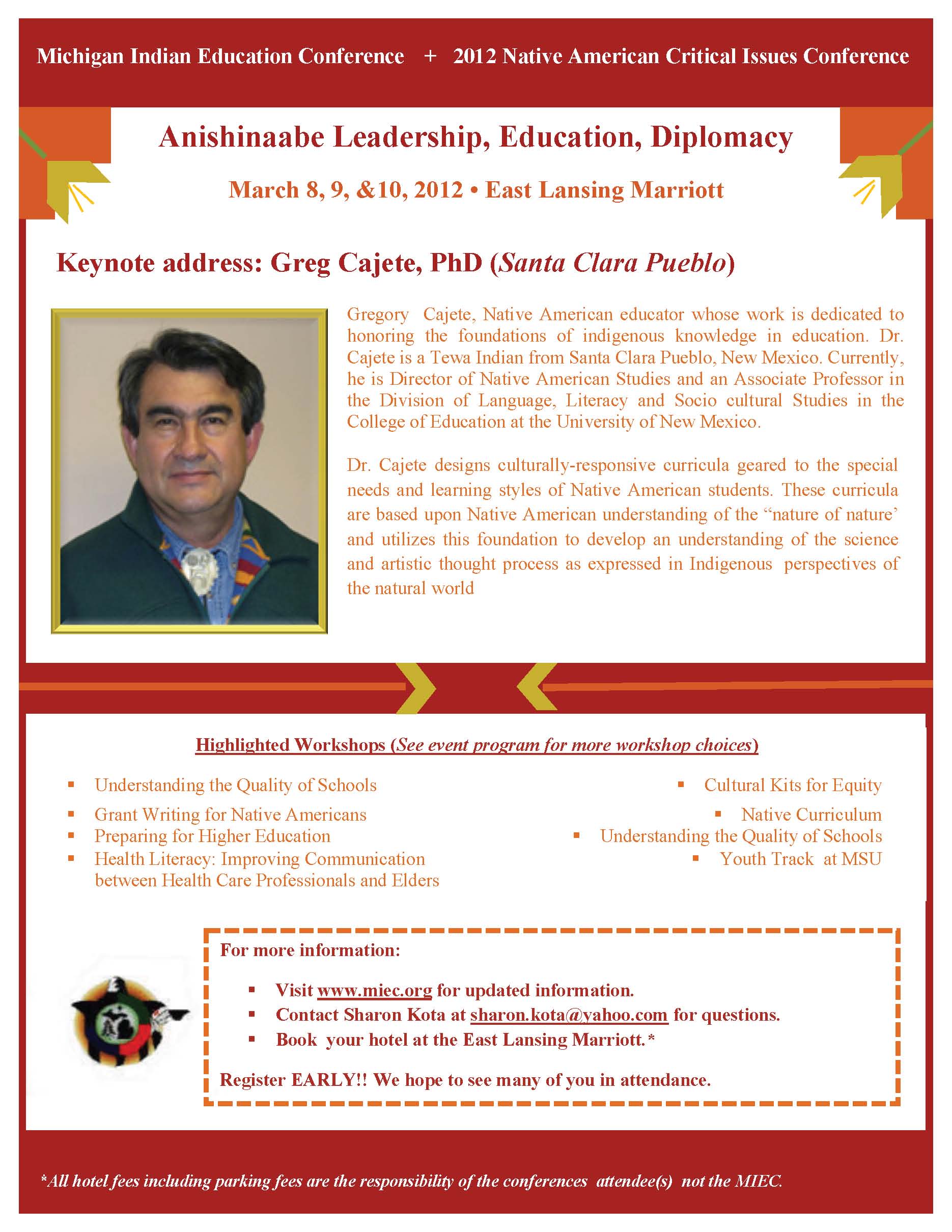
Here is a PDF: MIEC2012
Q&A with Fletcher on Patchak
Here.
News Coverage on Proposed Lansing Casino
Commentary on Sault Tribe’s Proposed Lansing Casino
I can’t not say anything, since this proposed casino is in our own backyard. But seriously? The mayor says in 12-24 months he expects construction to start, and then another year or so after that there will be a fully functioning Indian casino in Lansing.
Wow.
We’re going to predict that it won’t happen. No chance.
Off-reservation Indian gaming is the most hotly-contested, politicized issue in American Indian affairs right now and maybe forever. Think of the interests arrayed against a Lansing casino, let alone one owned by an Indian tribe. The Detroit casinos will be opposed because it will cut into their bottom lines, and the entire City of Detroit, the Michigan Congressional delegation, the unions, everyone will throw their weight against this casino proposal.
More, up north just a few miles is another big problem for the mayor — the Saginaw Chippewa Indian Tribe. They’ll throw their weight against a Lansing casino, too, since a Lansing casino might destroy that tribe’s gaming market. They’ll have nothing to lose by fighting this every step of the way because they will be so severely injured by a Lansing casino that no lobbyist, no lawsuit, nothing will be too expensive to throw at it.
Finally, the law makes this difficult. Been saying this for months now. I suppose Sault Tribe believes, as I imagine the Bay Mills Indian Community does, that Bay Mills will eventually win on its legal theories relating to the Vanderbilt casino. it seems doubtful at best, given that Interior and the NIGC disagree. If that happens, then there will be 10-15 more Indian casinos in and around Lansing, Detroit, Grand Rapids, Muskegon, and so on in the next five years, especially if Bay Mills doesn’t comply with its revenue sharing obligations to the other tribes contained in the 1993 compacts (that’s right, even if they win, they only get one-seventh of the profit — go read section 9 of the 1993 compacts). Really hard to believe that will happen. Let’s set that aside for a minute.
The Sault Tribe will have to purchase land in Lansing, maybe the Lansing convention center or something. Then they’ll have to ask the Secretary of Interior to take the land into trust. And every trust acquisition application for gaming purposes requires an Environmental Impact Statement, and those take a few years to conclude. Once that’s done, the tribe will have to persuade Interior to take this land into trust. And that’s not so easy. The Indian Gaming Regulatory Act requires the governor to concur on any off-reservation gaming proposals. The Secretary has to then agree to take the land into trust, and even then someone in the Michigan Congressional could push through a rider preventing that action. It’s happened before.
And then, assuming the Secretary does take the land into trust, the lawsuits start. Trust acquisitions are governed by the Administrative Procedures Act. Anyone can sue, pretty much. The experiences of the three Potawatomi tribes in Michigan are instructive. The suits take years and years to conclude.
Of course, I’m no political scientist. Politics is money (see Citizens United) and anything can happen, including a backlash against Indian gaming that persuades Congress to ban off-reservation gaming. But the mayor’s three years is a dream, and kind of sick thing to promise to people in Lansing who might believe the mayor and see this as a real possibility for improving their lives.
 Turtle Talk
You must be logged in to post a comment.