Swinomish and Washington State to Co-Manage and Co-Own a New Park

This news is a few months old, but the Swinomish Indian Tribal Community and the Washington State Parks Commission have entered into an intergovernmental agreement to co-manage and co-own a new park within the boundaries of the Tribe’s reservation. Here’s a news article about it.

UPDATE–More information here:

10-036 Swinomish Tribe and State Parks announce joint ownership of Kiket Island

Seattle attorney Quanah Spencer honored by National Center for American Indian Enterprise Development

Another 40 under 40 award, this time for Yakima citizen and tribal attorney Quanah Spencer.  The link is here.

BLT: Cobell Settlement Deadline Extended to Jan. 2011

From BLT:

The extension for congressional authorization of the $3.4 billion settlement in a long-running Indian trust suit in Washington was pushed back today to January 2011, giving Congress more time to examine the deal.

Senior Judge Thomas Hogan of Washington federal district court expressed concern today that Congress has not approved the deal, first announced in December 2009. Hogan met this morning with Justice and Interior department lawyers and attorneys for lead plaintiff Eloise Cobell.

Cobell’s suit, filed in 1996 in the U.S. District Court for the District of Columbia, seeks a historical accounting of billions of dollars held in trust for the use of Indian land for oil, timber and minerals. The terms of the agreement call for $1.5 billion in payment to account holders. Nearly $2 billion would be dedicated to a land consolidation program.

The deadline for congressional authorization has been extended numerous times. Hogan today, repeating earlier public statements, urged Congress to act on the settlement, which he said was negotiated at arm’s length.

A team of Kilpatrick Stockton attorneys, working with D.C. solo practitioner Dennis Gingold, represent Cobell. Deputy Secretary David Hayes of the Interior Department attended today’s session with Interior Solicitor Hilary Tompkins. The plaintiffs’ lawyers, including Gingold and Kilpatrick Stockton partner Keith Harper, met with the government attorneys in Hogan’s chambers for about 30 minutes before holding a public court session.

Continue reading

HNPBI Council Member Named One of “40 Under 40”

From ICT:

The Nottawaseppi Huron Band of the Potawatomi is pleased to announce that Tribal Council Vice Chairperson Jamie P. Stuck has been named as one of the “Native American 40 Under 40” by the National Center for American Indian Enterprise DevelopmentBoard of Directors.

Stuck, who is serving his second term on the NHBP Tribal Council, will accept the award at the 38th Annual Indian Progress in Business awards event at the Hard Rock Hotel and Casino in Albuquerque, N.M., on Oct. 21.

The Nottawaseppi Huron Band of the Potawatomi is the owner and operator of FireKeepers Casino in Battle Creek, Mich.

“It is quite an honor for Tribal Vice-Chairperson Stuck to have been selected to be among the prestigious group of leaders who represent the ‘40 Under 40’ community,” said NHBP Chairperson Homer A. Mandoka.

Continue reading

NARF: Pamunkey Indian Tribes Files for Federal Acknowledgment

From the NARF Press Release:

Boulder, CO – After years of preparing the necessary historical, legal, genealogical and anthropological evidence to fully document its petition for federal acknowledgment, the Pamunkey Indian Tribe, located on the Pamunkey Indian Reservation, Virginia, filed its petition with the Office of Federal Acknowledgment, Bureau of Indian Affairs (BIA) on October 14, 2010. It is the only Indian Tribe located in the Commonwealth of Virginia to have filed a fully documented petition. Established no later than 1646, the Pamunkey Indian Reservation is located next to the Pamunkey River, and adjacent to King William County, Virginia. The Reservation comprises approximately 1,200 acres and is the oldest inhabited Indian reservation in America.

The history of the Pamunkey people is rich and well documented. In the course of collecting evidence for the federal acknowledgment petition, researchers compiled more than a thousand documents recording their existence from the period of first European contact through the present. These documents comprise official censuses, correspondence between the Pamunkeys and officials of the Commonwealth and U.S. governments, numerous newspaper stories, church and school records, books by prominent scholars, popular authors, and federal officials, memoirs and much more. Because of these rich resources, continuous, detailed genealogies have been created for the Pamunkey Tribal members, which trace their lineage back over two hundred years.

Notably, documents have been preserved both in the United States and England that show the continual existence of the Pamunkey Indian Tribe as an independent sovereign since the first visit of Capt. John Smith in 1607, when the English settled Jamestown. At this time, Powhatan, father of Pocahontas, ruled a vast empire which included the great and powerful Pamunkey Indians who were at the core of his empire. A Treaty relationship between the Pamunkeys and Great Britain in 1646, followed by the Treaty of Middle Plantation in 1677, is still honored between the Pamunkeys and the Commonwealth of Virginia. One expression of this continuing relationship is the annual tribute ceremony at Richmond, Virginia where deer and other wild game are presented to the Virginia Governor by the Pamunkey Chief and members of Tribal Council.

Continue reading

Navajo Times: Navajo SCT in Navajo Council’s “Crosshairs”

Additional documents:

NN Pres Press Release onElection of NN Judges

Justice Grant denied appt

Justice Shirley denied appt

From the Navajo Times:

The Navajo Nation Supreme Court is under attack.

Legislation to amend the rules for the Council’s Judiciary Committee governing removal of Supreme Court justices and district court judges is targeting Chief Justice Herb Yazzie, according to a “confidential” memo on the bill.

On Wednesday, the Judiciary Committee voted against the permanent appointment of Associate Justice Louise Grant, although she had resigned Oct. 8 and did not attend the hearing.

A day earlier, the committee voted against permanent appointment of Associate Justice Eleanor Shirley, despite a hearing in which no negative comments or information about her were presented.

According to Navajo law, the president cannot reappoint people to the bench once the Judiciary Committee has voted not to confirm them in a permanent appointment.

Leonard Tsosie (Pueblo Pintado/Torreon/Whitehorse Lake), the only lawyer on the Judiciary Committee, said Tuesday that the committee’s 4-3 vote against Justice Shirley was “revenge” for the Supreme Court’s ruling in favor of President Joe Shirley Jr. (no relation) and against the Council’s position in recent cases.

“The evidence before us didn’t support voting against Justice Shirley,” said Tsosie, one of three committee members who voted to confirm her. “In fact, it was unanimously satisfactory.”

On Wednesday, committee Chairman Kee Allen Begay (May Farms/Round Rock) denied Tsosie’s claim.

“The actions of the committee are not to retaliate against the Supreme Court like honorable Leonard Tsosie claims. The committee acted in the best interest of the Navajo people by upholding trust and being an accountable government,” Begay said. “Honorable Tsosie has a history of instigating arguments if a decision does not benefit his values, belief systems or himself.”

In May, the Supreme Court upheld the lower court’s dismissal of voter Tim Nelson’s complaint seeking to overturn a Dec. 15 election that reduced the 88-member Council to 24.

The high court also ordered the Navajo Election Administration to immediately conduct an election for 24 delegates and not 88, derailing efforts by current Council leaders to postpone the downsizing for four years.

The justices also upheld the lower court decision that the Council illegally placed President Joe Shirley Jr. on leave pending a special prosecutor’s investigation of two business deals that cost the tribe millions.

The high court’s ruling is now being recognized as a landmark decision that addresses the role of Diné Fundamental Law, the encroachment of the Council into the judicial branch, the balance of power between the executive and legislative branches, and the primary role of the Navajo people in shaping their government.

According to Sept. 13, 2010, memo labeled “confidential” and addressed to Chief Legislative Counsel Frank Seanez from Delegate Lorenzo Curley (Houck/Lupton/Nahata Dziil), proposed legislation to amend the Judiciary Committee’s hearing rules is intended “to remove the Navajo Nation Chief Justice.”

Continue reading

Settlement in Indian Farmers Case May Be Close

From Law.com:

The Justice Department is nearing a comprehensive class settlement with a class of Native American farmers who filed a discrimination suit against the federal government in 1999.

Lawyers for the plaintiffs and DOJ attorneys met for a status conference this week in Washington federal district court. A lead plaintiffs’ attorney, Joseph Sellers of Washington’s Cohen Milstein Sellers & Toll, said a settlement is close.

Neither side in the dispute discussed the terms of the proposed settlement in court and Sellers declined to provide specifics about the deal-in-progress after the hearing. He said the settlement, which could impact tens of thousands of farmers, would not require congressional authorization. The suit against the U.S. Department of Agriculture was filed in 1999 in the U.S. District Court for the District of Columbia.
Continue reading

Minnesota Public Radio: White Earth Pushes for More Law Enforcement

From Minn. Public Radio:

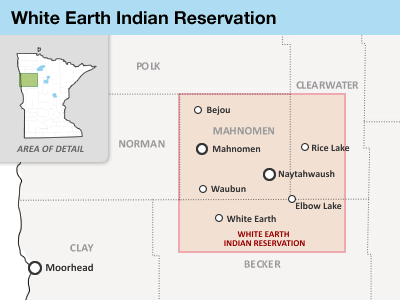
White Earth Indian Reservation, Minn. — Unhappy with the way criminal cases are handled on the White Earth Indian Reservation, tribal officials are seeking more control over law enforcement and the courts.

Tribal officials say local counties don’t prosecute crimes on the reservation aggressively enough.

AN UNEASY RELATIONSHIP

Rape cases particularly are going unpunished on the White Earth reservation, Tribal Attorney Joe Plummer said. Tribal officials want those cases prosecuted to help break the cycle of teen pregnancy and poverty on the reservation.

“These are young girls, 14, 15, 16 years old being impregnated by older men, 21 and older,” Plummer said. “And these are not being prosecuted. I can’t remember when one was prosecuted.”

But county officials strongly disagree. They contend tribal members don’t cooperate with investigators.

The tribe’s dissatisfaction over how criminal cases are handled on the reservation is just one example of the tension between White Earth and Mahnomen County over land, taxes and crime.

“I can’t remember when [a rape case] was prosecuted.”
– Tribal Attorney Joe Plummer

A review of Mahnomen County court records from 2008 to 2009 appears to confirm Plummer’s complaint about the lack of prosecution for criminal sexual conduct cases. But it’s unclear if all of the records from those years are entered in the public database.

When it comes to fighting crime on the White Earth Reservation, counties control the system. The tribe can investigate crimes, but county prosecutors decide who gets charged with a crime.

The two sides often disagree on how cases are handled. It’s one of many areas where the tribe and the county don’t see eye to eye.

COUNTY ATTORNEY: VICTIMS DON’T COOPERATE

Mahnomen County Attorney Julie Bruggeman said she’s not the problem. She said crime victims don’t cooperate with her office.

She also questions whether tribal officials really want justice for all the people accused of a crime. Bruggeman accused tribal officials of wanting to pick and choose who is prosecuted based on tribal connections.

Continue reading

News Coverage of Madison County v. OIN

From How Appealing:

“U.S. Supreme Court to hear Oneida Indian Nation foreclosure case”: The Utica Observer-Dispatch contains this article today.

Sault Tribe v. Bouschor Trial Starts This Week

From the Soo Evening News:

SAULT STE. MARIE — For six years, the Sault Tribe of Chippewa Indians has sought to recover approximately $2.66 million disbursed to former tribal employees — Daniel Green, David Scott, James Jannetta, Daniel Weaver, Paul Shagen, Joseph Paczkowski and Jolene Nertoli — in the wake of former Tribal Chairman Bernard Bouschour’s defeat to Aaron Payment in the 2004 election.

On Wednesday, the tribe will finally get to make it’s case before Judge Charles Johnson in the 50th Circuit Court.

Jury selection is scheduled to begin at 8:30 a.m. with a court official saying the docket is blocked off through Oct. 22 in anticipation of a lengthy civil trial. In one of the rulings leading up to this case, Judge Johnson determined on a motion from the defense that members of the Sault Tribe of Chippewa Indians and those employed by the tribe cannot serve on the jury.

Certain facts regarding this case have never been in dispute. Both sides agree that Bouschor cut large severance checks to high-level employees which allowed them to walk away from their jobs after the chairman was defeated in his re-election bid.

Continue reading