Nick Nehamas’ profile, “The tribe that said no: How one rogue tribal member tried to drag the Oglala Sioux into payday lending.”
News
Northwest Intertribal Court System Appellate Opinions Now Online
Canadian Supreme Court Issues Decision in Tsilhqot’in First Nation Land Claim
Decision here
Held: The appeal should be allowed and a declaration of Aboriginal title over the area requested should be granted. A declaration that British Columbia breached its duty to consult owed to the Tsilhqot’in Nation should also be granted.
***
In finding that Aboriginal title had been established in this case, the trial judge identified the correct legal test and applied it appropriately to the evidence. While the population was small, he found evidence that the parts of the land to which he found title were regularly used by the Tsilhqot’in, which supports the conclusion of sufficient occupation. The geographic proximity between sites for which evidence of recent occupation was tendered and those for which direct evidence of historic occupation existed also supports an inference of continuous occupation. And from the evidence that prior to the assertion of sovereignty the Tsilhqot’in repelled other people from their land and demanded permission from outsiders who wished to pass over it, he concluded that the Tsilhqot’in treated the land as exclusively theirs. The Province’s criticisms of the trial judge’s findings on the facts are primarily rooted in the erroneous thesis that only specific, intensively occupied areas can support Aboriginal title. Moreover, it was the trial judge’s task to sort out conflicting evidence and make findings of fact. The presence of conflicting evidence does not demonstrate palpable and overriding error. The Province has not established that the conclusions of the trial judge are unsupported by the evidence or otherwise in error. Nor has it established his conclusions were arbitrary or insufficiently precise. Absent demonstrated error, his findings should not be disturbed.
APTN story here.
CBC here.
Ambassador Harper delivers Joint Statement on Eliminating Violence Against Indigenous Women and Girls
Here is “Joint Statement on Eliminating Violence against Indigenous Women and Girls.”
The text:
I have the honor to make this statement on behalf 35 countries.
[Albania, Australia, Austria, Belgium, Benin, Bulgaria, Chile, Croatia, Congo, Czech Republic, Denmark, Estonia, Finland, Germany, Greece, Guatemala, Iceland, Italy, Lithuania, the former Yugoslav Republic of Macedonia, Mexico, Moldova, Montenegro, the Netherlands, New Zealand, Norway, Poland, Portugal, Slovenia, Spain, St Kitts and Nevis, Sweden, Switzerland, the United Kingdom, and the United States.]
As we prepare for the upcoming World Conference on Indigenous Peoples, we express great concern that indigenous women and girls often suffer multiple and intersecting forms of discrimination and poverty that increase their vulnerability to all forms of violence. We also stress the need to seriously address the high and disproportionate rates of violence, which takes many forms, against indigenous women and girls worldwide. Indigenous women and girls have the same human rights and fundamental freedoms as everyone else, and a common recognition of those rights must underpin efforts to address violence against indigenous women and girls.
Improving access to justice and empowering indigenous peoples are critical to this effort. We recognize that indigenous peoples themselves may well be in the best position to combat violence against indigenous women and girls. They are closer and better able to address the issue when provided with tools and the legal capability to stop the violence. We will strive to, and encourage other states to, where appropriate, enable and empower indigenous peoples to better address these issues themselves by providing resources, adopting legislation and policies, and taking other necessary steps in an effort to stop the cycle of violence that affects them. We also stress the need for coordination and dialogue between state and indigenous justice institutions to improve access to justice for indigenous women and girls and to enhance awareness campaigns, including ones directed at men and boys.
Ending the global scourge of violence against indigenous women and girls will also require comprehensive support services for survivors and improved data collection to illuminate the scope of the problem. It will demand intensified measures to provide accountability for perpetrators and redoubled efforts to prevent abuse. It will also entail improvements in indigenous women’s access to birth registration. Respecting and promoting reproductive rights – including the right to make decisions concerning reproduction free of discrimination, coercion and violence, and access to comprehensive sexual and reproductive health services – must be integral to our efforts to end violence against indigenous women and girls.
We believe the topic of violence against indigenous women and girls requires greater attention. We encourage the relevant UN mechanisms to recommend ways to use the UN’s existing tools more effectively to prevent and address this serious problem. We also believe the upcoming World Conference on Indigenous Peoples should consider this problem and ways to heighten awareness and respond to this concern throughout the UN system. The meaningful participation of indigenous representatives in the World Conference and its preparatory process will be essential in this regard.
NPR Piece on Aaron Carapella’s Maps
Here.
NYTs on Patty Mills
Here is the New York Times’ excellent article, “Flying 3 Flags and Seeking One Banner: The Diverse Heritage of the San Antonio Spurs’ Patty Mills.”
NARF Press Release re: Hunter Cox
Meet Hunter Cox – Siletz Grant Recipient from the Native American Rights Fund!
Each summer NARF hosts the summer clerkship program, a ten to twelve week program 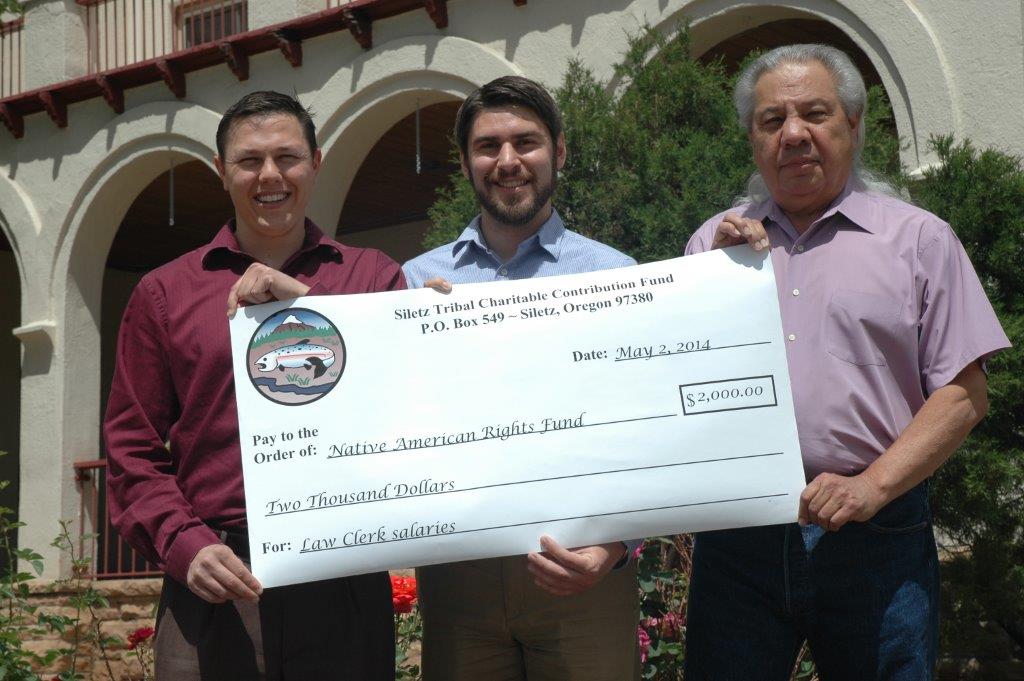 for second year law students. Unlike most law clerk projects that consist mainly of legal research and writing, NARF’s projects are extremely challenging because NARF practices before federal, state, and tribal forums, and because most of its cases – whether at the administrative, trial, or appellate level – are complex and involve novel legal issues.
This summer the law clerk program was supported by a grant from the Confederated Tribes of Siletz Indians through the Siletz Tribal Charitable Contribution Fund. This summer NARF has six law clerks – two in the Alaska office, one in the D.C. office, and three in the Boulder office. Law Clerk Hunter Cox (Prairie Band of Potawatomi Nation), was chosen to be the recipient of this grant due to his recent and impactful work collaborating with NARF attorney Steve Moore to protect the rights of Native high school students to wear their eagle feathers during their graduation ceremony.
Earlier this month, NARF, California Indian Legal Services (CILS), and the American Civil Liberties Union (ACLU) of Northern California advocated on behalf of Native students in Lemoore, California, who wanted to wear eagle feathers at their graduation ceremony. The gift of an eagle feather is a great honor and is typically given to recognize an important transition in a young person’s life. Many graduates are given eagle feathers in recognition of their educational journey and the honor the graduate brings to his or her family, community, and tribe. Hunter, along with Steve, CILS, and ACLU, sent a letter on the students’ behalf requesting the school district to allow the students to wear their eagle feathers during graduation. After initially denying the students requests, the school district relented once receiving the letter, and allowed the students to wear their feathers despite originally denying the students request.
To read the letter sent on the students’ behalf, click here. And, to read the press about the students wearing their feathers, click here.
NARF thanks the Confederated Tribes of Siletz Indians and the Siletz Tribal Charitable Contribution Fund for its grant to further the NARF law clerk program, which allows Native law students to make an impact on Indian law and to Native people during their term at NARF.
CONTACT: For questions regarding eagle feathers – Steve Moore, Native American Rights Fund – 303-447-8760
For questions about NARF’s Law Clerk Program – Matthew Campbell, Native American Rights Fund – 303.447.8760
Eid: “Reasons to be optimistic about Alaska’s public safety crisis”
From the Alaska Dispatch.
An excerpt:
The report of the all-volunteer, bi-partisan commission, “A Roadmap for Making Native America Safer,” highlights Alaska’s violent crime epidemic. This includes a domestic violence rate 10 times the national average and sexual assault rates 12 times higher. It’s a crisis in the Bush, but also in Anchorage and other cities where families flee when village life becomes unbearable. Where criminals keep victimizing women and children because they were never held accountable for their crimes back home.
Randall Akee: “The press for Native Hawaiian federal recognition is presumptuous”
From the Hawaii Independent. A response to this news.
An excerpt:
In moving forward, what should be done? The process for Federal recognition was a knee-jerk reaction to the Rice v. Cayetano decision. Surely there are other legal strategies and plans that the Office of Hawaiian Affairs and State officials can undertake to protect the OHA trust assets and Native Hawaiian entitlement programs. In the 14 years since the decision, the trust and programs have survived without a serious attack. It should be noted that political winds change all the time and there is no absolute certainty with Federal recognition either. For instance, during the 1940s, 1950s and 1960s the US Federal government’s policy was to terminate the legal and political existence of some Federally recognized American Indian tribes in California, Oregon and a number of other US States. During the Civil Rights era of the 1960s and 1970s, the US Federal government made a significant change in that policy and worked to empower tribal governments. However, it is impossible to guarantee that future US Federal policies will not shift back in that direction again.
538 on Impact of Washington Football Team Trademark Decision on National Electoral Politics
In short, virtually none.
Here.
 Turtle Talk
You must be logged in to post a comment.