Here are the materials in Jim v. Shiprock Associated Schools (D.N.M.):
Research
SCOTUS Denies Cert in Four Indian Law Matters (Miccosukee + Jim, ICWA, and Comanche)
Frank Pommersheim Symposium — John Petoskey [the elder]
Frank Pommersheim leads an exemplary life as a poet, Buddhist practitioner, federal Indian law practitioner, tribal judge and Indian law scholar with a demonstrated professorial panache as a law school lecturer, not to mention his many presentations at Indian law conferences, law review articles, tribal court opinions and books over the last 45-50 years. He has participated, collected and systematized Indian law in the tradition of Felix Cohen, shedding light and direction on a fractured Indian law history. Tribal government and Indian law have gone through an enormous change in the last 50 years. Frank, participated in that change with sympathy, empathy and informed advocacy—thinking and guiding the non-Indian and Indian communities through the hard work of seeing each other, and understating each other, across the chasm of a stained history of violence, fear, misunderstanding, and forced accommodation. His scholarly output on developing Indian law and arguments supported Tribes’ and Indians’ assertion of their multiple rights—treaty, tribe, jurisdiction, continued self-determination– to exist in the face of a history of forced Indian trauma, forced land lost, forced cultural destruction, forced loss of children, and so much more; in general, the long curious cruel story of legal conquest in the courts’ and texts’ of the conqueror. Each tribe addresses its unique legal history in the texts of the conqueror, Frank wrote against this tradition of the conquest text, the conqueror’s story of justification. Frank told part of our story from our perspective, legal narrative and analysis in opposition to the continued domination of legal conquest, writing suggesting the possibilities of being an Indian lawyer in resistance to conqueror’s legal narrative that destroyed tribes and Indian people.
Over many years I have been the grateful recipient of his Buddhist Haiku poems to allay my fears, affirm my hopes, to aspire me to be a better person, and to make me see the present in the acts of everyday life. One of his Haiku poem is the sound of a screen door closing late at night of a teenage child’s return from a night out, stopping his unstated fear, Buddha worrying on nothing but inevitable change.
Frank may go out for the night, and I will wait for that sound of the screen door closing of his return, and if not, Buddha said what is the sound of one screen door closing? Who really retires, anyway?
Ninth Circuit Confirms Assimilative Crimes Act Applies in Indian Country
Here is the opinion in United States v. Smith.
Briefs:
MSU Treaty Commemoration Call for Proposals
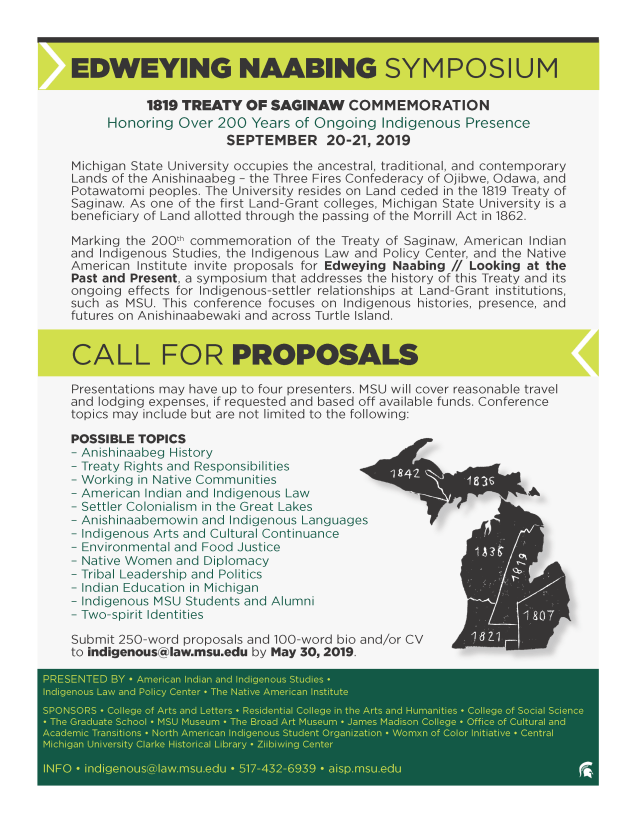
Commemorating the bicentennial of the 1819 Treaty of Saginaw, we invite proposals for the Edweying Naabing Symposium at Michigan State University College of Law. Please submit a 250-word presentation description with 100-word bio to indigenous@law.msu.edu by Thursday, May 30.
Frank Pommersheim Symposium — Angela Riley
I’m not certain of the first time I met Frank, but one of my earliest memories of him is from an Indian law mentoring event at Lewis and Clark Law School, probably around the year 2005. That event, which included other luminaries in the field, was organized by Bob Miller to identify and mentor junior scholars. (I was so inspired by the event, in fact, I copied it years later at UCLA). That symposium was undoubtedly one of the turning points in my career. I was a junior scholar, and, while I had benefited from some professional guidance, I had not received much mentoring around being an Indian Law professor to that point. At that meeting, in particular, I recall I was working out some new ideas that would ultimately turn into my (Tribal) Sovereignty and Illiberalism piece and aid in securing my tenure. I had not yet figured out how to really refine my ideas, and I remember presenting them in sort of a muddle. Instead of harsh criticism, however, the senior colleagues gathered there were encouraging and thoughtful, while pushing for better, clearer ideas, crisper arguments, and deeper thinking.
Frank made an impression on me then, one that has stayed with me. I recall very clearly Frank’s tall, quiet way. His very deep voice, his stylish Western vest, his humble and unassuming demeanor. He had a way about him: earnest and kind, but always with a quiet humor percolating just beneath the surface. I was wowed and intimidated by him in those days, until eventually I found my footing and we became peers and, later, friends. When he published Broken Landscape, I poured through it. Shortly thereafter, I wrote a review of the book, which Matthew has graciously agreed to reprint below. That review highlighted, among the many things I admired about Frank’s excellent book, his clear optimism and sense of hope. As I wrote in 2011:
Broken Landscape is a comprehensive, beautifully crafted, ambitious work that courageously breaks from the swarm of contemporary critique of the Supreme Court’s Indian law jurisprudence. From my vantage point, the most promising thing about Broken Landscape is that it is a beginning, not an end.
For this and other reasons, I still assign it every time I teach my Good Native Governance seminar, introducing students at UCLA, Harvard, and Montana to Frank’s insights.
From that point, Frank became a trusted colleague. I moderated the panel at Fed Bar when he discussed the ideas – along with other scholarly giants, Carole Goldberg and Rebecca Tsosie — and I have referred students to his work countless times. Though I love Broken Landscape, in my view, Frank’s greatest impact is the work he did with and for tribal courts, leaving a truly profound imprint on Indian country. So when he sent me Tribal Justice: Twenty -Five Years as a Tribal Appellate Justice a few years later and asked me to blurb it, I was honored. I remember the plane I was on, flying from Los Angeles to Oklahoma, when I read it. And my words that appear on the back cover are truly from the heart:
Only a poet could so seamlessly intertwine memoir, practical how-to, and grand vision in one remarkable book about law and life in Indian country. Tribal Justice is deeply compelling, taking the reader on a more than quarter-of-a-century ride through an extraordinary career devoted to tribal law and the people from which it springs.
I have to say, I felt a little forlorn that Frank did not allow an event to celebrate his greatness and his mark on Indian country. So I was delighted and honored when Matthew told me he would be putting this incredible collection together on Turtle Talk and asked if I want to contribute. I jumped at the chance.
Though there are volumes of things one could say to honor Frank, I’ll say this. Frank is a poet, a dreamer, a visionary, a teacher, an intellectual, a pragmatist, and a friend. But of all of his remarkable qualities, I have probably been most influenced by one characteristic that stands out above all others to me. That is respect. As his entire career – and certainly his work on tribal courts – reflects, Frank holds enormous respect for the world around him, for his place on the planet in relation to other living things, and, most of all, for Indian people. In conversation and in his writing, Frank always speaks of Indian people, of reservation life, of tribal justice systems, of indigenous (and other) cultural and spiritual commitments, with the deepest respect. In my experience, that is the foundation for understanding and connection in this oftentimes fragmented and disassociated world that keeps us so lacking in empathy and gratitude. Frank taught respect by showing respect.
Like Broken Landscape, this chapter of Frank’s journey undoubtedly is a beginning, not an end. I will follow that journey with rapt attention. And I extend my deep respect to Frank and thank the Creator who made him. Jagenagenon.
Supreme Court Denies Cert in Carter v. Washburn (Sweeney) [ICWA Class Action]
Maggie Blackhawk: “The Indian Law That Helps Build Walls”
Here, in the New York Times.
Frank Pommersheim Symposium — Gloria Valencia-Weber
An Ode to Frank Pommersheim from a Grateful Non-Poet Law Professor
Caveat: It is impossible to properly title you. Long ago you went beyond a mere Indian Law professor. Unquestioned, we are all in your debt for the great law professor stuff.
FRANK
Engaged in the imaginative reach past the everyday task of thinking hard about Native Americans and their misadventures among the centuries of U.S. law.
Who keeps asking the “why not” questions. Challenging us by invoking alternative ways to look at the real-life quandary facing the now-breathing persons caught in a tribal law problem that sometimes spins out into the perilous space of state and federal law.
Propagating reality- based contemplations that do not allow the evasive work around if justice is to be delivered and made real among the living.
Then you take us along on the ultimate personal poetic spin into a universe of nature and ancient wisdom from other lands and cultural imaginations.
Creating missals of non-rhyming poetry that fly into your life at just the right moment. They have gently landed in my life at times when it seemed you knew there were some rough patches to overcome.
Even the paper was comforting to hold. The poetics soothed the momentary not-really a crisis as well as the absolutely a crisis. Later readings produce a contemplative appreciation of the “then” moment and where one is now.
Gratitude when words are inadequate.
Friday Job Announcements
Any posts received prior to 12pm EST on Friday will appear in that week’s announcements. If you would like to submit a post for an open Indian law or leadership job, please send the following to indigenous@law.msu.edu:
- In the email body, a typed brief description of the position which includes position title, location, main duties, and closing date;
- An attached PDF job announcement.
Earthjustice
Staff Attorney, Florida Regional Office, Miami, FL. Manage new and existing cases from start to finish, performing all aspects of litigation, including: drafting pleadings, motions, and briefs; conducting discovery; presenting oral arguments; and handling appeals. Conduct factual investigations and develop legal theories for possible advocacy or litigation advancing the goals of our clients. For more information please see the job description, and apply here. Application is open until filled.
Associate Attorney, Denver, CO. Work closely with Staff Attorneys and clients to investigate, develop, and prosecute cases. Participate in the full range of tasks involved in complex litigation, including factual investigation, legal research and analysis, discovery, briefing, and oral advocacy. For more information please see the job description for more information, and apply here. Application is open until filled.
Colorado Policy Advocate, Denver, CO. Develop and implement legislative and administrative strategies to advance our positions on environmental issues. Directly lobby the Colorado legislature, Governor’s Office, and key administrative agencies and commissions. Track and analyze legislation relating to assigned issues. For more information please see the job description, and apply here. Application is open until filled.
Little River Band of Ottawa Indians
Tribal Council Legal Services, Manistee, MI. Provide legal counsel, guidance, and direction for Tribal Council and Legislative Branch where the Unified Legal Department is prohibited from participating. The application closing date is June 17, 2019. Please see the job description for more information.
Chemehuevi Indian Tribe
RFP, Attorney for the Chemehuevi Gaming Commission, Havasu Lake, CA. Searching for an experienced attorney with a minimum of 5 years’ experience in California gaming. Attorney will be on on-call bases and be able to provide legal advice and directions. For more information please see the description. Deadline for submission is Friday June 28, 2019.
See posts from May 20, 2019.
 Turtle Talk
You must be logged in to post a comment.