Gregory Alexander on the Complexities of Land Reparations

Gregory S. Alexander has posted his paper, “The Complexities of Land Reparations,” on SSRN.

Here is the abstract:

The question whether unjust dispossessions of land perpetrated on whole peoples in the past should be corrected by restitution in kind, that is, granting reparations in the form of returning land to the dispossessed former owners or their present-day successors is substantially more complex than the questions posed by other forms of reparations. I argue that the complexities involved in all of the situations where claims for land reparations are made to correct historic injustices give us good reasons to be hesitant about granting such claims. At the same time, we should not dismiss such claims out of hand. Reparations which take a form other than restitution of dispossessed land may be both necessary and sufficient to establish a public marker of acknowledgment.

Top 20 SSRN Indian Law Papers in 2012 (So Far)

Here are the top 20 papers, by download (a lousy indicator, but I’m procrastinating right now so work with me). I included papers on American Indian law, though I included papers on international law so long as they included some discussion of American Indian tribes, and excluded papers published prior to 2012, and my own papers (tacky).

From here:

Jurisdiction, Crime, and Development: The Impact of Public Law 280 in Indian Country
Valentina P. Dimitrova-Grajzl , Peter Grajzl and A. Joseph Guse
Virginia Military Institute , Washington and Lee University – Department of Economics and Washington and Lee University – Williams School of Commerce, Economics, and Politics
Date Posted: June 26, 2012
Last Revised: September 18, 2012
Working Paper Series
168 downloads

Clarence Thomas’s Originalist Understanding of the Interstate, Negative, and Indian Commerce Clauses
University of Detroit Mercy Law Review, Vol. 88, No. 769, 2011
Ralph A. Rossum
Claremont McKenna College
Date Posted: June 17, 2012
Accepted Paper Series
144 downloads

‘The Tale of the Tribe and the Company Town’: What We Can Learn About the Workings of Whiteness in the Pacific Northwest
Oregon Law Review, Vol. 90, No. 5 (2012), Gonzaga University School of Law Research Paper No. 2012-6
John Shuford
Gonzaga University – Department of Philosophy
Date Posted: July 25, 2012
Last Revised: August 01, 2012
Accepted Paper Series
135 downloads

What’s at Stake for Tribes? – The U.S. Department of Justice Office of Legal Counsel Opinion on Internet Gaming, Testimony of Dean Kevin K. Washburn, Oversight Hearing Before the United States Senate Committee on Indian Affairs, 112th Congress, Second Session
UNM School of Law Research Paper No. 2012-04
Kevin K. Washburn
University of New Mexico – School of Law
Date Posted: February 07, 2012
Last Revised: April 20, 2012
Accepted Paper Series
113 downloads

Unjustifiable Expectations: Laying to Rest the Ghosts of Allotment-Era Settlers
36 Seattle U. Law Rev. 129 (2012).
Ann E. Tweedy
Hamline University School of Law
Date Posted: February 17, 2012
Last Revised: October 06, 2012
Accepted Paper Series
106 downloads

Globalization and its Special and Significant Impacts on Indigenous Communities
Arizona Legal Studies Discussion Paper No. 12-19
Robert Hershey
University of Arizona – James E. Rogers College of Law
Date Posted: May 29, 2012
Working Paper Series
104 downloads

Priceless Property
Georgia State University Law Review, Forthcoming, Wayne State University Law School Research Paper No. 2012-03
Kirsten Matoy Carlson
Wayne State University Law School
Date Posted: March 28, 2012
Last Revised: May 09, 2012
Working Paper Series
104 downloads

Political Science and the Study of Indigenous Politics
Kevin Bruyneel
Babson College
Date Posted: May 18, 2012
Last Revised: October 29, 2012
Working Paper Series
101 downloads

The Meaning of Due Process in the Navajo Nation
The Indian Civil Rights Act at Forty (UCLA American Indian Studies Center Publications) 2012
Paul Spruhan
Navajo Nation Department of Justice
Date Posted: March 29, 2012
Accepted Paper Series
91 downloads

Limiting Principles and Empowering Practices in American Indian Religious Freedoms
Connecticut Law Review, Vol. 45, No. 2, Forthcoming 2012
Kristen A. Carpenter
University of Colorado Law School
Date Posted: March 04, 2012
Last Revised: May 08, 2012
Accepted Paper Series
85 downloads

Continue reading

New Scholarship by Sarah Krakoff on Race, Tribal Membership, and Tribal Sovereignty

Sarah Krakoff has posted her new paper, “Inextricably Political: Race, Membership and Tribal Sovereignty,” forthcoming from the Washington Law Review, on SSRN. Here is the abstract:

Courts address equal protection questions about the distinct legal treatment of American Indian tribes in the following dichotomous way: are classifications concerning American Indians “racial or political?” If the classification is political (i.e. based on federally recognized tribal status or membership in a federally recognized tribe) then courts will not subject it to heightened scrutiny. If the classification is racial rather than political, then courts may apply heightened scrutiny. This article challenges the dichotomy itself. The legal categories “tribe” and “tribal member” are themselves political, and reflect the ways in which tribes and tribal members have been racialized by U.S. laws and policies.

First, the article traces the evolution of tribes from pre-contact independent sovereigns to their current status as “federally recognized tribes.” This history reveals that the federal government’s objective of minimizing the tribal land base entailed a racial logic that was reflected in decisions about when and how to recognize tribal status. The logic was that of elimination: Indian people had to disappear in order to free territory for non-Indian settlement. The Article then examines two very distinct tribal places, the Colorado River Indian Tribes’ (CRIT) reservation and the former Dakota (Sioux) Nation of the Great Plains. The United States’ policies had different effects on the CRIT (where four distinct ethnic and linguistic groups were consolidated into one tribe) and the Sioux (where related ethnic and linguistic groups were scattered apart), but the causal structures were the same. Indian people stood in the way of non-Indian settlement, and federal policies defined tribes and their land base with the goal of shrinking both. Despite these goals, the CRIT and Sioux Tribes have exercised their powers of self-governance and created homelands that foster cultural survival for their people. Like other federally recognized tribes, they have used the given legal structure to perpetuate their own forms of indigenous governance, notwithstanding the law’s darker origins.

The legal histories of CRIT and the Sioux Tribes reveal that unraveling the logic of racism in American Indian law has less to do with tinkering with current equal protection doctrine than it does with recognizing the workings of power, politics, and law in the context of the United States’ unique brand of settler colonialism. The way to counter much of the prior racial discrimination against American Indians is to support laws that perpetuate the sovereign political status of tribes, rather than to dismantle tribes by subjecting them to judicial scrutiny in a futile attempt to disentangle the racial from the political.

HIGHLY recommended!

Scholarship Amusement: Voters Reward Incumbents When Local College Sports Teams Win the Weekend before Election Night

Here. H/T Bleeding Heart Libertarians.

Hate to say it (HATE to say it), but Go Buckeyes for one weekend (this weekend only). Luckily, they’re playing a team I dislike even more, the Illini.

Incidentally, we were at the game when Michigan beat Illinois by 100 touchdowns or so a few weeks ago.

Those people down in the end zone are the Michigan students who were in the 2012 Summer Olympics. They also cover kickoff returns.

Dr. Nick Reo’s New Program at Dartmouth!

Our Turtle Talk friend Dr. Nick Reo has started a new website — Ecosystems, Societies & Knowledge research group. Check it out.

Here’s Nick (right) exploring an ecosystem:

Here’s the program description:

Our group works with American Indian Tribes and other Native peoples on applied research concerning the management and use of natural resources. We explore the application, preservation and outcomes of traditional resource management systems that are embodiments of tribal traditional ecological knowledge. We also study the political interactions that occur between tribes and their neighbors surrounding natural resource issues, including cross-boundary cooperation, conflict and co-management of ecosystems and subsistence resources.


Forthcoming Book on Individuals Who Preserved Tribal Sovereignty

We are watching for the release next year of “Our Cause Will Ultimately Triumph”: The Men and Women who Preserved and Revitalized American Indian Sovereignty, edited byTim Alan Garrison. It is forthcoming from Carolina Academic Press in 2013.

MSU alum and TT contributor Adrea Korthase has written a chapter on Michigan’s own Michael Petoskey, legendary tribal judge.

The first chapter available is on Eloise Cobell, written by Bethany Berger.

Michigan Radio: Great Lakes Futures Project

Another story from Michigan Radio this morning. We hope the January meeting will include invitations to tribes as well.

A new project is going to try to predict the future of the Great Lakes.

It’s called… wait for it… the Great Lakes Futures Project.  It’s a collaboration of 21 universities from the U.S. and Canada.

Don Scavia is the director of the Graham Sustainability Institute at the University of Michigan. He’s one of four project leaders.  He says students will team up with a counterpart from the other country, along with a faculty mentor.  The teams will develop white papers outlining the biggest things driving change in the Great Lakes region.

“They’ll be looking at things like climate, economics, demographics, chemical and biological pollution, invasive species. Looking back, what have the trends been in the past 50 years and what do we expect trends to look like in the next 50 years?”

Tom Gede on the Problems with an Oliphant Fix

Tom Gede has published “Criminal Jurisdiction of Indian Tribes: Should Non-Indians Be Subject to Tribal Criminal Authority Under VAWA?” in ENGAGE: The Journal of the Federalist Society Practice Groups.

Here is a sampling:

As a policy matter, Congress must consider whether the “relaxing” of restrictions on inherent tribal criminal jurisdiction over non-Indians is warranted, given that it would subject non-Indian citizens to the authority of an extraconstitutional sovereign to which they had not previously been subject, and where the customary guarantees of federal constitutional protections may be questioned. Unlike the Duro-fix, which related to non-member Indians, a full or partial Oliphant-fix that relies on reaffirming inherent tribal criminal jurisdiction will bring significant constitutional and prudential questions that will likely have to be tested at the highest levels. An Oliphant-fix that grants federal delegated authority to tribal governments and includes federal appellate review likely will be more palatable to non-Indians and to a Supreme Court that looks to constitutional structure guarantees, among others, but does nothing to respect tribal sovereignty. The real question ought to be what instrument most effectively and expeditiously permits the local prosecution and punishment of domestic violence and sexual assault and other crimes committed by non-Indians in Indian country.

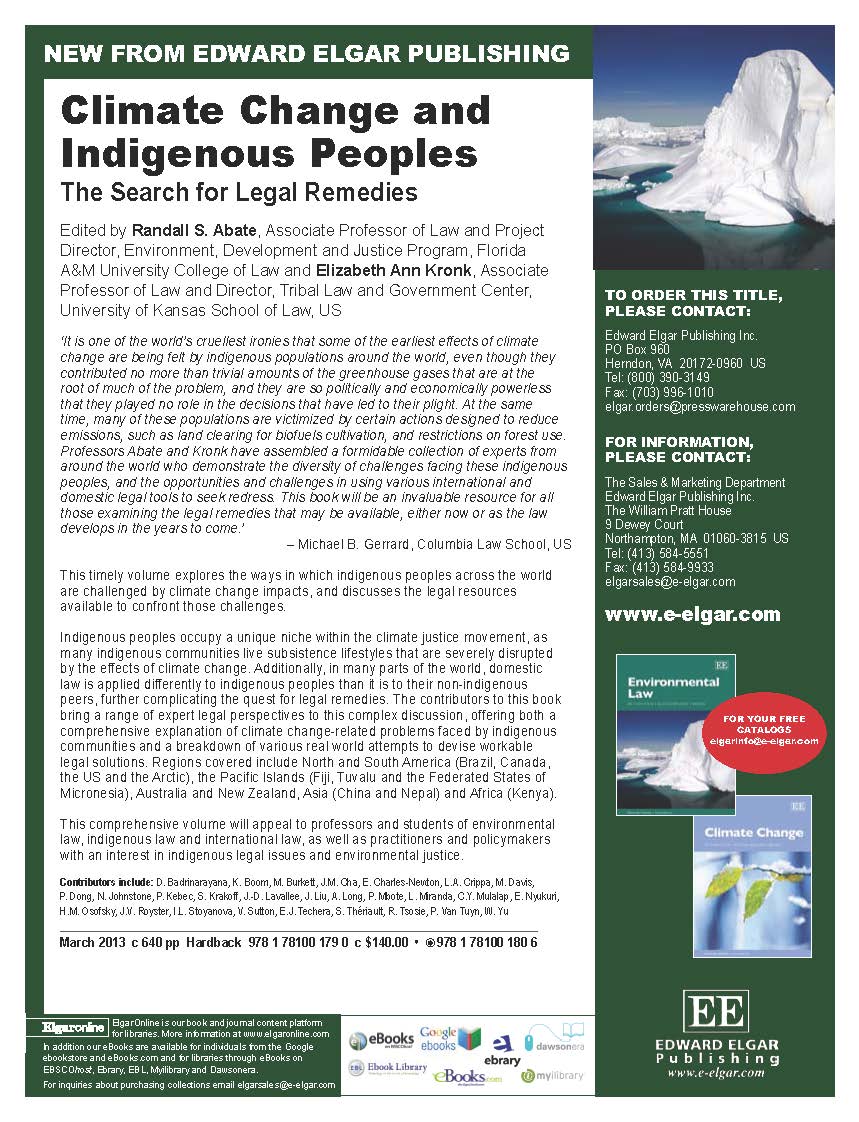
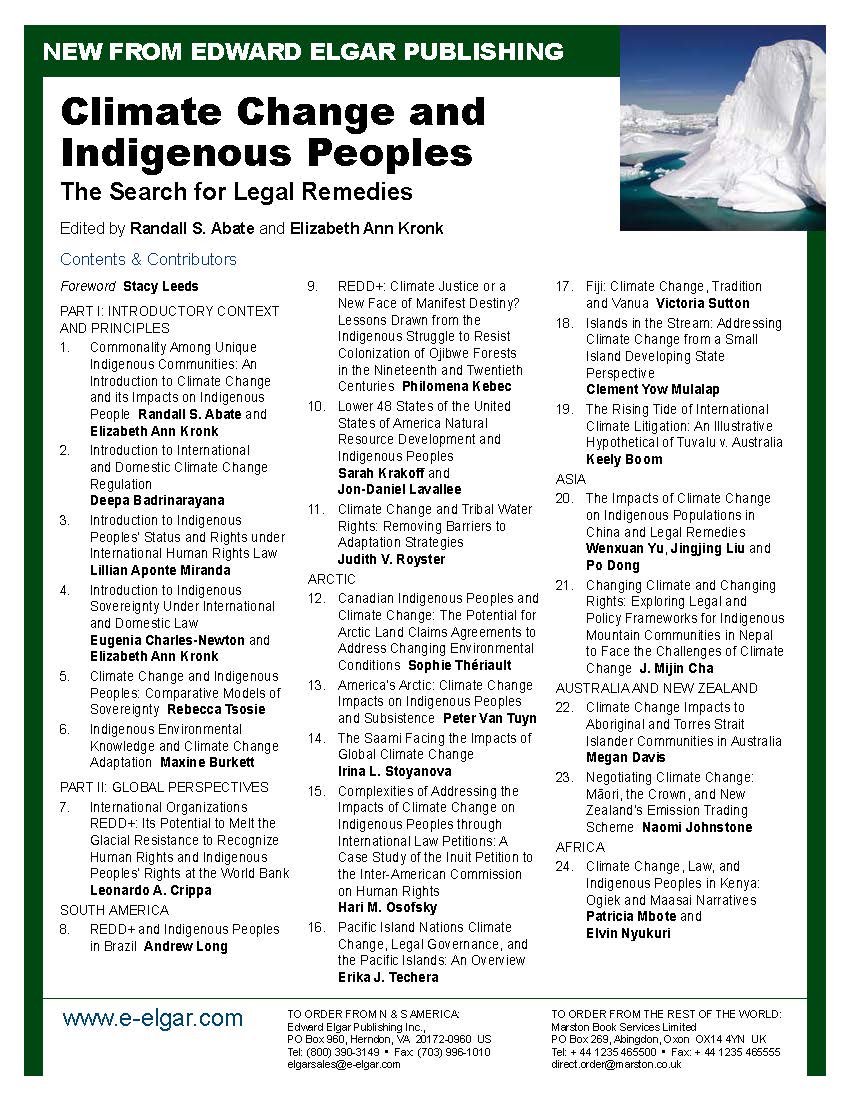
Forthcoming Book Announcement: “Climate Change and Indigenous Peoples” (Abate & Kronk, eds.)

Flyer here: Abate & Kronk – Flyer for North and South America – Aug. 12

On Localist Judging and Tribal Courts

There’s new and interesting scholarship on something called “Localist Statutory Interpretation” on SSRN. Here is the abstract:

This paper argues for more attention to citizens’ point of contact with our legal system within local courts – and makes an effort to conceptualize local judges as parts of local governments. Once the paper highlights the role of local courts within the constellation of local government, it offers an argument for why certain forms of “localist judging” are appropriate postures for local judges to take when confronted with hard cases of statutory interpretation. The paper explores the virtues of a type of “intrastate judicial federalism.”

I’m interested in the application of these ideas to tribal courts. I don’t think the paper’s author intends to comprehensively theorize how local judges can engage in “localist judging,” and therefore the paper has limited or no utility for tribal judges, but it does raise several important points.

First, the Tribal Law and Order Act amended the Indian Civil Rights Act to include this requirement for tribes who want to exercise enhanced sentencing authority:

In a criminal proceeding in which an Indian tribe, in exercising powers of self-government, imposes a total term of imprisonment of more than 1 year on a defendant, the Indian tribe shall … require that the judge presiding over the criminal proceeding–(A) has sufficient legal training to preside over criminal proceedings; and (B) is licensed to practice law by any jurisdiction in the United States….

The bold language is what’s confusing to the tribes thinking about using the enhanced sentencing provisions (that apparently there is a verb tense agreement problem will only bother Bryan Garner). I have been asked about this provision a couple times in the last week. I am glad to report someone smarter than I shares my view on this question (quoting from footnote 19 in the paper linked above):

I am here avoiding the debate about whether it is sound (or constitutional) to have lay people adjudicating cases in the legal system. See Gordon v. Justice Court, 525 P.2d 72 (Cal. 1974) (holding that it is a violation of the federal Constitution to allow non-attorney judges to sit in judgment over criminal defendants for offenses punishable by incarceration); North v. Russell, 427 U.S. 328 (1976) (suggesting that it is not unconstitutional, so long as de novo review is available in a court with a legally-trained judge); City of White House v. Whitley, 979 S.W.2d 262 (Tenn. 1998) (rejecting the logic of North and finding non-lawyer adjudications imposing jail time to violate Tennessee’s Constitution). New York has many village and town courts without lawyer adjudicators – and given the New York Times reporting several years ago, supra note 2, it is hard to think it is anything but a scandal.

There’s my answer in there, again in bold, to the question whether tribes can utilize enhanced sentencing provisions through judges who are not lawyers licensed by a state bar.

Second, I am concerned about the sometimes extreme disadvantage Indian tribes and individual Indians have in “local” (read: non-Indian) courts. Perhaps the days of local judges disregarding treaty rights are largely over, but local judges routinely, openly, and notoriously disregard and denigrate the Indian Child Welfare Act. Recently, the South Dakota Supreme Court refused to intervene in what appears to be exactly the kind of open hostility of ICWA. Plus, there was that weird Iowa magistrate judge who just pointedly refused to acknowledge blackletter federal Indian law as some sort of manifesto against the Iowa Supreme Court’s recognition of the right to same-sex marriage.

Third, I’m not at all down on this paper. Tribal courts are the epitome of localist judging. The material within the paper on the role of local judges changing depending on whether or how they are elected or nominated would be interesting reading for tribal judges who are serious about understanding their role in tribal communities. It’s a pretty short paper, and I urge tribal judges and tribal court practitioners to take a look.