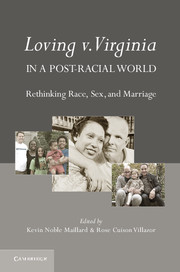
New Book: Loving v. Virginia in a Post-Racial World

Congrats to Kevin and Rose!!!! Book website here. Excerpt here.

Loving v. Virginia in a Post-Racial World

Rethinking Race, Sex, and Marriage
  • Edited by: Kevin Noble Maillard, Syracuse University, School of Law
  • Edited by: Rose Cuison Villazor, Hofstra University, School of Law

In 1967, the U.S. Supreme Court ruled that laws prohibiting interracial marriage were unconstitutional in Loving vs. Virginia. Although this case promotes marital freedom and racial equality, there are still significant legal and social barriers to the free formation of intimate relationships. Marriage continues to be the sole measure of commitment, mixed relationships continue to be rare, and same-sex marriage is only legal in 6 out of 50 states. Most discussion of Loving celebrates the symbolic dismantling of marital discrimination. This book, however, takes a more critical approach to ask how Loving has influenced the “loving” of America. How far have we come since then, and what effect did the case have on individual lives?

Harvard Law Review Profiles (and Lauds) Stephen Pevar’s Updated “Rights of Indians and Tribes”

Here. An excerpt:

In this updated edition of his landmark 1983 work, Stephen L. Pevar continues his decades-long effort to distill the intricacies of Indian law into an easy-to-understand format that will help Indian tribes vindicate their rights and their sovereignty. Mr. Pevar concisely explains important concepts in Indian law through a question-andanswer format, drawing on history, case law, legal scholarship, and sociology to explain not only what the state of Indian law is, but also why it has come to be that way, taking into account major recent developments in Indian law. While Mr. Pevar is proud of the progress Indian civil rights activists have made since the “termination era” of 1953 to 1968, which he describes in scathing terms, he also expresses fear for the future of Indian rights and sovereignty, which he views as threatened by a conservative Supreme Court and aggressive federal legislators (pp. 11–15). The book contains a number of useful maps, lists, and charts, as well as the texts of major Indian law statutes and over 130 pages of helpful footnotes. Mr. Pevar’s work will be of interest to legal scholars, historians, Indian law litigators, and Indian rights activists alike.

More details about Stephen’s book here.

Judge Matthew Martin on the Origins of Westernized Tribal Jurisprudence

EBCI Judge J. Matthew Martin continues his interesting scholarly work in the legal histories of tribal justice systems with “Chief Justice John Martin and the Origins of Westernized Tribal Jurisprudence,” recently published in the Elon Law Review.

From the article:

Judge John Martin created the modern Tribal Court. This template, still in use today, envisions a Court based on notions of jurisprudence easily recognizable to western eyes, yet leavened with aspects of Tribal culture and tradition. The model comprises a Court system that is familiar and dedicated not only to sovereignty, but also to defiance. The significance of the beginnings of the modern Tribal Court has been consistently underestimated, particularly by the Supreme Court of the United States. John Martin’s crucial role in it has largely been forgotten.

Angela Riley’s “Indians and Guns” Just Published

Angela Riley has published “Indians and Guns” in the Georgetown Law Journal.

Here is the abstract:

The Supreme Court’s recent Second Amendment opinions establish a bulwark of individual gun rights against the state. District of Columbia v. Heller confirmed that the Second Amendment guarantees an individual the right to bear arms for self-defense, and the Court applied this analysis to the states via incorporation theory two years later in McDonald v. City of Chicago. As a result of these cases, it is often assumed that individual gun rights now extend across the United States. But this conclusion fails to take account of a critical exception: Indian tribal nations remain the only governments within the United States that can restrict or fully prohibit the right to keep and bear arms, ignoring the Second Amendment altogether. Indian tribes were never formally brought within the U.S. Constitution; accordingly, the Second Amendment does not bind them. In 1968, Congress extended select, tailored provisions of the Bill of Rights to tribal governments through the Indian Civil Rights Act but included no Second Amendment corollary. As a result, there are over 67 million acres of Indian trust land in the United States, comprising conspicuous islands within which individuals’ gun rights are not constitutionally protected as against tribal governments. With Indian nations thus unconstrained—bearing in mind that gun rights and regulations are oftentimes set by tribal law—pressing questions regarding gun ownership and control arise for those living under tribal authority.

Gonzaga Law Review Publishes Indian Law Symposium Issue

Here is their press release, with links to the articles:

Modern Issues of Tribal Sovereignty and Jurisdiction

This month, the Gonzaga Law Review published its first issue devoted to Indian Law, titled Modern Issues of Tribal Sovereignty and Jurisdiction.  The issue features professor Joshua Jay Kanassatega’s case for a new application of the abstention doctrine—one in which federal and state courts should dismiss civil actions better left to the courts of the Indian tribes.  In a separate piece, Winter King, Eric Shepard, and Rob Roy Smith examine the 2011 Ninth Circuit Court of Appeals’ decision in Water Wheel Camp Recreational Area, Inc. v. LaRance.  The authors, who served as counsel for the Colorado River Indian Tribes and other amici in Water Wheel, explain that the Ninth Circuit’s decision has reinvigorated the oft-forgotten authority of Indian tribes to assert regulatory and adjudicatory jurisdiction over nonmembers using a tribe’s inherent authority to exclude.

These articles and the rest of the issue’s contents can be found at http://gonzagalawreview.org/.  Requests for print copies should be sent to Gonzaga Law Review, Gonzaga University School of Law, P.O. Box 3528, Spokane, WA 99220-3528 or by email to lawreview@lawschool.gonzaga.edu.

Important New Empirical Research on PL280’s Impact on Indian Reservation Crime and Economies

Valentina P. Dimitrova-Grajzl, Peter Grajzl, and A. Joseph Guse, have posted “Jurisdiction, Crime, and Development: The Impact of Public Law 280 in Indian Country” on SSRN. Here is the abstract:

Public Law 280 transferred jurisdiction over criminal and civil matters from the federal to state governments in selected parts of Indian country. Where enacted, the law fundamentally altered the pre-existing legal order. Public Law 280 thus provides a unique opportunity to study the impact of legal institutions and their change on socio-economic outcomes. The law’s controversial content has attracted interest from legal scholars. However, empirical studies of its impact are scarce and do not address the law’s endogenous nature. We examine the law’s impact on crime and on economic development in U.S. counties with significant American Indian reservation population. To address the issue of selection of areas subject to Public Law 280, our empirical strategy draws on the law’s politico-historical context. We find that the application of Public Law 280 increased crime and lowered incomes. The law’s adverse impact is robust and noteworthy in magnitude.

This is perhaps the most important piece of empirical scholarship on Public Law 280 in that the researchers are not recognized as supporting either side, as far as I can tell.

New Scholarship on Tribal Court Contempt Power over Nonmembers

The North Carolina Law Review has published “The Jurisdictional ‘Haze’: An Examination of Tribal Court Contempt Powers Over Non-Indians.”

Here is the abstract:

Recently, in the case of In re Russell, the Cherokee Tribal Court confronted the thorny issue of criminal contempt­. The court ruled that because all courts’ criminal contempt powers are inherent, they fall outside the scope of Oliphant. This Recent Development argues, however, that while imprecise facets of Oliphant and contempt law would make it appropriate for the Cherokee Tribal Court to claim power over summary criminal contempt prosecutions of non-Indians in some circumstances, the court’s blanket decree that criminal contempt is always within a tribal court’s jurisdiction runs counter to current law.

Part I presents the facts of the Cherokee Tribal Court’s order in In re Russell as the backdrop for a discussion of the interplay between contempt law and tribal court jurisdiction. Part II provides a brief overview of tribal criminal court jurisdiction under the Supreme Court’s ruling in Oliphant. Part III surveys the history of contempt law, explaining the sometimes subtle differences between the types of contempt proceedings and how they are jurisdictionally determinative in tribal courts. Part IV applies the principles of Oliphant and contempt law to In re Russell, explaining why the Cherokee Tribal Court stepped beyond its jurisdictional limitations in the case. Part IV concludes by setting forth ways in which tribal courts can, consistent with Oliphant, enforce their authority through their contempt powers.

We will post a PDF of the article once we get it. If, that is.

We do have the order that inspired this article, and it is here.

Nathalie Martin and Joshua Schwartz on the Implications of Tribal Payday Lending

Nathalie Martin and Joshua Schwartz have posted their paper, “The Alliance between Payday Lenders and Tribes: Are Both Tribal Sovereignty and Consumer Protection at Risk?,” on SSRN. The paper appears in the Washington & Lee Law Review. Here is the abstract:

This article explores how tribal sovereign immunity is being used in the context of payday lending to avoid state law and explores the ramifications of this for both consumer-protection regulation and tribes. It discusses payday loans and tribal sovereignty generally, as well as tribal sovereign immunity, then discusses what might be done to address this consumer protection issue. More specifically, we discuss who in society has the power and resolve to dissolve this alliance, identifying tribes themselves, the Supreme Court, Congress, the Federal Trade Commission, and the Consumer Financial Protection Bureau as possibilities.

This is an important piece of scholarship from balanced scholars. Some tribal leaders and lawyers are thinking that payday lending is the new gaming for Indian country, but there seems to me that a certain amount of consent is missing in the way some payday lenders are behaving. I don’t think we saw the extent of bad faith in the early days of Indian gaming that we are sometimes seeing now with some of these tribal payday lenders. It’s important for Indian country as a whole to come together on this question as soon a possible, or else Congress will.

Ralph Rossum on Justice Thomas’ Views of the Three Commerce Clauses

Ralph A. Rossum (author of the definitive legal history of California v. Cabazon Band) has posted his paper, “Clarence Thomas’s Originalist Understanding of the Interstate, Negative, and Indian Commerce Clauses,” on SSRN. It is available in the University of Detroit Mercy Law Review. (Hat tip)

Here is the abstract:

During his twenty years on the Supreme Court, Justice Clarence Thomas has pursued an original understanding approach to constitutional interpretation. He has been unswayed by the claims of precedent — by the gradual build-up of interpretations that, over time, completely distort the original understanding of the constitutional provision in question and lead to muddled decisions and contradictory conclusions. Like too many layers of paint on a delicately crafted piece of furniture, precedent based on precedent — focusing on what the Court said the Constitution means in past cases as opposed to focusing on what the Constitution actually means — hides the constitutional nuance and detail he wants to restore. Thomas is unquestionably the Justice who is most willing to reject this build-up, this excrescence, and to call on his colleagues to join him in scraping away past precedent and getting back to bare wood — to the original understanding of the Constitution.

In what follows, Section I describes Thomas’s originalism and contrasts it with Antonin Scalia’s different kind of originalism. Section II explores Thomas’s originalist understanding of the limits of Congress’s power under the Interstate Commerce Clause. Section III focuses on Thomas’s rejection of the Court’s claim of power to invalidate state laws burdening interstate commerce under the negative Commerce Clause on originalist grounds. Section IV addresses Thomas’s rejection of the view that the Indian Commerce Clause gives the Congress plenary power in Indian country and his call in United States v. Lara for the Court to “examine more critically our tribal sovereignty case law.” Section V concludes.

I think Prof. Rossum is spot on when it comes to the Indian Commerce Clause, especially in terms of his excellent description of how the First Congress passed a whole series of statutes involving Indian affairs culminating in the first Trade and Intercourse Act.

Fletcher on NAICJA/Getches’ “Indian Courts and the Future”

I posted my University of Colorado Law Review symposium paper, “Indian Courts and Fundamental Fairness: Indian Courts and the Future Revisited.” Here is the abstract:

This paper comes out of the University of Colorado Law Review’s symposium issue honoring the late Dean David H. Getches. It begins with Dean Getches’ framework for analyzing Indian courts. I revisit Indian Courts and the Future, the 1978 report drafted by Dean Getches, and the historic context of the report. I compare the 1978 findings to the current state of Indian courts in America. The paper focuses on the ability of Indian courts to successfully guarantee fundamental fairness in the form of due process and the equal protection of the law for individuals under tribal government authority is uniquely tied to the legal infrastructure available to the courts. Congress tried to provide the basic framework in the Indian Civil Rights Act, and many of the most successful tribal justice systems have borrowed from ICRA or developed their own indigenous structure to guarantee due process and equal protection. I argue that ICRA is declining in importance as Indian tribes domesticate federal constitutional guarantees by adopting their own structures to guarantee fundamental fairness.

The Colorado Law Library recently archived Indian Courts and the Future and its two appendices  (here and here). Check them out. The Indian law portion of the symposium is here.