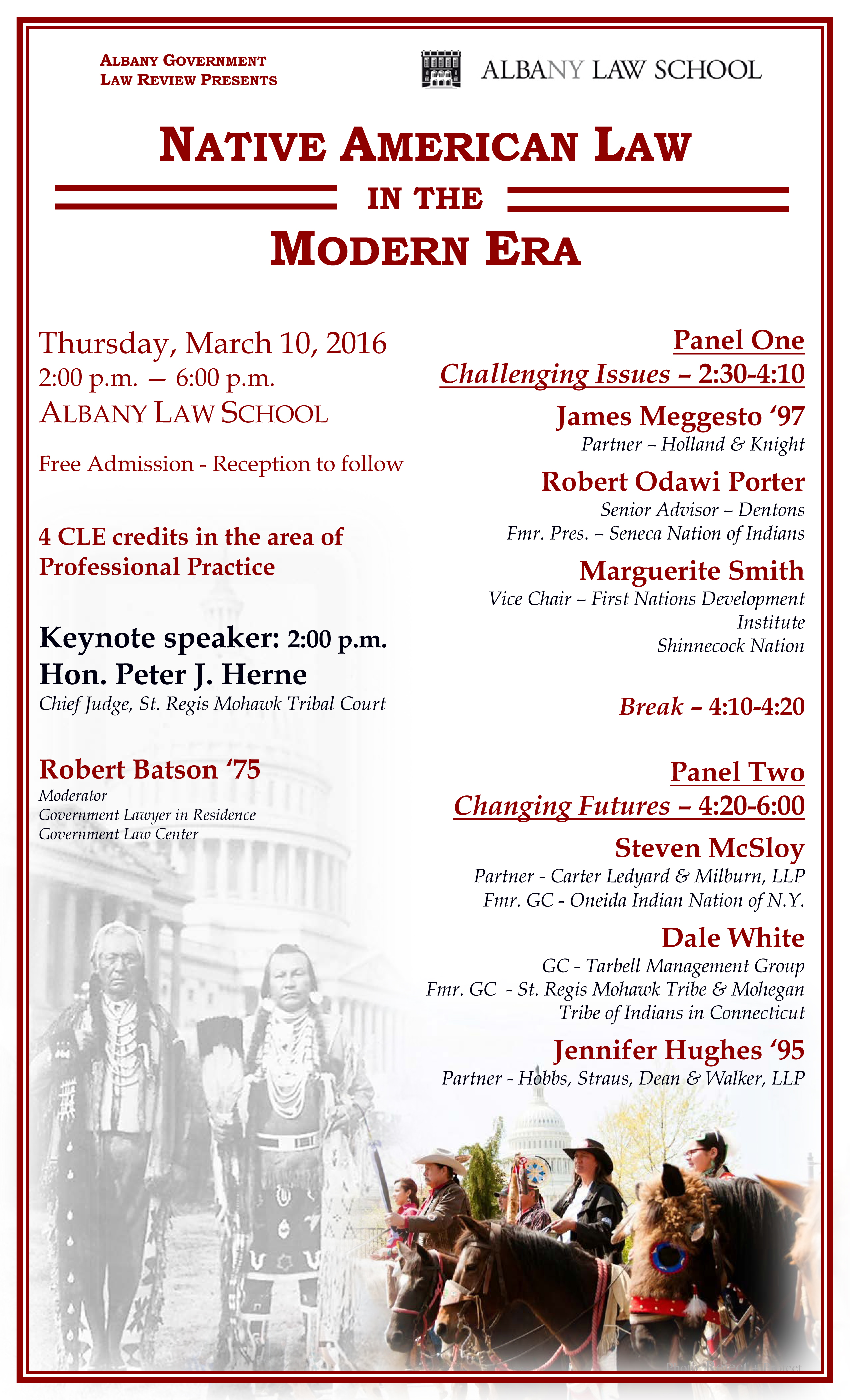
Albany Law School Symposium on Native American Law
A message from NYU Law Review editor Raymond Fadel…
NYU Law Review is seeking submissions from Indian law scholars.
Our Online Department has voted to publish an online feature series spotlighting the Dollar General case, and its legal and policy implications. Amongst other things, we are currently looking for pieces that discuss the case itself, its legal background and importance, and its implications for Indian and non-Indian country alike—particularly Indigenous women’s issues and its insights into women’s issues in general.
To facilitate timely debate, we plan on publishing the spotlight series shortly after the Dollar General case is decided. We encourage you to submit your Essays and Comments within two weeks after the Supreme Court’s decision, but of course, you are welcome to send your pieces for consideration as soon as you have them.
Online submissions have a maximum word limit of 10,000 words and may be submitted directly to our Senior Online Editor, Agne Jomantaite, at aj785@nyu.edu or via Scholastica. More information on our submission policy can be found on our website, www.nyulawreview.org.
As always, our Articles Department is seeking submissions covering diverse subject-matters, especially including general issues in Indian law that would be accessible to a generalist audience. Article submissions must have a minimum of 10,000 words and be submitted on Scholastica. In addition to submission on Scholastica, you may also forward any submission directly to our Senior Articles Editor, Tyler Domino, at tjd266@nyu.edu. The Department is accepting unsolicited articles through the end of March, 2016.
Acting Assistant Secretary Roberts Announces Launch of the Indian Affairs
2016 Student Leadership Summer Institute for Native Students
Summer Institute builds on President’s Generation Indigenous commitment to remove barriers to opportunities for success for Indian Country’s future leaders
WASHINGTON – As part of President Obama’s Generation Indigenous (“Gen-I”) initiative to remove barriers to success for Native Youth,Acting Assistant Secretary – Indian Affairs Lawrence S. Roberts today announced the launch of the 2016 Indian Affairs Student Leadership Summer Institute, a paid 10-week summer internship program with the agency that begins in early June. The Institute will provide American Indian and Alaska Native post-secondary students with a unique opportunity to learn about federal policymaking and develop management and leadership skills within high-profile offices throughout the Indian Affairs organization. Roberts made the announcement at the National Congress of American Indians’ “Tribal Nations Legislative Summit 114th Congress Executive Council” meeting.
“Indian Affairs is excited to offer the Indian Affairs Student Leadership Summer Institute, which will provide opportunities for Native students to gain experience and leadership skills to help serve Indian Country,” Acting Assistant Secretary Roberts said. “Under the President’s Gen-I initiative we are privileged to provide learning opportunities for the next generation of Native leaders, and believe that this program is a chance to help our young people gain valuable experience that will serve them well throughout the rest of their careers.”
The Indian Affairs Student Leadership Summer Institute’s mission is to engage and support the next generation of Native students interested in rising to leadership levels within federal government. The program will provide participants with:
The Institute is open to American Indian and Alaska Native students currently enrolled in undergraduate or graduate degree programs. Between 15-to-20 students will be selected to work at either Indian Affairs’ headquarters offices in Washington, D.C., or at the Bureau of Indian Affairs’ (BIA) 12 regional offices. Internships will begin in early June and end mid- August.
Application and Eligibility Requirements
I. To be eligible for the 2016 Indian Affairs Student Leadership Summer Institute, an applicant must:
II. Applications must include the following requirements:
While applications will begin to be accepted on Monday, February 29, 2016, through the federal employment opportunities website www.USAJobs.gov, they are due by 11:59 p.m. EST on Friday, March 11, 2016. Questions about the Indian Affairs Student Leadership Summer Institute program, eligibility, how to apply, and application requirements may be sent to IA_Institute@bia.gov.
Indian Affairs’ responsibility to the federally recognized American Indian and Alaska Native tribes is rooted in Article I, Section 8 of the United States Constitution and subsequently defined in treaties, acts of Congress, executive orders and actions, federal court decisions, and federal policies and regulations.
The Assistant Secretary – Indian Affairs supports the Secretary of the Interior in carrying out the Department’s responsibilities to the federally recognized tribes through BIA and BIE programs and services. The BIA’s mission includes developing and protecting Indian trust lands and natural and energy resources; supporting social welfare, public safety and justice in tribal communities; and promoting tribal self-determination and self-governance. For more information, visit www.indianaffairs.gov.
The BIE implements federal Indian education programs and funds 183 elementary and secondary day and boarding schools (of which two-thirds are tribally operated) located on 64 reservations in 23 states and peripheral dormitories serving over 40,000 students. BIE also operates two post-secondary schools, and administers grants for 28 tribally controlled colleges and universities and two tribal technical colleges, and provides higher education scholarships to Native youth. For more information, visit www.bie.edu.
There is still time to register for the CLE on the American Indian Probate Reform Act next Tuesday, Feb. 23, 2016 in Albuquerque, New Mexico. This five-hour course will expose you to the principles, purposes, and implications of AIPRA with the last hour dedicated to the ethics of writing AIPRA-compliant wills.
Course instructors are:
Stephanie Hudson, Adjunct Clinical Professor for the Jodi Marquette American Indian Wills Clinic at Oklahoma City University School of Law
Gus Kerndt, Fiduciary Trust Officer with the Office of the Special Trustee for American Indians in the Department of the Interior
Christine Zuni Cruz, Dickason Professor of Law at the University of New Mexico
The session will be held in the Auditorium at the New Mexico State Bar, 5121 Masthead St. N.E., Albuquerque, NM 87109. The charge for attendance is $350 for attorneys receiving 5 CLE credits (pending). Admission is free for law students, and others may attend for a nominal contribution to the Indian Land Tenure Foundation. Lunch is provided.
Click here to register for the event.

Matthew L.M. Fletcher (that’s me) just published “Federal Indian Law” as part of the West Academic hornbook series. Here’s the blurb:
Fletcher’s Hornbook on Federal Indian Law is a deep survey of the history and substantive law governing the relations between the three American sovereigns, federal, state, and tribal. Interwoven are issues of federalism, administrative law, constitutional rights, and international relations. This hornbook includes original research and novel analysis of foundational Supreme Court decisions and critical federal statutory schemes – the stories beyond the stories. In addition to delving into the origins and histories of cases and statutes, the hornbook analyzes modern Indian rights settlements, the international and comparative frontiers of Indian law, and the future of the field.
If you want a preview of the table of contents and the index, see here (PDF).
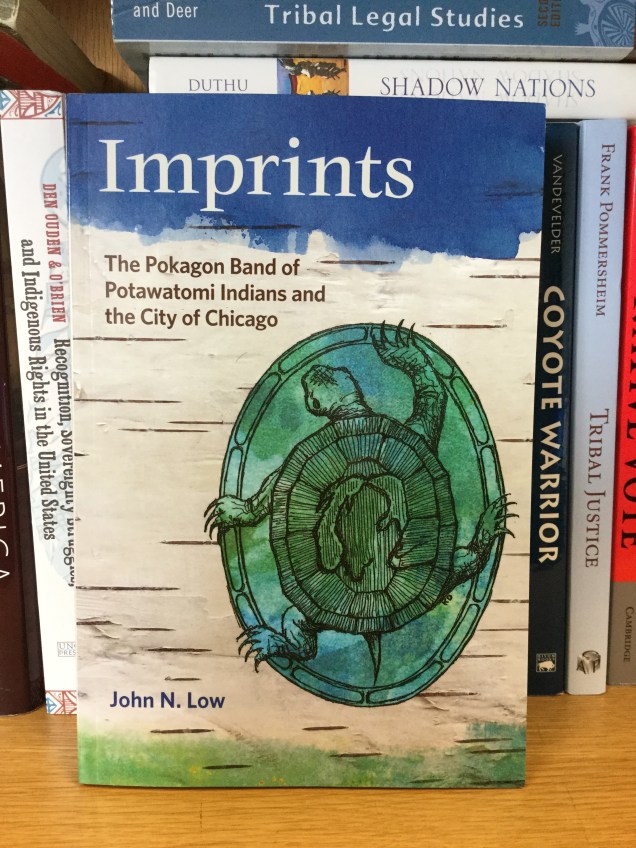
John Low has published “Imprints: The Pokagon Band of Potawatomi Indians and the City of Chicago” with Michigan State University Press (book page here).
From the website:
Imprints: The Pokagon Band of Potawatomi Indians and the City of Chicago
The Pokagon Band of Potawatomi Indians has been a part of Chicago since its founding. In very public expressions of indigeneity, they have refused to hide in plain sight or assimilate. Instead, throughout the city’s history, the Pokagon Potawatomi Indians have openly and aggressively expressed their refusal to be marginalized or forgotten—and in doing so, they have contributed to the fabric and history of the city.Imprints: The Pokagon Band of Potawatomi Indians and the City of Chicago examines the ways some Pokagon Potawatomi tribal members have maintained a distinct Native identity, their rejection of assimilation into the mainstream, and their desire for inclusion in the larger contemporary society without forfeiting their “Indianness.” Mindful that contact is never a one-way street, Low also examines the ways in which experiences in Chicago have influenced the Pokagon Potawatomi. Imprints continues the recent scholarship on the urban Indian experience before as well as after World War II.

Jeanette Wolfley has published “Reclaiming A Presence in Ancestral Lands: The Return of Native Peoples to the National Parks” in the Natural Resources Journal.
Here is the abstract:
For Native peoples, sacred sites and other traditional cultural properties are of critical importance to the preservation of their culture, society, and overall tribal sovereignty. Often these traditional cultural resources are part of present day national park landscapes. Today, tribes have unprecedented opportunities to reclaim a presence on their aboriginal lands, and in turn the National Park Service has an opportunity to ensure that parks remain a sanctuary for the practice of native traditions by accommodating and prioritizing native interests in the implementation of Indian policies and government-to-government obligations. This Article provides an overview of the tribal-NPS relationship, a discussion of the National Park Service Indian policies, and the application of trust obligations to accommodate tribal interests in the national parks. This Article advocates that the National Park Service should prioritize tribal interests to enable tribal peoples to access aboriginal lands where timehonored traditions and practices are celebrated and life is renewed.
Rebecca Webster has published “This land can sustain us: cooperative land use planning on the Oneida Reservation” in Planning Theory & Practice.
Here is the abstract:
Land use planning in indigenous communities often takes place within state-based planning initiatives, leaving indigenous governments to serve as token participants. Through these initiatives, state-based governments have the ability to wield their power and control the planning process to the detriment of indigenous governments. This study sets forth an alternative option involving cooperative land use planning practices where neither government controls the planning process. Drawing upon a case study of the Oneida Reservation in Wisconsin, USA, this study explores ways to increase cooperative land use planning relationships between indigenous and state-based governments. As one of the few empirical studies to apply critical planning theory to advocate for increased cooperative land use planning, this paper proposes a series of recommendations that can help indigenous and state-based governments avoid conflicts and work toward cooperative relationships.
The University of Colorado Indian Law Clinic has posted “Responsible Resource Development and Prevention of Sex Trafficking: Safeguarding Native Women and Children on the Fort Berthold Reservation” on SSRN.
Here is the abstract:
In 2010, large deposits of oil and natural gas were found in the Bakken shale formation, much of which is encompassed by the Fort Berthold Indian reservation, home to the Mandan, Hidatsa, and Arikara Nation (“MHA Nation” or “Three Affiliated Tribes” or “the Tribe”). However, rapid oil and gas development has brought an unprecedented rise of violent crime on and near the Fort Berthold reservation. Specifically, the influx of well-paid male oil and gas workers, living in temporary housing often referred to as “man camps,” has coincided with a disturbing increase in sex trafficking of Native women. The social risks of oil development on American Indian reservations like Fort Berthold are distinct from development in other areas in the United States. The complex and shifting nature of federal Indian law presents legal and practical challenges to law enforcement in civil and criminal contexts. Further, the historical exploitation of Indian lands and people informs current social and economic conditions that contribute to increased sex trafficking of Native women and children.
This paper begins by describing the intersection of sex trafficking and oil and gas development on the Fort Berthold reservation. Next, the paper describes the jurisdictional regime within federal Indian law and other barriers to law enforcement that have created a situation ripe for trafficking and other crime on the Fort Berthold reservation. Third, the paper will examine strategies to address this complex issue including: corporate engagement of relevant companies; tribal capacity and coalition building; and remedies contained in the Violence Against Women Act of 2014. This paper asserts that all of the stakeholders involved in oil development on the Fort Berthold reservation – federal, state, tribal, and public and private companies – must work cooperatively to decisively eliminate sex trafficking of Native women and children.
 Turtle Talk
You must be logged in to post a comment.