New Student Scholarship on Tribal Internet Gaming

The Jurimetrics Journal at ASU Law has published “A New Formula for Tribal Internet Gaming” by Racheal White Hawk. [pdf]

The abstract:

Tribal gaming is an industry that generates more than $27 billion a year. It comprises forty percent of all gaming in the United States, and has provided more than 628,000 jobs for Native and local communities. While tribal brick-and-mortar casinos contribute numerous economic, cultural, and social benefits to Native communities, Internet gaming profits are a potential boon. Internet gaming is well positioned for rapid growth because tens of millions of Americans use computers, cell phones, and tablets for shopping, games, and entertainment. Furthermore, with the advent of increasingly accurate geolocation technology, filtering, and blocking systems, the age and location of gamblers can be monitored, thus facilitating legal Internet gaming within state borders. Moreover, the potential for tax and licensing revenue from Internet gaming is immense, and states may enter into revenue-sharing agreements with tribes while offering exclusivity for tribal operators. For instance, in California, tribes contributed $467 million to state revenue in 2012 from brick and mortar casinos. States such as Delaware and New Jersey have legalized intrastate Internet gaming to reap tax revenue. California, however, has not yet legalized intrastate Internet gaming. Rather than wait for states to legalize intrastate Internet gaming, some tribes are launching their own online poker and bingo rooms to accept bets from players not located on Indian lands, asserting that doing so is legal under the Indian Gaming Regulatory Act (IGRA). However, some states disagree that it is legal under IGRA. To prevent impending expensive and time-consuming litigation and to support tribal economic development, Congress should reform the current regulatory patchwork of federal Internet gaming legislation by legalizing interstate Internet gaming, allowing states to opt out of the federal interstate Internet gaming scheme, and adding a new category specifically for Internet gaming to IGRA.

NNALSA 2016 Writing Competition Results

Congrats to Katie Jones!!!!

2016-NNALSA-Writing-Competition-Winners

Stanford Law School’s Production of Sliver of a Full Moon

Stanford NALSA is proud to announce the upcoming performance of Sliver of a Full Moon on Tuesday, May 10th, at 6PM followed by a panel on Native American sovereignty on May 11th.

Sliver of a Full Moon, written by playwright and attorney Mary Kathryn Nagle of the Cherokee Nation, is a portrayal of justice under the rule of law – the story of a movement to restore safety and access to justice to indigenous women in the U.S. It chronicles the history of the reauthorization of the Violence Against Women Act (VAWA) and the stories of the women it affected, featuring a cast of courageous Native women survivors who stepped forward to share their stories of abuse by non-Indians. The website can be found at http://sliverofafullmoon.org/.

There will be a reception prior to the performance, and the show will be followed by a Q&A session with the cast and survivors. Attendees will have the opportunity to engage more deeply with the details of the legal landscape at play during a lunch panel the following day, discussing VAWA reauthorization and its implications for Indian country. Panelists will include OJ Flores, Chief Prosecutor for the Pascua Yaqui, Judge Fletcher of the Ninth Circuit Court of Appeals, as well as a tribal judge.

Tickets to both the performance and the panel are free and simply require registration at the following link: http://tinyurl.com/gsolaz8

Harvard Law Review Developments in the Law Issue on Indian Law

Here:

Introduction

The Double Life of International Law: Indigenous Peoples and Extractive Industries

Securing Indian Voting Rights

ICRA Reconsidered: New Interpretations of Familiar Rights

Fresh Pursuit from Indian Country: Tribal Authority to Pursue Suspects onto State Land

Tribal Executive Branches: A Path to Tribal Constitutional Reform

North Dakota Law Review Symposium on the Oil Boom

Here. Includes panels on human trafficking and impacts on Indian country jurisdiction.

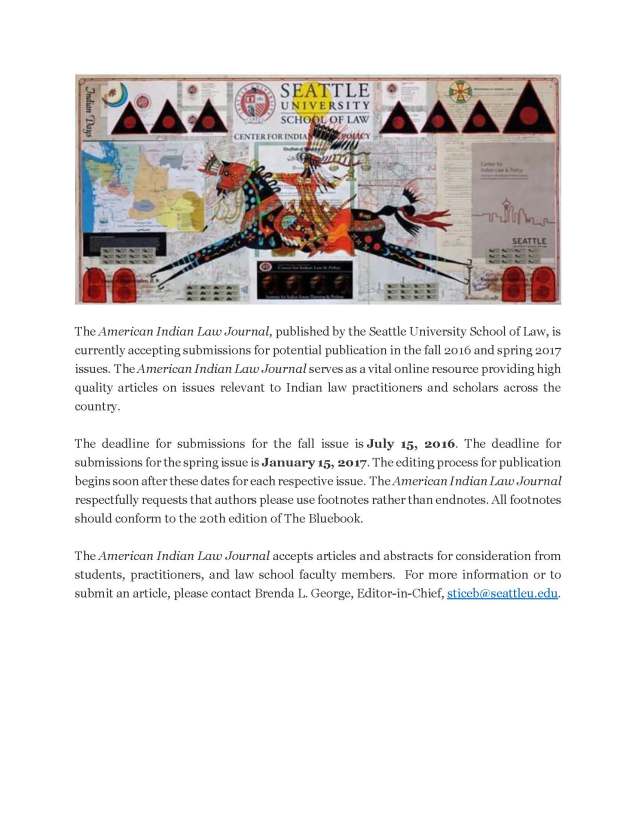
American Indian Law Journal Call for Articles (7/15/16/ & 1/15/17 Deadlines)

Here (Solicitation Letter):

Solicitation Letter_Page_1

2016 NNALSA Moot Court

Final Round Judges and Oralists:

2016 NNALSA Moot Court
Judge Wenona Singel, Judge Patricia Millett, KU Law Students Maureen Orth & Jessica Frederickson, OU Law Students Victoria Procter & Ashley Akers, Judge Bridget McCormack, Judge Matthew Fletcher, and Judge Michael Petoskey

Congrats to Kansas for prevailing!

Finalists
All-woman final!
Rice Award
Maureen Orth winning the G. William Rice Best Oralist Award presented by Professor Rice’s daughter Karen Rice and her fellow PLSI sisters to support Karen and honor Bill Rice.

More pics….

Hemp Bar
0.3% THC soap

MSU Moot Court

MSU Moot Court Team [Elise McGowan-Cuellar directed the competition, and so she gets the waabigwan]

Karen Rice

Our new best friend, Karen Rice! [and that’s Hunter Cox doing some heavy listing on the left]

IMG_1596
A shot of the field before the competition. Top overall seed in the front on the right, Emmett Waasamowin and Owen Buki Waabmigizi.

NYU Law Review Seeking Submissions from Indian Law Scholars

A message from NYU Law Review editor Raymond Fadel…

NYU Law Review is seeking submissions from Indian law scholars.

  1. Online Series on Dollar General.

Our Online Department has voted to publish an online feature series spotlighting the Dollar General case, and its legal and policy implications. Amongst other things, we are currently looking for pieces that discuss the case itself, its legal background and importance, and its implications for Indian and non-Indian country alike—particularly Indigenous women’s issues and its insights into women’s issues in general.

To facilitate timely debate, we plan on publishing the spotlight series shortly after the Dollar General case is decided. We encourage you to submit your Essays and Comments within two weeks after the Supreme Court’s decision, but of course, you are welcome to send your pieces for consideration as soon as you have them.

Online submissions have a maximum word limit of 10,000 words and may be submitted directly to our Senior Online Editor, Agne Jomantaite, at aj785@nyu.edu or via Scholastica. More information on our submission policy can be found on our website, www.nyulawreview.org.

  1. Print Articles.

As always, our Articles Department is seeking submissions covering diverse subject-matters, especially including general issues in Indian law that would be accessible to a generalist audience. Article submissions must have a minimum of 10,000 words and be submitted on Scholastica. In addition to submission on Scholastica, you may also forward any submission directly to our Senior Articles Editor, Tyler Domino, at tjd266@nyu.edu. The Department is accepting unsolicited articles through the end of March, 2016.

NNALSA To Name Highest Honor Received At NNALSA’s Annual Moot Court Competition, The “G. William Rice Best Oralist Award”

Press release here:

NNALSA Honors Prof. Rice Moot Court AwardRice


MSU NALSA Climate Change Panel

Whitney Gravelle and Kyle Whyte

  
Chris Caldwell