New Volume of Indigenous Peoples’ Journal of Law, Culture & Resistance

Here:

Current Issue, Volume 4, Issue 1, 2017

Front Matter

Front Matter

Contents

Editorial

Letter from the Editor
Anter, Simone

Illustration

“Water is Life” Editoon
Two Bulls, Marty Sr.

Photography

Oceti Sakowin Camp
Hewitt, Cathy

Gallery I
Wilson, Rob

Articles

Environmentalism and Human Rights Legal Framework: The Continued Frontier of Indigenous Resistance
Thompson, Geneva E. B.

Photography Continued

Gallery II
Wilson, Rob

Poetry

White Man’s Elixir
Kuauhtzin, Tekpatl Tonalyohlotl

Current Issue of American Indian Law Review (Vol. 41, No. 1)

Here:

Vol. 41, No. 1 (2016-2017)

Click any link to view in PDF format  

Article

Capital, Inequality, and Self-Determination: Creating a Sovereign Financial System for Native American Nations – W. Gregory Guedel, Ph.D and J. D. Colbert

Comments

Why Indigenous Peoples’ Property Rights Matter: Why the United Nations Declaration on the Rights of Indigenous Peoples May Be Used to Condemn Isis and the State of Iraq for Their Failure to Protect the Property Rights of Indigenous Peoples in the Nineveh Plains – Brooke E. Hamilton

Defending the Cobell Buy-Back Program – Rebekah Martin

Intellectual Property Rights and Informed Consent in American Indian Communities: Legal and Ethical Issues– Naomi Palosaari

Raising Capital in Indian Country – Evan Way
Note

Christman v. Confederated Tribes of Grand Ronde: A Chapter in the Disenrollment Epidemic – Tabitha Minke


Special Features

The Dynamic Legal Environment of Daily Fantasy Sports – Elizabeth Lohah Homer

Trespass to Culture: The Bioethics of Indigenous Populations’ Informed Consent in Mainstream Genetic Research Paradigms – Alexandra Winters 

HUNAP: “SpearChief-Morris Becomes First Indigenous Student President of Harvard Law School’s Legal Aid Bureau”

Here.

NYU Law Review Seeking Submissions from Indian Law Scholars

A message from the editorial board:

NYU Law Review is seeking submissions from Indian law scholars.

1. Print Articles.

As always, our Articles Department is seeking submissions covering diverse subject-matters, especially including general issues in Indian law that would be accessible to a generalist audience. Article submissions must have a minimum of 10,000 words and be submitted on Scholastica. In addition to submission on Scholastica, you may also forward any submission directly to our Senior Articles Editor, Simon Williams, at sjw446@nyu.edu. The Department is accepting unsolicited articles through the end of March, 2016.

2. Online Essays and Comments.

Our Online Department is similarly interested in submissions in Indian law. The Online Department is focused on publishing content addressing timely legal issues, such as current controversies and debates. Online submissions have a maximum word limit of 10,000 words and may be submitted directly to our Senior Online Editor, Marcelo Triana, at mt3497@nyu.edu or via Scholastica. More information on our submission policy can be found on our website, www.nyulawreview.org.

American Indian Law Journal — Fall 2016 Volume

Here:

AILJ – Fall 2016

Contents

Masthead
Assessing Political Economy In Native American Nations W. Gregory Guedel, Ph.D., JD
A Legal Practitioner’s Guide To Indian and Tribal Law Research Kelly Kunsch
Why the Religious Freedom Restoration Act Cannot Protect Sacred Sites Timothy Wiseman
Student Articles
Money Is For Nothing: The Inherent Want of Consideration Found In Substantial Exclusivity Terms Within Tribal-State Compacts Paul C. Alexander II
A Silent Epidemic: Revisiting the 2013 Reauthorization of the Violence Against Women Act to Better Protect American Indian and Alaska Native Women Rory Flay
Complex Adaptive Peacemaking: How Systems Theory Reveals Advantages of Traditional Tribal Dispute Resolution Methods Juliana E. Okulski

Read the entire issue here (PDF).

Law Students: Enter the LSAC 2017 Diversity Writing Competition to win $5000

This year’s LSAC Diversity Writing Competition topic is “Why Pipeline Programs Targeting Students from Underrepresented Racial and Ethnic Backgrounds are Essential to the Future of the Legal Profession.”  Current JD candidates are invited to submit papers addressing this topic.  The deadline for submissions is Friday, March 31, 2017, and LSAC will award three $5000 prizes to the best paper submitted by a 1L, 2L, and 3L/4L.  In addition, one winner will have a chance to publish their entry in the Journal of Legal Education.

We know there are law students following Turtle Talk who could write excellent papers on this topic. LSAC’s rules for submissions are here.

Student Scholarship on Cross-Border Affirmative Action

Here:

An Indian by Any Other Name: Cross-Border Affirmative Action
Forthcoming, 92 N.Y.U. L. REV. (2017)
Raymond J. Fadel
New York University (NYU), School of Law, Students
Date Posted: December 08, 2016

Univ. of Washington NALSA Stop DAPL Project

Call for Submissions:Dear Turtle Talk Community, 

The University of Washington Native American Law Student Association (NALSA) is asking for photos (digital or print) documenting the myriad of ways & moments during which native people gathered in direct action opposing the DAPL protest. As law students, we hope one day to advance causes for Indian Country in the courtroom, but today we want to celebrate and feature the strength and character shown at the “Stop DAPL” encampment through a photography exhibition. 

On the first floor of our Law building, there exists a common space that rotates art each 3 to 6 months. The NALSA of the University of Washington will select 7 to 10 of the submissions for display (printing them if not already printed) to recognize the ongoing effort to protect Native American sacred space. The print will be in this art space for the next 3 to 6 months with acknowledgement to the photographer.

Once the “Stop DAPL” encampment exhibition is complete, NALSA will return the printed piece to the contributor as a token of our appreciation. Or in the alternative, the contributor could donate it to our student Association for auction at our annual dinner in Feb. 2017.

With heartfelt thanks,

University of Washington Native Law Students.

Contact, Tony Aronica, aronicat@uw.edu
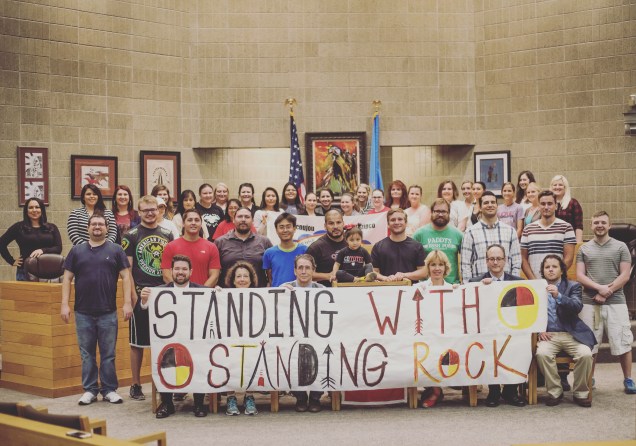
South Dakota NALSA: “Standing with Standing Rock”

Here:

Standing with Standing Rock.jpg

Reminder: Apply to Clerk at NARF by September 2, 2016

Founded in 1970, the Native American Rights Fund (“NARF”) is the oldest and largest nonprofit law firm dedicated to asserting and defending the rights of Indian tribes, organizations, and individuals nationwide. NARF’s practice is concentrated in five key areas: the preservation of tribal existence; the protection of tribal natural resources; the promotion of Native American human rights; the accountability of governments to Native Americans; and the development of Indian law and educating the public about Indian rights, laws, and issues.

NARF is currently seeking candidates for its Summer 2017 Clerkships! Each year, NARF conducts a nation-wide search for law students to participate in its Law Clerk Program. Positions are available in all three of NARF’s offices: Anchorage, AK; Boulder, CO; and Washington, D.C.

Here is the advertisement. The deadline to apply is September 2, 2016.