Here:
Peace Commission Treaty Tribes Amicus Brief
Topside briefs here.
Here:
Questions presented:
Whether a federal court may force a non-consenting, non-Indian plaintiff to exhaust his claims in tribal court when the defendant tribe has expressly consented by contract to federal or state court jurisdiction and waived both sov- ereign immunity and tribal exhaustion.
Whether a state court may adjudicate a contractual dispute between a tribe and a non-Indian where the tribe has provided specific contrac- tual consent to state court jurisdiction; or in- stead, whether the Constitution or laws of the United States prohibit such exercises of state court jurisdiction unless the State has assumed general civil jurisdiction over tribal territory under Sections 1322 and 1326 of Title 25.

Lower court materials here.
Update:
Here:
Lower court materials here.

Questions presented:
Here is Monday’s order list.
The Court denied cert in Caballero v. United States, lower court materials here.
The tribe described an earlier incarnation of this case as “sovereign identity theft.”

Here is today’s order list.
The Court denied Samish v. Washington, an effort by the tribe to assert treaty rights, and Hawkins v. Haaland, a challenge to the Klamath Tribes’ regulation of the Klamath River.

Here.

Here.
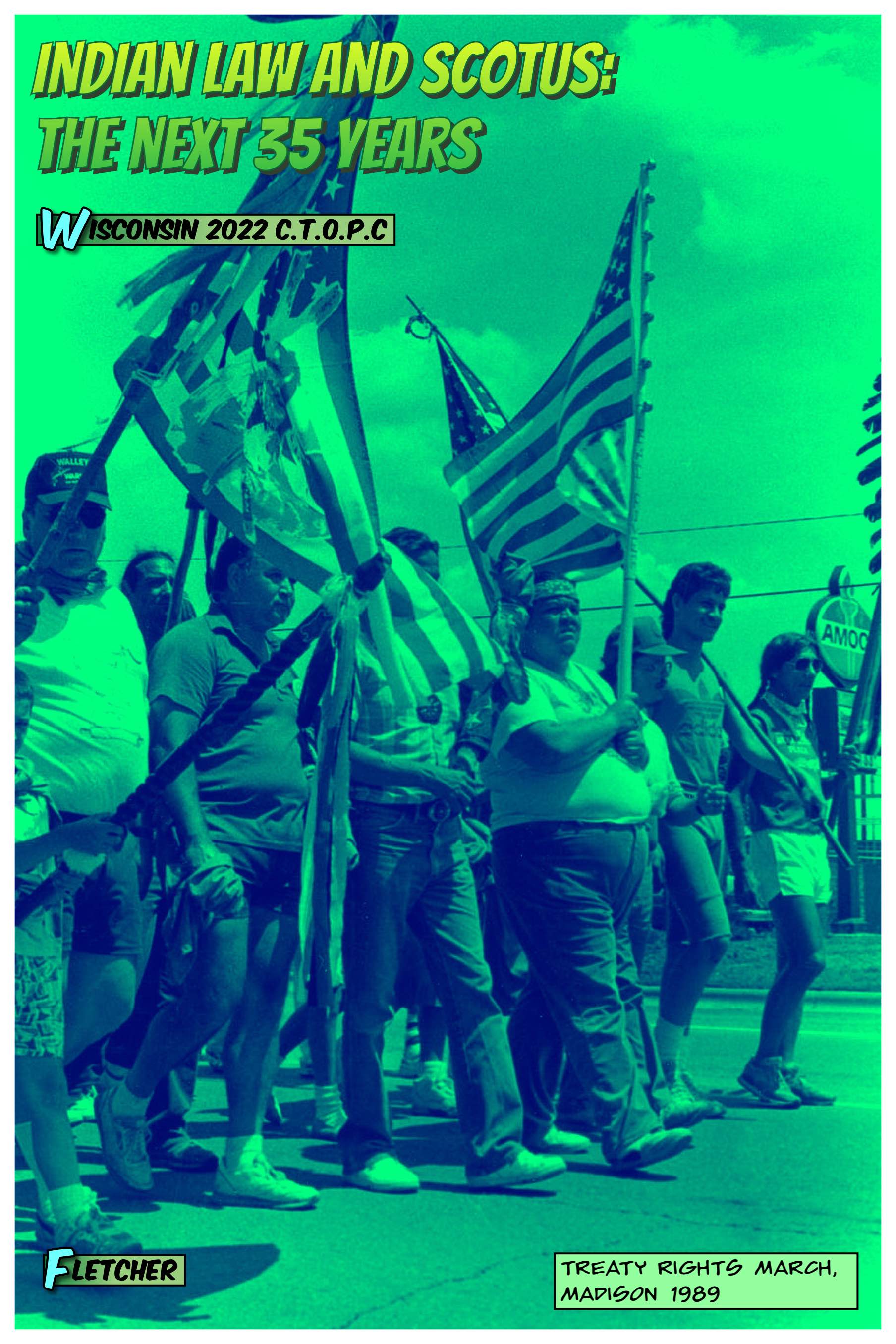
Blurb: “Leah recaps Denezpi v. United States, an important case about tribal sovereignty, with Matthew Fletcher(Michigan State University & Chief Justice of the Pokagon band of Potawatomi Indians Court of Appeals) & April Youpee-Roll (Munger Tolles & Olson), which may involve … Neil Gorsuch’s heel turn in Indian law?!?”

Here:
Amicus briefs:
Oklahoma DAs and Sheriffs Amicus Brief
States Amicus Brief Supporting Oklahoma
Cert stage and lower court materials here.
The only Indian law opinion we can find that Judge Brown Jackson wrote was in Fredericks v. Dept. of the Interior, a dispute over gas royalties at Fort Berthold.
The second Indian law opinion we found after actually making an effort to look is Mackinaw Band v. Jewell, where the court ordered the tribe to exhaust administrative remedies in a federal recognition suit:
Judge Brown Jackson also wrote an opinion in a pro se prisoner FOIA request to the Bureau of Indian Affairs, Kovalevich v. BIA. Judge Brown Jackson also rejected a facial challenge in Rothe v. Dept. of Defense to Section 8(a) of the Small Business Act that benefits many tribes and tribal businesses. In Sierra Club v. Army Corps, she excused the government from having to prepare an Environmental Impact Statement to assess environmental impacts from the approval of a domestic pipeline, a case that recalls the Dakota Access decision, which reached the opposite conclusion.
Judge Brown Jackson clerked for Justice Breyer in the 1999 Term, when Rice v. Cayetano was decision (Breyer went the wrong way on that one).
Judge Brown Jackson also clerked for First Circuit Judge Selya from 1999 to 2000. Judge Selya wrote the opinion in Ninigret Development v. Narragansett Indian Wetuomuck Housing Authority, where the court rejected a tribal sovereign immunity defense from a contract dispute.
 Turtle Talk
You must be logged in to post a comment.