Here, in the National Law Review.
Troy Eid: “McGirt v. Oklahoma: Understanding What the Supreme Court’s Native American Treaty Rights Decision Is and Is Not”
Here, in the National Law Review.
Here, in the National Law Review.
Here.
Here.
In a bit, I will publish a post recommending Turtle Talk readers check out the Mother Jones article “How Native Tribes Started Winning at the Supreme Court.” It’s an excellent read on how the Tribal Supreme Court Project started after tribal interests lost 4 out of 5 cases in 2001 and first met (on 9/11 in D.C. while the Pentagon was burning) to figure out how to stop losing so much.
But the subtitle . . . “In July, the court ruled that half of Oklahoma is an Indian reservation. The decision was two decades in the making.” No good. IT IS NOT TRUE THAT HALF OF OKLAHOMA IS OWNED BY INDIAN TRIBES. Stop it.
The McGirt case involved the Muscogee (Creek) Nation’s reservation, which is maybe 10 percent of Oklahoma (I don’t know the exact amount). Yeah, four other tribes (Cherokee, Choctaw, Chickasaw, and Seminole), and maybe others have similar histories and can expect to benefit from the McGirt case. If you count all the Five Tribes you might get to 40 percent.
Here’s the NYTs map that shows the land areas of all of the five tribes likely affected by McGirt:
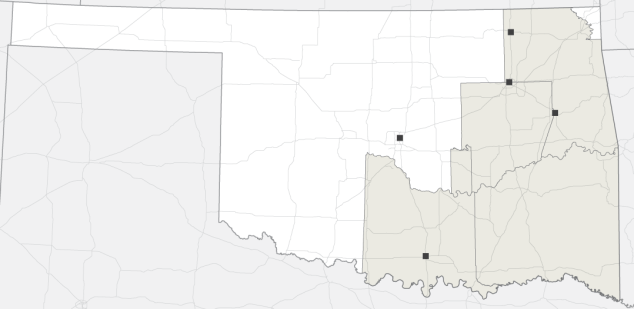
Half? Sure, whatever.
Here’s the same one with the Creek rez circled (the purple dot in what is probably Roger Mills or Beckham county is an error, I was trying to stab Custer in Custer County but I missed):
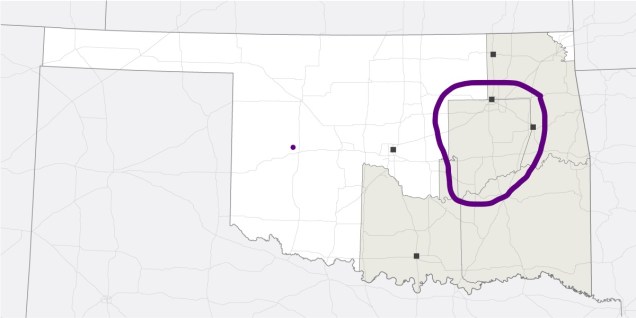
That’s the area covered by McGirt. That’s all (for now anyway). There will be lawsuits that address the other reservations in time, see, e.g., here). But for now, this is it.
News writers, don’t be the State of Oklahoma, trying and failing to win this case by mischaracterizing McGirt’s claims by invoking the “half of Oklahoma” thing (here, page 1 of the argument, page 16 of the pdf).
Stop it!!!!
Bad actors (bad!) include:
SCOTUSblog (“entire eastern half of Oklahoma” — really?! — but from these guys I expect it — an angel dies every time someone clicks on SCOTUSblog)
NPR (“Supreme Court Rules That About Half Of Oklahoma Is Native American Land”)
S&P Global (“a large swath of land (approximately 19 million acres that is home to roughly 48% of the state’s population) in eastern Oklahoma (AA/Negative) as tribal reservation land for purposes of federal criminal law”; loving the reference to Oklahoma’s bond rating though)
Julian Brave NoiseCat in the Atlantic (“Or, put more plainly, 19 million acres composing 47 percent of the state of Oklahoma—an area that’s home to 1.8 million people—is still Native land.”)
Heritage Fundation guy. (“This is especially important now that the Supreme Court has determined that almost half of Oklahoma is, in fact, tribal land.”)
National Law Review (“half the State of Oklahoma – 113 years after it was admitted as the 46th State in the Union – being declared ‘Indian Lands’ and given back to the Creek Nation Native Americans”)
A few others, most of whom have since changed their headlines because apparently there is no memory on the internet.
How about this one? SCOTUS Holds Creek Reservation is Indian Country
That’s enough. These are good people, good places (mostly, looking at you SCOTUSblog). We love you and we’ll keep posting your great work.
Everyone. Just. This. One. Thing.
Here.
And, yes, we know the Marshall Project headline is inaccurate, but High Country News (publishing in tandem with M.P.) did it better: “How the Supreme Court upended a century of federal Indian law.”
Here:
Questions presented:
1. The Contraband Cigarette Trafficking Act prohibits the knowing transportation of “a quantity” of more than 10,000 untaxed cigarettes in the “possession” of unauthorized persons. 18 U.S.C. § 2341(2). The first question presented is whether multiple shipments from different shippers may be aggregated to satisfy the 10,000-cigarette threshold.
2. The Prevent All Cigarette Trafficking Act of 2009 exempts UPS by name if its tobacco-delivery agreement with New York is “honored” nationwide. 15 U.S.C. § 376a(e)(3)(B)(ii)(I). The second question presented is whether substantial compliance is a prerequisite to this statutory exemption.
Second Circuit materials here:
DCT materials here.
Here:
Questions presented:
The Major Crimes Act, 18 U.S.C. § 1153, grants the federal courts exclusive jurisdiction over listed offenses committed by an “Indian.”
The Questions Presented are:I. How does one determine whether a defendant is an Indian?
II. Is Indian status a jury question?
Lower court materials here.
Here.
Here.
From the ABA Journal, “SCOTUS delivers on US promises, at least partly, made to Native Americans after Trail of Tears.”
From the National Judicial College, by Judge Jan Morris, “McGirt v. Oklahoma: A tribal member and tribal judge’s view.”
Glenn Feldman letter to editor at WSJ, here.
Aila Hoss interviewed at Tulsa Public Radio, here.
The Cherokee Phoenix Breakdown: McGirt v. Oklahoma, episode 1 featuring Chuck Hoskin, Jr. and Stacy Leeds:
 Turtle Talk
You must be logged in to post a comment.