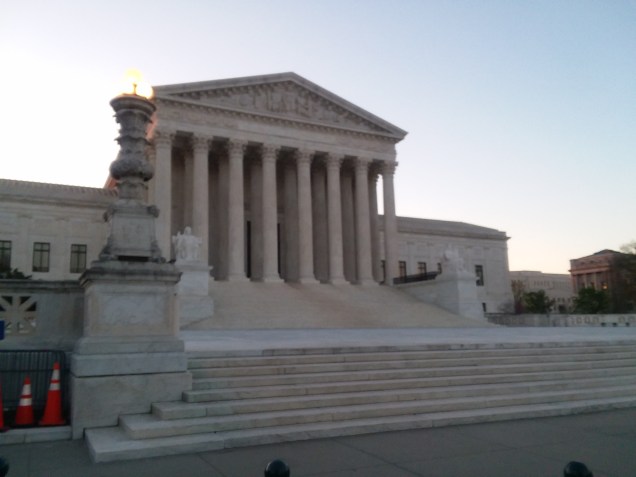

Awaiting the Culverts Argument
Here is the petition:
Questions presented:
Does 28 U.S.C. § 1491 grant the court of federal claims jurisdiction over an action to recover grant-in-aid funds unlawfully recouped by the United States or is the action one for specific relief which must be brought under the Administrative Procedure Act, 5 U.S.C. § 702?
Does the court of federal claims have jurisdiction to enter a judgment on an illegal exaction claim when the United States had previously awarded money to a recipient under a grant-in-aid statute and then unlawfully recouped the funds?
Where a grant-in-aid statute mandates that the United States pay grant funds to a plaintiff, does the court of federal claims have jurisdiction to enter a money judgment for the failure to pay the grant funds even if there are conditions on the use of the grant funds after they are awarded?
Lower court materials here.
UPDATE:
Here is the petition in County of Amador v. Dept. of the Interior:
UPDATE: Cert Opp
Questions presented:
1. Whether Congress intended the phrase “under Federal jurisdiction,” as used in the 1934 Act, to encompass a tribe that, as of June 18, 1934, had no land held on its behalf by the federal government, either in trust or as allotments; was not a party to any treaty with the United States; did not receive services or benefits from the federal government; did not have members enrolled with the Indian Office; and which was not invited to organize under the IRA in 1934 by the Secretary like other recognized tribes in Amador County; but for whom the federal government had unsuccessfully attempted to purchase land pursuant to a generic appropriation authorizing the purchase of land for unspecified “landless Indians” in California?
2. Whether the Secretary’s authority to take land into trust for “members of any recognized Indian tribe now under Federal jurisdiction” requires that the tribe have been “recognized” in 1934, in addition to being “under Federaljurisdiction” at that time, or whether such “recognition” can come decades after the statute’s enactment?
3. Whether the Secretary, having explicitly concluded that in enacting the Indian Gaming Regulatory Act Congress intended that Indian tribes “restored to Federal recognition” refers only to tribes that are “restored” pursuant to (a) congressional legislation, (b) a judgment or settlement agreement in a federal court case to which the United States is a party, or (c) “through the administrative Federal Acknowledgment Process under [25 C.F.R. § 83.8],” and having embodied that conclusion in a formal regulation, 25 C.F.R. § 292.10, can then act contrary to Congress’s intention by “grandfathering in” a preliminary (i.e., non-final) agency action treating Indians who do not meet the regulatory definition as “restored”?
Here.
Here is “Supreme Court case tests weight of old Native American treaties in 21st century,” from The Conversation.
Background materials on the culverts case are here.
Oral argument transcript: oral argument transcript
Merits stage briefs:
Amici in Support of Petitioners:
Idaho and 10 Other States Brief
Pacific Legal Foundation Brief
Modoc Point Irrigation District Brief
Citizens Equal Rights Foundation Brief
American Forest & Paper Association and National Mining Association Brief
Washington State Association of Counties and Association of Washington Cities
Amici Supporting Respondents:
Fishermans Associations amicus brief
Warm Springs et al amicus brief
State and Local Officials amicus brief
Other docs:
Ninth Circuit panel decision here. Briefs:
Pacific Coast Federation of Fishermen’s Associations
En banc stage briefs:
Washington Rehearing/En Banc Petition
Idaho and Montana Amicus Brief
Klamath Critical Habitat Landowners Amicus Brief
District court materials are here:
Tribal Motion for Summary Judgment
State Motion for Summary Judgment
 Turtle Talk
You must be logged in to post a comment.