Federal Court Orders San Juan County Voting Rights Suit to Trial

Here are the materials in Navajo Nation Human Rights Commission v. San Juan County (D. Utah):

93 Motion to Dismiss Counterclaims

99 Opposition to Motion to Dismiss Counterclaims

106 Reply

141 County Motion for Summary J

144 Navajo Motion for Summary J

149 Navajo Opposition

151 County Opposition

154 County Reply

155 Navajo Reply

174 DCT Order Denying Summary Judgment

174 DCT Order Granting Motion to Dismiss Counterclaims

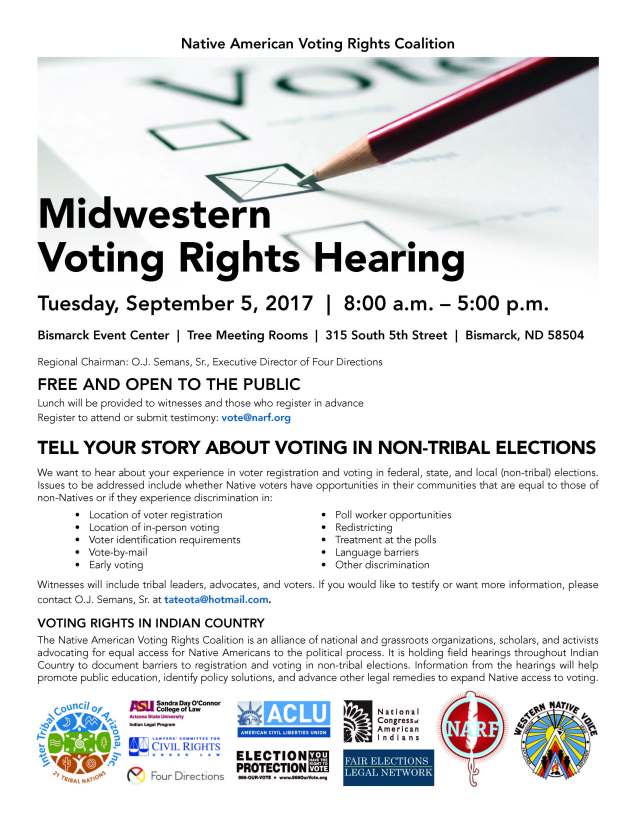
Native American Voting Rights Coalition: Midwestern Voting Rights Hearing (9/5/2017)

Here (PDF):

NAVRC ND Hearing_Sept 2017

Native Voting Rights in South Dakota—We Do the Math

From Indian Country Today:

South Dakota’s Help America Vote Act Grant Board has approved funding for Indian-reservation satellite-voting centers for the 2018 elections. Secretary of State Shantel Krebs created the bipartisan board in 2015. It distributes federal HAVA money to counties that use it for maintaining voting machines and other election-related expenses. Krebs praised board members for “their dedication to improving ballot access and keeping our county election equipment current.”

HERE.

Federal Court Rejects San Juan County Remedial Maps, Orders Appointment of Special Master

Here is the order in Navajo Nation v. San Juan County (D. Utah):

397 DCT Opinion

An excerpt:

For the reasons below, San Juan County’s remedial plans fail to pass constitutional muster. Specifically, the court concludes race was the predominant factor in the development of District 3 of the School Board plan and Districts 1 and 2 of the County Commission plan. The County’s consideration of race requires strict scrutiny analysis of these districts. The court concludes the County has failed to satisfy strict scrutiny and, therefore, these districts are unconstitutional. The court will not adopt the County’s plans.

PBS Newshour: 300,000 Disenfranchised by Voter ID Law in Wisconsin Alone

Here

That state was decided by 22,000 votes in last Presidential election.  

NARF Press Release on Presidential Commission on Voter Suppression

Saw this coming.

Here:

FOR IMMEDIATE RELEASE

Friday, May 12, 2017

Contacts: Natalie Landreth, NARF Staff Attorney, (907) 276-0680; Matt Campbell, NARF Staff Attorney, (303) 447-8760

President Announces Commission to Investigate American Voters

Yesterday, the President announced the creation of the “Presidential Commission on Election Integrity,” a new body intended to investigate American voters for “improper” or “fraudulent” voting.  This is not only an unprecedented attack on the American electorate, it is also completely misleading because there is virtually no voter fraud anywhere in the United States.  Instead, the problems experienced by American voters are long lines, lack of polling places, lack of early voting opportunities, gerrymandered districts, and jurisdictions’ failure to follow voting laws such the Motor Voter bill and the language assistance provisions of the Voting Rights Act.  These problems are actually increasing in American elections, in large part due to the activities of people newly appointed to the Commission.  Prominent advocates of voter suppression such as Kris Kobach sit on this Commission.

“This Commission is completely backwards; it is not the American people who need to be investigated, it is the jurisdictions using more suppressive tactics to keep citizens from voting,” said Natalie Landreth staff attorney for the Native American Rights Fund and voting rights litigator. “Voter suppression is designed by those in power to keep themselves in power. They know as the electorate changes, their power wanes so these tactics are meant to ‘freeze the electorate’ in a way.”

The Native American Rights Fund (NARF) has litigated voting cases on behalf of American Indians and Alaska Natives since the 1980s, and it currently leads the Native American Voting Rights Coalition, a group of voting rights advocates who work in Indian Country across the United States.  In this capacity, NARF encounters a wide variety of problems faced by American Indian and Alaska Native voters.  These problems are many and widespread, but do not include voter fraud.

“North Dakota is a great example of how this narrative works,” said Staff Attorney Matt Campbell, who currently represents the plaintiffs in Brakebill v. Jaeger. “The state passed the strictest voter identification law in the country on the basis that they wanted to prevent voter fraud, but over the course of the case the state admitted there had never been a single case of fraud in North Dakota. It’s a myth, one designed to keep Native Americans and the elderly from voting.”

“It is ironic that this President purports to investigate election integrity since it is now known that he very likely benefitted from Russian interference in the November 2016 election,” said Landreth. “That is what needs to be investigated, not the American voters. And I want to be very clear about why the President is doing this: he is purporting to create a record that will surely form the basis for nationwide legislation to further suppress voting.”


Moyers & Co.: “The Trump Administration’s Lies About Voter Fraud Will Lead to Massive Voter Suppression”

Lies have a purpose.

Here.

Political Lies and the Future of Voting Rights

Lies are often much more plausible, more appealing to reason, than reality, since the liar has the great advantage of knowing beforehand what the audience wishes or expects to hear. He has prepared his story for public consumption with a careful eye to making it credible, whereas reality has the disconcerting habit of confronting us with the unexpected, for which we were not prepared.

Hannah Arendt, Crises of the Republic

Be prepared for a massive purge of American voters, mostly Democratic Party-leaning, mostly minorities, from the rolls of register voters. The plan seems to be to claim that the President actually won the popular vote (a falsehood, by millions of votes), then to claim that millions of people voted for the Democratic Party candidate illegally (also a falsehood), then to audit voters in targeted locations (Mike Pence promised to do it), declare the audit actually did uncover millions of illegal voters (whether or not it’s true, and it’s not), and then purge them. It’ll have to be done in less than two years before the midterm election where, all things being equal, the Republican Party is headed for disaster.

Two entities in power can stop this — the Republican Party and the Roberts Court — but those are entities that are not going to do anything to assist the Democratic Party or minority voting rights. Rs believe almost religiously that illegal immigrants vote in large numbers, for example, all but foreclosing a Party response on that front. And the Roberts Court’s record on minority voting rights is just bad, possibly because the Chief Justice is not a fan of the voting rights act.

One can watch, or one can act.

ACLU: Michigan voter ID bill and what you can do to help today/this weekend

Friends,

As you are aware, a strict voter ID bill is currently being rammed through the Michigan legislature. It has passed the House and will be considered by the Senate next week. The bill will be before the Senate Elections Committee on Tuesday, and it could reach the Senate floor potentially as early as that day, or on Wednesday or Thursday (the last day of session). I am told that it would be most effective if pressure were applied directly to certain key Senators (listed below), through an avalanche of both e-mails and phone calls. Also, note that all State Senators in Michigan are up for reelection in 2018.

Michigan voter IDs are issued out of the SOS branch offices (https://services2.sos.state.mi.us/servicelocator/), not the DMV, and I am told that Senators from rural areas may be particularly moved by communications from constituents (or others) describing the difficulties of travelling to the remote SOS office especially if they are only open during limited hours. Of course, constituents and others should feel free to include any other argument against voter IDs, reminding them about the disproportionate impact that these laws have on racial minorities, including the fact that nearly half of the 18,000 votes cast by affidavit were from Wayne County, which is about 40% African American (compared to 14% statewide), or any other written materials about the disparate impact of voter ID laws. Note that the bill does not require ID for mail-in absentee ballots, and in Michigan anyone age 60 years or older or persons with disabilities (persons “unable to vote without assistance at the polls”) can vote absentee, but emphasizing the importance to many elderly persons or persons with disabilities of being able to cast a ballot in person may also be helpful.

Because the Senate Committee meeting has not been formally scheduled yet, written comments cannot yet be sent to the committee clerk for inclusion in the record (that probably will not happen until Monday at which point I can let folks know), but comments can of course be made directly to the Senators right now.

Senate Elections Committee

  • David Robertson (R) Committee Chair, 14th District, 517-373-1636, sendrobertson@senate.michigan.gov
  • Patrick Colbeck (R) Vice Chair, 7th District, 517-373-7350, senpcolbeck@senate.michigan.gov
  • Judy K Emmons (R) 33rd District, 517-373-3760, senjemmons@senate.michigan.gov
  • Mike Shirkey (R) 16th District, 517-373-5932, senmshirkey@senate.michigan.gov
  • Morris W Hood III (D) Minority Vice Chair, 3rd District, 517-373-0990, senmhood@senate.michigan.gov

Senators with rural districts (In order of priority)
District 38 – Tom Casperson, 517-373-7840, Sentcasperson@senate.michigan.gov
District 37 – Wayne Schmidt, 517-373-2413, senwschmidt@senate.michigan.gov
District 36 – Jim Stamas, 517-373-7946, senjstamas@senate.michigan.gov
District 35 – Darwin Booher, 517-373-1725, sendbooher@senate.michigan.gov
District 19 – Mike Nofs, 517-373-2426, senmnofs@senate.michigan.gov
District 26 – Tonya Schuitmaker, 517-373-0793, sentschuitmaker@senate.michigan.gov
District 34 – Goeff Hansen, 517-373-1635, senghansen@senate.michigan.gov
District 33 – Judy Emmons, 517-373-3760, senjemmons@senate.michigan.gov
District 31 – Mike Green, 517-373-1777, senmgreen@senate.michigan.gov
District 21 – John Proos, 517-373-6960, senjproos@senate.michigan.gov
District 25 – Phil Pavlov, 517-373-7708, senppavlov@senate.michigan.gov
District 16 – Mike Shirkey, 517-373-5932, senmshirkey@senate.michigan.gov
District 17 – Dale Zorn, 517-373-3543, sendzorn@senate.michigan.gov

Onward,
Voting Rights Project
ACLU
Federal Judge Orders Satellite Polling Places on Two Nevada Reservations

Here are the briefs and order in the matter of Sanchez et al v. Cegavske et al, 16-cv-00523 (D. Nev. Oct. 7, 2016):

Doc. 1 – Verified Complaint for Injunctive and Declaratory Relief

Doc. 10 – Verified First Amended Complaint for Injunctive and Declaratory Relief

Doc. 26 – Emergency Motion for Preliminary Injunctive and Declaratory Relief and Memorandum or Points and Authorities in Support Thereof (Oral Argument Requested)

Doc. 37 – Defendant Secretary of State’s Opposition to Plaintiff’s Emergency Motion for Preliminary Injunction and Declaratory Relief

Doc. 39 – Mineral County Defendants’ Opposition to Plaintiff’s Emergency Motion for Preliminary Injunction

Doc. 43 – Statement of Interest of the United States of America

Doc. 45 – Reply to Defendant Secretary of State’s Opposition to Emergency Motion for Preliminary Injunction and Declaratory Relief

Doc. 46 – Reply to Mineral County Defendants’ Opposition to Plaintiffs’ Emergency Motion for Preliminary Injunction

Doc. 60 – Order on Plaintiffs’ Motion for Preliminary Injunction