
webinar
Integrating Doctrine & Diversity Speaker Series — This Thursday

Beyond the First Year: Integrating Doctrine & Diversity, Volume 2 Release Celebration
Join us for an enriching webinar as we celebrate the release of “Beyond the First Year,” the latest volume in the Integrating Doctrine & Diversity series. Engage in a dynamic discussion with the series editors and gain valuable insights into weaving diversity, equity, inclusion, and belonging into a variety of upper level courses. Listen to a selection of authors discuss their essays and offer practical strategies for enhancing your teaching throughout the upper-level curriculum. Don’t miss this opportunity to advance your approach and contribute to the evolving landscape of inclusive legal pedagogy.
This event is co-sponsored by Roger Williams University School of Law, City University of New York School of Law, George Washington University Law School, Berkeley Law, and JURIST.
2:00 PM – 3:30 PM EST
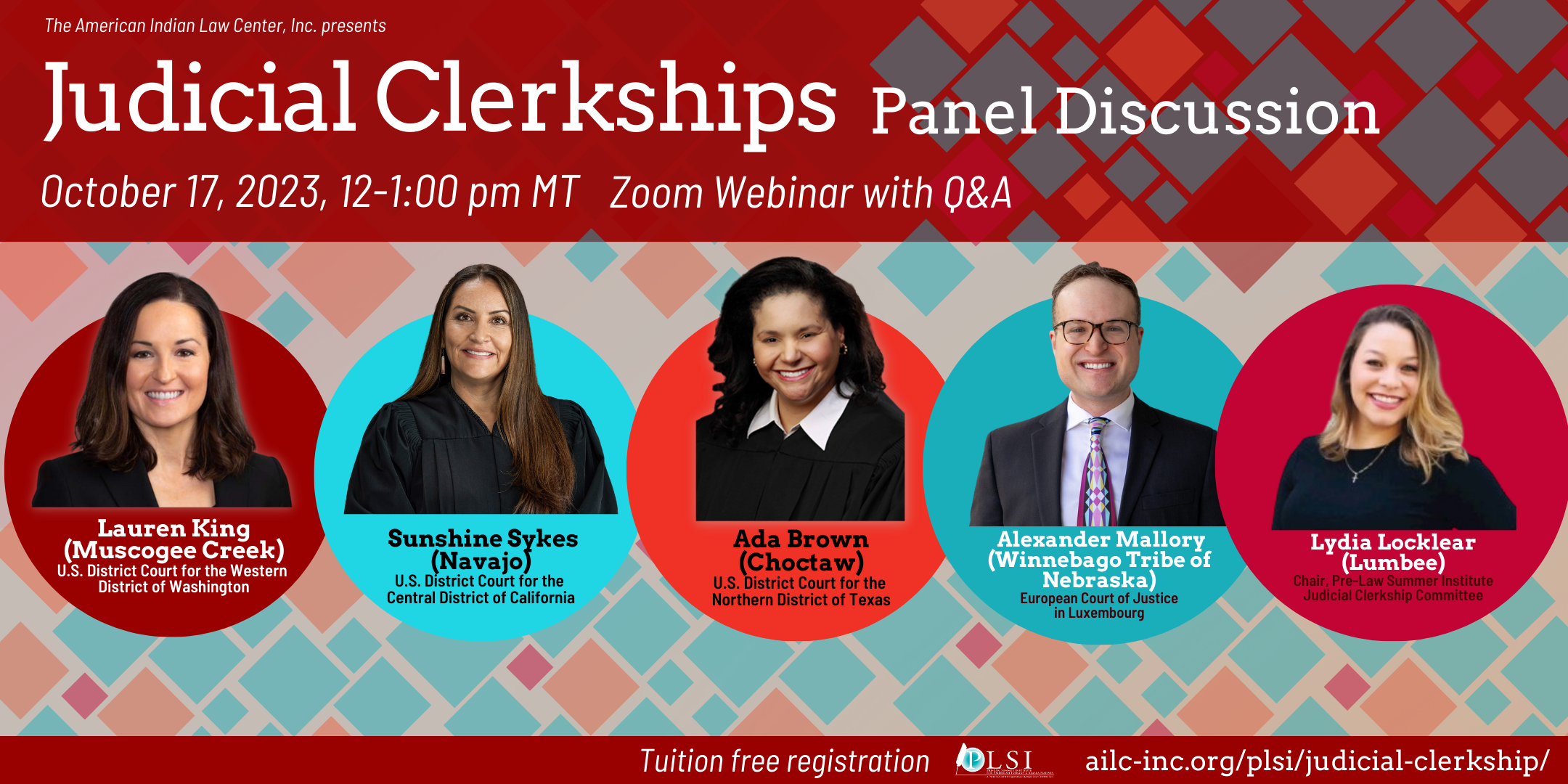
AILC & PLSI Judicial Clerkship Panel Discussion Next Week
Judicial Clerkships Panel Discussion
October 17, 2023, 12-1 pm MT
Zoom Webinar with Q&A
The tribal, state, and federal benches need more Native judges and judicial clerks. We encourage Native law students to join us to meet Native federal judges and learn more about their journey. Please share with NALSA groups!
Visit the website for more information about the panelists and to register.
ABA Panel on the 2022 Term in Indian Law
ABA Webinar on the NDN Law Cases of the 2022 Term
Join us for a free webinar hosted by the ABA CRSJ discussing Indian law cases decided by SCOTUS this term. We have a great panel, Erin Doughtery Lynch, Shay Dvoretzky, Matthew Fletcher, Lenny Powell, Pratik Shah, who will discuss the cases and the broader impact on federal Indian law principles.
Date: Tuesday, August 29, 2023
Time: 3:00 PM – 4:30 PM ET
Register HERE: https://lnkd.in/gZz6YWnJ
ABA SCOTUS Indian Law Cases Webinar (August 29, 2023)
Date: Tuesday, August 29, 2023
Time: 3:00 p.m. – 4:30 p.m. ET
Format: Free non-CLE Webinar
Sponsor: ABA Section of Civil Rights and Social Justice
The United States Supreme Court decided several Indian law cases this term that touch on fundamental concepts at the core of federal Indian law. This panel, made up, in part, of lawyers who were directly involved in each of these cases on behalf of Indian Tribes, and other lawyers and scholars who will offer a broader perspective, will discuss each of these cases and their impact on broader federal Indian law principles.
Speakers:
- Erin C. Dougherty Lynch – Senior Staff Attorney and Managing Attorney, Native American Rights Fund
- Shay Dvoretzky – Partner, Supreme Court and Appellate Litigation, Skadden, Arps, Slate, Meagher & Flom LLP and Affiliates
- Matthew L.M. Fletcher – Harry Burns Hutchins Collegiate Professor of Law, University of Michigan Law School
- Leonard R. Powell – Associate, Jenner & Block
- Pratik A. Shah – Partner, Akin Gump Strauss Hauer & Feld LLP
Moderator:
- Patty Ferguson Bohnee – Director, Indian Legal Clinic, Arizona State University Sandra Day O’Connor College of Law; Attorney, Sacks Tierney
Register HERE: https://americanbar.zoom.us/webinar/register/WN_lbFcLRxERZqV6JrqtYYOWw
The Section of Civil Rights and Social Justice is the only ABA membership entity solely dedicated to the advancement of human rights, civil rights, civil liberties, and social justice. We invite you to become involved with critical legal and public policy issues by joining one or more Section committees. You may want to become part of a committee to learn more about developments in a particular issue area. Or you may choose to take a more active role by participating in or organizing specific activities. Whatever your area of interest or specialization, we have a home for you. To get involved, join us here.
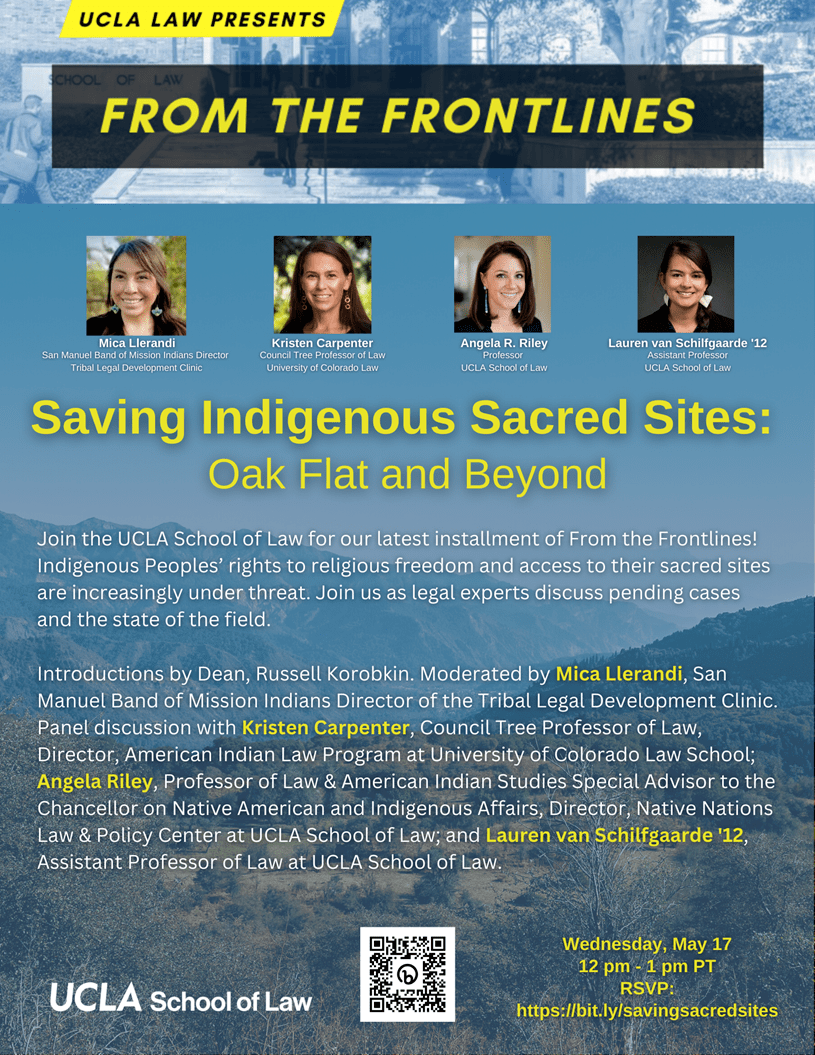
UCLA Webinar on Indigenous Sacred Sites
ABA SEER “Community Conversation” re: Arizona v. Navajo Nation Supreme Court Argument
Here.
Title: Arizona v. Navajo Nation, U.S. Supreme Court Oral Argument Debrief
Date/Time: April 20, 2023, 12–1 pm Mountain Time.
Registration link: https://americanbar.zoom.us/meeting/register/tJIqf-uprDgtHNJdop7wBRttqIpyu3j9-Xw2#/registration
Description: Last month, the U.S. Supreme Court held oral arguments in Arizona v. Navajo Nation, a case that pertains to the Navajo Nation’s claims to water rights in the mainstem of the Colorado River and the United States’ trust obligation to assess and assert those rights under the Court’s more-than-century-old Winters doctrine. Although this current case ostensibly relates to one Tribe’s rights to one specific water source, the forthcoming Supreme Court ruling could have ripple effects for Native Nations across the United States as they seek to assert, quantify, and settle their water rights in ongoing adjudications nationwide. Join law professors Heather Whiteman Runs Him (University of Arizona), Derrick Beetso (Arizona State University), and Heather Tanana (University of Utah) for a discussion about the Arizona v. Navajo Nation oral arguments, the potentially wide-ranging implications of the case, and their work on the amicus briefs they coauthored and submitted to the Court, during this free virtual event sponsored by the ABA Section of Environment, Energy, and Resources’ (SEER) Native American Resources Committee and Water Resources Committee.

Brackeen Post-Oral Argument Discussion – via Zoom
Please join the Indigenous Law and Policy Center this Wednesday, November 9, at 6:00 p.m. ET for a post-oral argument discussion of Brackeen over Zoom. Wenona Singel will be moderating this conversation with speakers Matthew L.M. Fletcher, Melody McCoy and April Youpee-Roll.
The link to register is here. Please see the below flyer for more information.

 Turtle Talk
You must be logged in to post a comment.