Ablavsky and Berger on Birthright Citizenship and Elk v. Wilkins

Gregory Ablavsky and Bethany Berger have posted “Subject to the Jurisdiction Thereof: The Indian Law Context,” forthcoming in the NYU Law Review Online, on SSRN.

Here is the abstract:

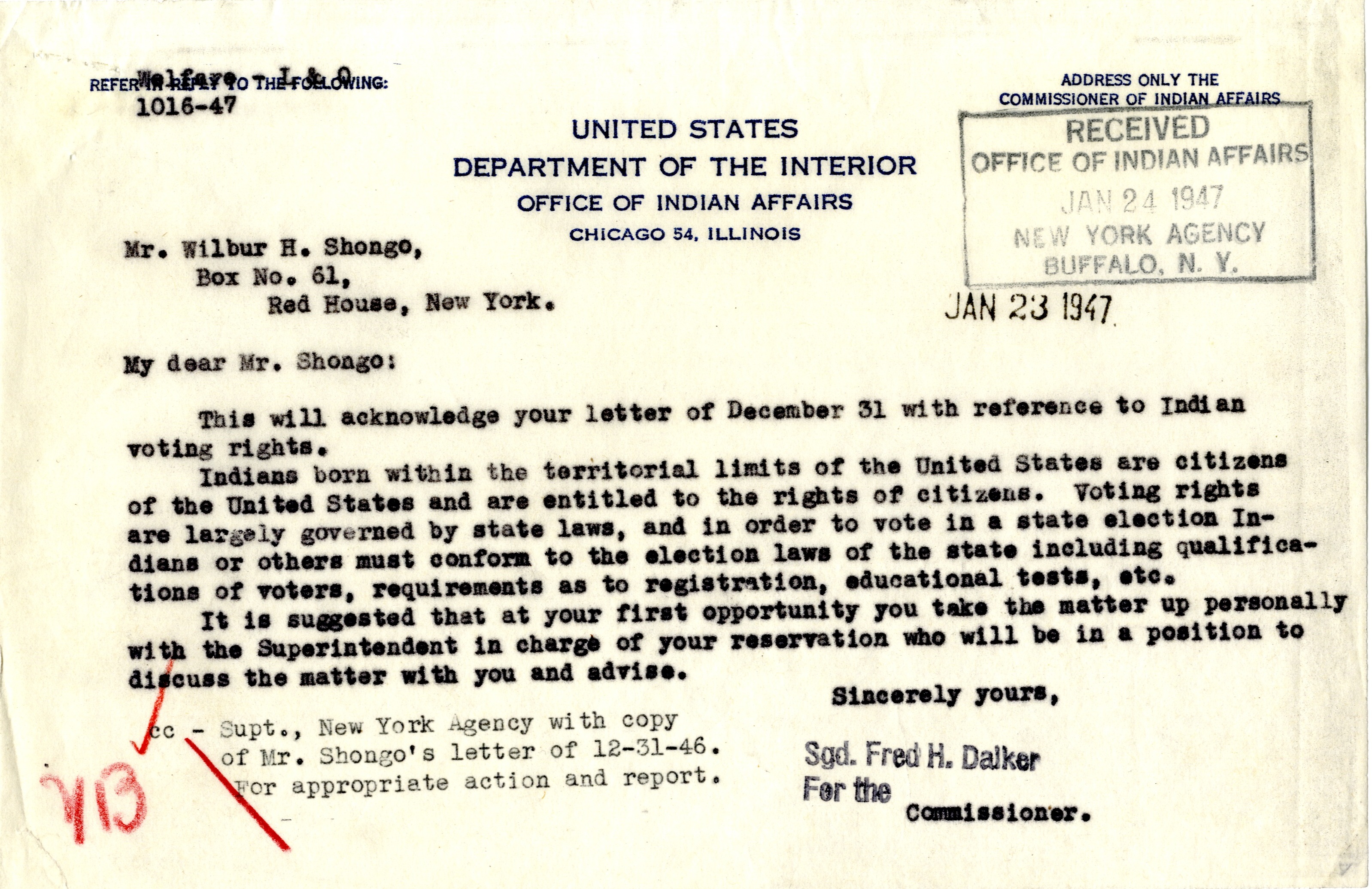
Section 1 of the Fourteenth Amendment provides that “All persons born or naturalized in the United States, and subject to the jurisdiction thereof, are citizens of the United States and of the State wherein they reside.”  Much of the debate over the meaning of this provision in the nineteenth century, especially what it meant to be “subject to the jurisdiction” of the United States, concerned the distinctive status of Native peoples—who were largely not birthright citizens even though born within the borders of United States.  

It is unsurprising, then, that the Trump Administration and others have seized on these precedents in their attempt to unsettle black-letter law on birthright citizenship. But their arguments that this history demonstrates that jurisdiction meant something other than its ordinary meaning at the time—roughly, the power to make, decide, and enforce law—are anachronistic and wrong. They ignore the history of federal Indian law.

For most of the first century of the United States, the unique status of Native nations as quasi-foreign entities was understood to place these nations’ internal affairs beyond Congress’s legislative jurisdiction. By the 1860s, this understanding endured within federal law, but it confronted increasingly vocal challenges. The arguments over the Fourteenth Amendment, then, recapitulated this near century of debate over Native status. In crafting the citizenship clause, members of Congress largely agreed that jurisdiction meant the power to impose laws; where they heatedly disagreed was whether Native nations were, in fact, subject to that authority. Most concluded they were not, and in 1884, in Elk v. Wilkins, the Supreme Court affirmed the conclusion that Native nations’ quasi-foreign status excluded tribal citizens from birthright citizenship. 

But the “anomalous” and “peculiar” status of Native nations, in the words of the nineteenth-century Supreme Court, means that the law governing tribal citizens cannot and should not be analogized to the position of other communities—or at least any communities who lack a quasi-foreign sovereignty and territory outside most federal and state law but within the borders of the United States. Indeed, the Court in Wong Kim Ark expressly rejected the attempt to invoke Elk v. Wilkins to deny birthright citizenship to a Chinese man born in the U.S. to non-citizen parents, ruling that the decision “concerned only members of the Indian tribes within the United States.” The analogy has no more validity today than it did then, and the current Court should continue to reject it.

Materials in the Challenge to the Birthright Citizenship Executive Order [and Commentary]

Here are the materials in State of Washington v. Trump (W.D. Wash.):

1 Complaint

10 Motion for TRO

36 Opposition

43 DCT TRO

And here are the materials in State of New Jersey v. Trump (D. Mass.):

1 Complaint

5 States Motion for Injunction

Elie Mystal Asks Racists to Stop Using the “Indians Not Taxed” Clause to Attack Birthright Citizenship (I should say “demands” instead of “asks”)

Here.

News Profile of Samoan Birthright Citizenship Cases

From Mother Jones, here is “The Obama Administration Is Using Racist Court Rulings to Deny Citizenship to 55,000 People.”

HT to How Appealing.

D.C. Circuit Panel Holds American Samoans Not Entitled to American Birthright Citizenship

Here is the opinion in Leneuoti Tuaua v. United States.

An excerpt:

As even the dissent to Elk recognized, “it would be obviously inconsistent with the semi-independent character of such a tribe, and with the obedience they are expected to render to their tribal head, that they should be vested with the complete rights—or, on the other, subjected to the full responsibilities—of American citizens. It would not for a moment be contended that such was the effect of this amendment.” Id. at 119–20 (Harlan, J., dissenting). Even assuming a background context grounded in principles of jus soli, we are skeptical the framers plainly intended to extend birthright citizenship to distinct, significantly self-governing political territories within the United States’s sphere of sovereignty—even where, as is the case with American Samoa, ultimate governance remains statutorily vested with the United States Government. See Downes, 182 U.S. at 305 (White, J., concurring) (doubting citizenship naturally and inevitably extends to an acquired territory regardless of context).

I would have thought (hoped) that the rule of Elk v. Wilkins had faded into meaninglessness, but here it is again.

Another excerpt:

At base Appellants ask that we forcibly impose a compact of citizenship—with its concomitant rights, obligations, and implications for cultural identity12—on a distinct and unincorporated territory of people, in the absence of evidence that a majority of the territory’s inhabitants endorse such a tie and where the territory’s democratically elected representatives actively oppose such a compact.

That footnote 12 in bold? Here:

See also, e.g., Robert B. Porter, The Demise of the Ongwehoweh and the Rise of the Native Americans: Redressing the Genocidal Act of Forcing American Citizenship Upon Indigenous Peoples, 15 HARV. BLACKLETTER L.J. 107, 169 (1999) (arguing that statutorily “[f]orcing American citizenship upon Indigenous [Native American] people [destructively] transformed [their] political identity”).


Paul Finkelman, Jim Anaya, and Jack Chin on Birthright Citizenship

From the Huffington Post (h/t LHB):

Under the Fourteenth Amendment, children born in the United States are citizens, even if their parents are not. Inspired by Arizona’s new (and partially suspended) law regulating unauthorized immigration, Senators Mitch McConnell, John Kyl, John McCain, Lindsey Graham, Representative John Boehner, and other Republican leaders have proposed considering amending the Constitution to deny citizenship to children born in the United States but whose parents are undocumented.

As law professors we oppose the proposed change, not only for historical and legal reasons, but also on deeply personal grounds. We are the face of the children of illegal aliens, people who are not just abstractions but parts of the human mosaic of the American nation. As it happens, all three of us are the grandchildren of individuals who entered the United States without authorization. From our perspective, the proposal is unwise.

For centuries, James Anaya’s family lived off land that became part of southern New Mexico. Some of them relocated to Mexico after the United States acquired the territory in 1853. His grandfather, born in Mexico, returned to his ancestral homeland after statehood and his wife to be — James’s grandmother — followed. Both of them entered the United States illegally. Theoretically they could have immigrated legally, because there was no maximum quota on immigration from Mexico until 1965. However, while penniless Europeans were admitted, impoverished Mexicans were routinely turned back. James’s grandparents just moved without any papers and their children, born in the United States, became citizens at birth.

Gabriel Chin’s grandfather immigrated from Guangxiao, China in the period (1882-1943) when the Chinese Exclusion Act prohibited the immigration of racial Chinese. Like many other Chinese men admitted as paper sons, he entered California on the false claim that he was the Chinese-born child of a United States citizen and thus a citizen himself.

Paul Finkelman’s Polish-born grandfather feared being turned back at Ellis Island because of his poor eyesight. At the time people with glaucoma were not allowed into the United States. His grandfather did not have glaucoma, but he did not understand the rules. Immigration inspectors carefully excluded people who they feared could not work, so he took no chances and entered by a clandestine trek through Canada, later regularizing his status. His other grandfather lied about his age at Ellis Island — grounds for deportation — so that he could work when he landed. He later gained his citizenship when he was drafted in World War I, even though he was actually too young to be drafted. The lie brought him into the work force and then citizenship, but it was all in violation of immigration laws.

We are struck by what the absence of birth citizenship might have meant for our parents and us, and what it might mean for others in the future. Looming is the caste problem — if the children of undocumented immigrants are not citizens, then perhaps their grandchildren and great-grandchildren are not citizens either. This raises the spectre of multi-generational groups who are citizens of no nation yet know no other land than the United States. In addition, intentionally or not, most people to be denied citizenship would be of Hispanic ancestry. After centuries of effort to remove race from American law, the overwhelming racial impact would inevitably be divisive.

As legal scholars, we believe it would be a mistake to repudiate the long tradition of birthright citizenship in the United States, as number of Republican leaders want to do. Before the Civil War all white people born in the United States were citizens at birth, even if their parents were aliens. This tradition predated the American Revolution. In fact, some of the complaints against King George III centered on his refusal to allow for rapid naturalization of immigrants to the colonies.

Continue reading