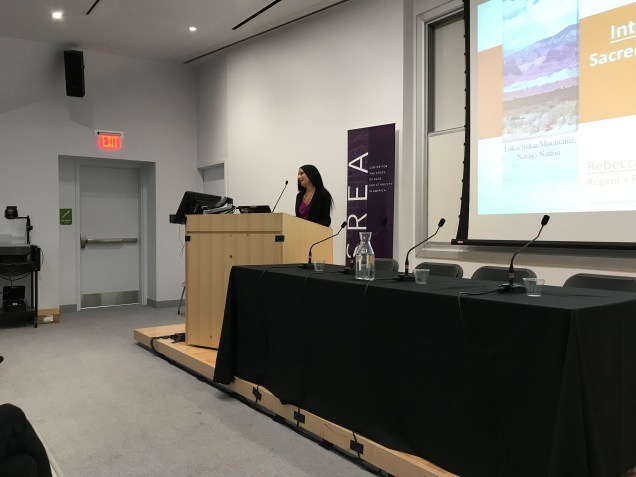
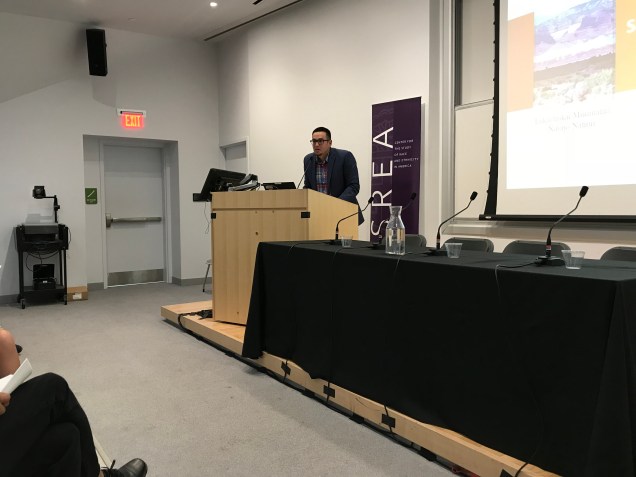
Here:
IBES Room 130, 85 Waterman Street
The political and social dynamics of American Indian sacred sites and basic human rights protections within the contemporary U.S. are constantly evolving. This panel, including various legal scholars, community leaders, and activists, will explore issues of human rights, self-determination, sovereignty, and potential International legal remedies in order to better understand the contemporary realities of misunderstanding, lack of social justice, U.S. constructed hierarchies of economic and political inequality, and overall legacies of colonialism.
A CSREA Faculty Grant Event. Organized by Nicholas Laluk, Postdoctoral Fellow with CSREA and the Department of Anthropology.
Cosponsored by the Taubman Center for American Politics and Policy, Native American and Indigenous Studies, and the Haffenreffer Museum of Anthropology.
Here.
From Law & Humanities Blog:
Call for Participation: 13th Annual ASLCH Conference
March 19-20, 2010
Brown University, Providence, Rhode Island
The Association for the Study of Law, Culture and the Humanities is an organization of scholars engaged in interdisciplinary, humanistic legal scholarship. The Association brings together a wide range of people engaged in scholarship on legal history, legal theory, jurisprudence, law and cultural studies, law and literature, law and the performing arts, and legal hermeneutics. We want to encourage dialogue across and among these fields about issues of interpretation, identity, ideals, values, authority, obligation, justice, and about law¹s place in culture.
We will be accepting proposals for panels, roundtables, papers, and volunteers for chairs and discussants from July 15th until October 15th 2009.
PLEASE NOTE: To submit proposals, please go to the online submission site https://www.regonline.com/13thAnnual
From the Brown Daily Herald:
The faculty’s decision last week to rename Columbus Day “Fall Weekend” on the University calendar has garnered more attention both locally and nationally than the average code revision, with Providence mayor David Cicilline ’83 and Rush Limbaugh, the high-profile conservative pundit, among those decrying the move.
Though the faculty’s vote last Tuesday seemed to reflect student opinion — a recent Herald poll suggested that the majority of Brown students disapproved of continuing to call the holiday Columbus Day — the resolution has prompted a wave of criticism from city leaders, who said the move was hypocritical and disrespectful to Italian-Americans.
***
“I definitely support the decision,” Avi Kenny ’11 said. Columbus is “undeserving of a holiday,” he said.
“What they teach us in elementary school is misleading — hero worshipping,” said Josh Marcotte ’11, calling the faculty’s decision “a progressive step.”
Araceli Mendez ’12 said she too supported the change, but understood why some groups, such as Italian-Americans, might see it as offensive. “It’s not that complicated of an issue, but I understand where they’re coming from,” she said.
Michael Hogan ’11 said he generally approved of the decision to rename Columbus Day, but expressed some concern about the precedent such a move might set. “Are we going to stop Presidents Day because Thomas Jefferson had slaves?” he asked.
The faculty vote was preceded by months of pressure from a small group of students who wanted the University to stop recognizing Columbus Day. The students had originally proposed that the University take a different day off, but the months of dialogue ended with the proposal to change only the name of the holiday, in part because some faculty and staff wanted the University’s October holiday to coincide with that of local schools.
Columbus Day, observed on the second Monday in October, has been a federal holiday since 1971.
The American Constitution Society just released an issue brief called “Understanding How Employees’ Rights to Organize Under the National Labor Relations Act Have Been Limited: The Case of Brown University.” Anyone following Indian Law knows that not all employees have this problem!
Here it is: dannin-issue-brief
Just take the words “Brown University” and replace them with “San Manuel Indian Bingo and Casino” and you have a wildly different result. This issue brief, which is well-written, notes how the NLRB ignores precedent to reach pro-employer results and harms employee rights. Unfortunately, there is no mention of the San Manuel Indian Bingo and Casino decision (from the same year as the Brown University decision, 2004), which reversed 30 years of precedent, gave short shrift to tribal sovereignty, and utterly ignored the governmental purposes of tribal gaming.
I haven’t seen any issue briefs on Indian Law from the ACS, an organization I support. I suppose it’s not a major issue for the ACS, but I urge the ACS and its issue brief writers to consider Indian Law on occasion. Dean Getches wrote a decade ago that tribal interests fare worse than any class of litigant before the Supreme Court, worse than convicted criminals, and not much has changed to the benefit of tribal interests.
Here are a few things the ACS could write about:
There are many other issues. There’s a lot of good things going on in Indian Country, too.
 Turtle Talk
You must be logged in to post a comment.