Very prestigious. Congratulations to Charles! 
Notice here.
Very prestigious. Congratulations to Charles!
Notice here.
The event will be on June 13 in Seattle. More information is here. Charles Wilkinson will be speaking.
Listen here.

It sounds kind of obvious. If a state or the federal government signs a treaty, it should honor the agreement. But as recently as the 1970s that wasn’t true of treaties signed with Indian tribes. David Getches fought to change that. During his legal career, he also worked on other big issues in the West, like water law and public lands. Most recently, Getches was the dean of the law school at CU-Boulder. He died earlier this month at age 68 of pancreatic cancer. Two of his colleagues join Ryan Warner. John Echohawk heads the Native American Rights Fund and Professor Charles Wilkinson teaches law at CU.
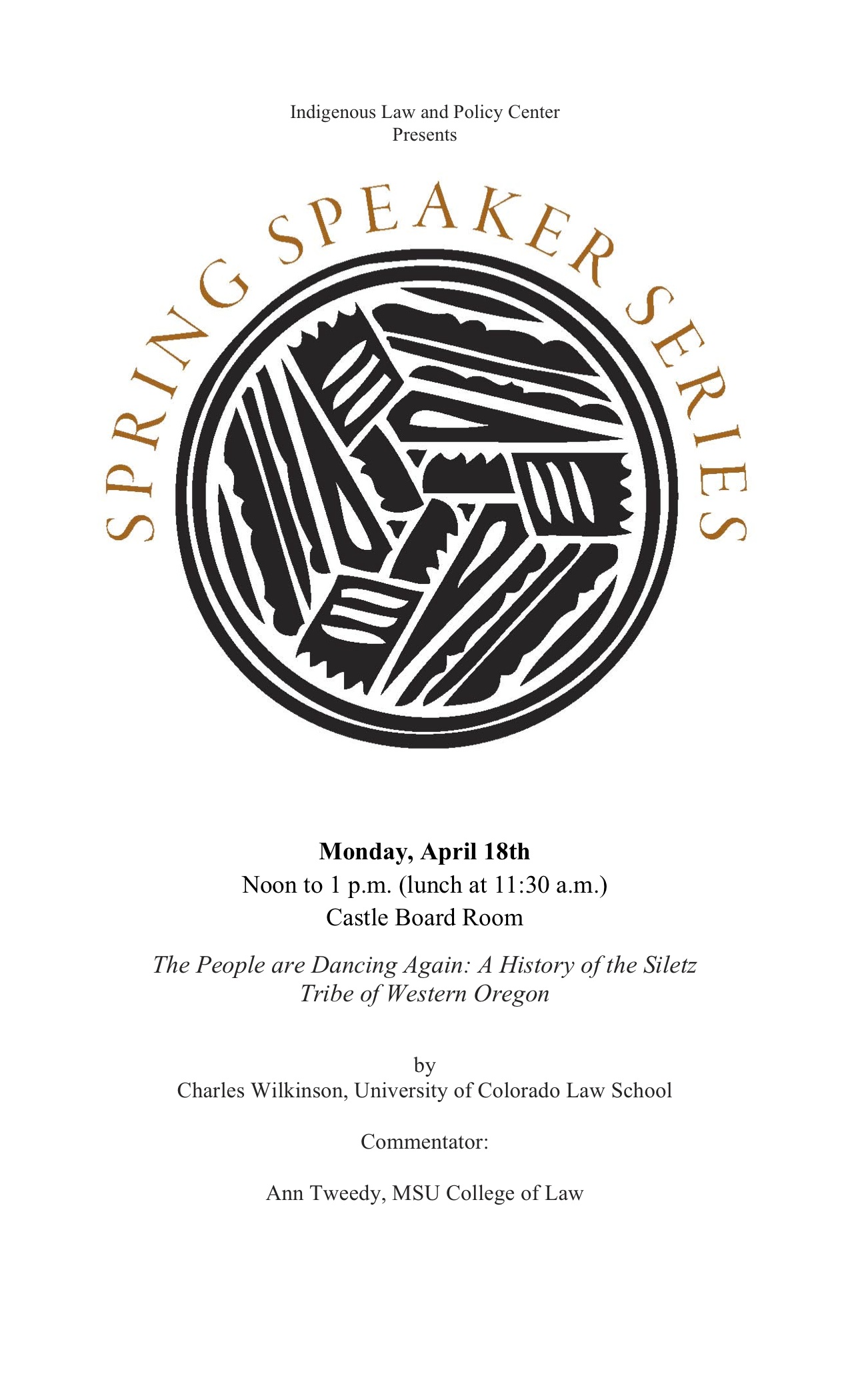
Please come hear Charles Wilkinson speak about his new book, The People are Dancing Again: The History of the Siletz Tribe of Western Oregon. Ann Tweedy will be providing commentary. Lunch will be served around 11:30, with the speakers starting at noon in the Castle Board Room.
To be published in November by the University of Washington Press!
Book website here. Book trailer here.

Here’s the blurb:
The history of the Siletz is in many ways the history of many Indian tribes: a story of heartache, perseverance, survival, and revival. The history of the Siletz people began in a resource-rich homeland thousands of years ago. Today, the tribe is a vibrant, modern community with a deeply held commitment to tradition.
The Confederated Tribes of Siletz Indians-twenty-seven tribes speaking at least ten languages-were brought together on the Oregon Coast through treaties with the federal government in 1853-55. For decades after, the Siletz people lost many traditional practices, saw their languages almost wiped out, and experienced poverty, ill health, and humiliation. Again and again, the federal government took great chunks of the magnificent, timber-rich tribal homeland, reducing their reservation from the original allotment of 1.1 million acres-which reached a full 100 miles north to south on the Oregon Coast-to what is today several hundred acres of land near Siletz and 9,000 acres of forest. By 1956, the tribe had been “terminated” under the Western Oregon Indian Termination Act, selling off the remaining land, cutting off federal health and education benefits, and denying tribal status. Poverty worsened, and the sense of cultural loss deepened.
From the Federal Circuit Bar Journal (17 Fed. Circuit B.J. 235 (2008)):
Here’s an excerpt from “Indian Nations and the Federal Government: What Will Justice Require in the Future?”, a part of the 20th Annual Federal Circuit Judicial Conference:
The Court of Federal Claims has asked me to take a few minutes to step back, look out toward the horizon, and even dream a bit, about what the field of Indian law might be and I’m honored to oblige as best I can.
I believe that Indian tribes would receive the high justice they deserve from our courts if judges were to understand two legal doctrines in their full context and to understand them in two different ages. What I will propose is easy to state but difficult to apply. Yet it is realistic and can be done largely or completely by those judges able to invest the time.
I wish that judges could know tribal sovereignty and the trust relationship. I wish further that they could know them under the circumstances at treaty time and under the circumstances today. And I wish that they couldfeel them as well as know them. Lawyers and judges apply most legal rules mechanically. But some patches of law, because of their sensitive content, histories, and human faces, hold elevated places in the law. These are the terrains of the law that wefeel -free speech, due process in a murder trial, freedom from racial discrimination and others-the ones that touch a judge’s soul, the ones that make a judge put in the time, reflect, worry, and insist on pure justice, however that may cut in a particular case. Tribal sovereignty and the trust rightfully belong in that company, the law’s highest company.
***
Much of the law of tribal sovereignty comes back to tribal courts. This applies even to cases that do not directly involve tribal court jurisdiction. Should a federal court uphold a tribal tax, zoning ordinance, or fishing or hunting regulation? Non-Indians may be affected. The tribal courts inevitably must be considered because, if the tribe has the substantive lawmaking authority, then disputes will go to tribal court. Can the federal court trust the tribal court?
To a person, state and federal judges know both state and federal courts and how they work. It’s second-nature. But very few know much about tribal courts. Given that, it’s human nature for federal and state judges to be concerned about upholding the jurisdiction of courts that may be incompetent or unfair. This is important: Tribes own 58 million acres in the 48 continuous states-an area larger than Minnesota-and the tribal land base is steadily growing.
 Turtle Talk
You must be logged in to post a comment.