Prof. Frank Pommersheim at Snoqualmie

Prof. Frank Pommersheim

Among the highlights of Professor Pommersheim’s sage talk was the advice to Tribes to broaden business licenses to include consent to tribal jurisdiction over tort claims related to the business and consent by the business’ employees. He also suggests that Tribes consider amending their civil procedure codes to eliminate interlocutory appeals over jurisdictional questions.

Frank Pommersheim Talk at Snoqualmie (4-4-16)

Here:

POMMERSHEIM

Lewis & Clark Law School Talk with Frank Pommersheim on March 10, 2016

Click to enlarge
Click to enlarge

Rosebud Sioux Tribe Supreme Court Decision in Tribal Chairman’s Removal Dispute

Here is the opinion in Scott v. Kindle:

Scott

An excerpt:

The case at bar is fraught with such risk. There is no doubt that the action of the Tribal Council in removing President Scott from office is of historical significance. As such, it ought not be too readily set aside, especially when no practical remedy is available. As noted above, a new Tribal president, William Kindle, has recently been elected and taken office. Mr. Scott, even if he could prevail on his substantive arguments, cannot be placed back in office.3 Under these circumstances, it’s best to avoid any unnecessary constitutional conflict.


Cheyenne River Sioux Tribal Court of Appeals Decision in Tribal Redistricting Dispute

Here is the opinion in Woods v. Cheyenne River Sioux Tribal Council:

woods

An excerpt:

Despite the long and convoluted history of this case, much has been accomplished and both parties are to be commended for the positive results to date. As noted by Attorney Gunn in his letter of September 21, 2015, which is now part of the record in this case:

… the Tribal Council does not seek to undermine the rights and values enshrined in the Tribal Constitution or the Indian Civil Rights Act. To the contrary, the Tribal Council has honored and protected those rights by enacting redistricting legislation that ensures, and will continue to ensure, proportionate representation in the Tribal Council for all Tribal citizens.

There may still be differences of opinion in the details, but not on the overarching Tribal constitutional principle that mandates Tribal Council reapportionment. This, indeed, is worthy and noteworthy advance.

To be clear, while this case is over, the process of reapportionment and redistricting is not. Both sides realize that there is more to come, especially in regards to the Tribal Council’s commitment to taking a new tribal census in 2017 to guide redistricting for 2018 elections. See, e.g., Tribal Council Resolution 10-2015-CR. The implementation of this Tribal Council resolution may or may not lead to new litigation. If there is such litigation, the issue of Tribal Council sovereign immunity may be raised as a defense at that time. If it is, both the trial court and this Court shall rule upon it.

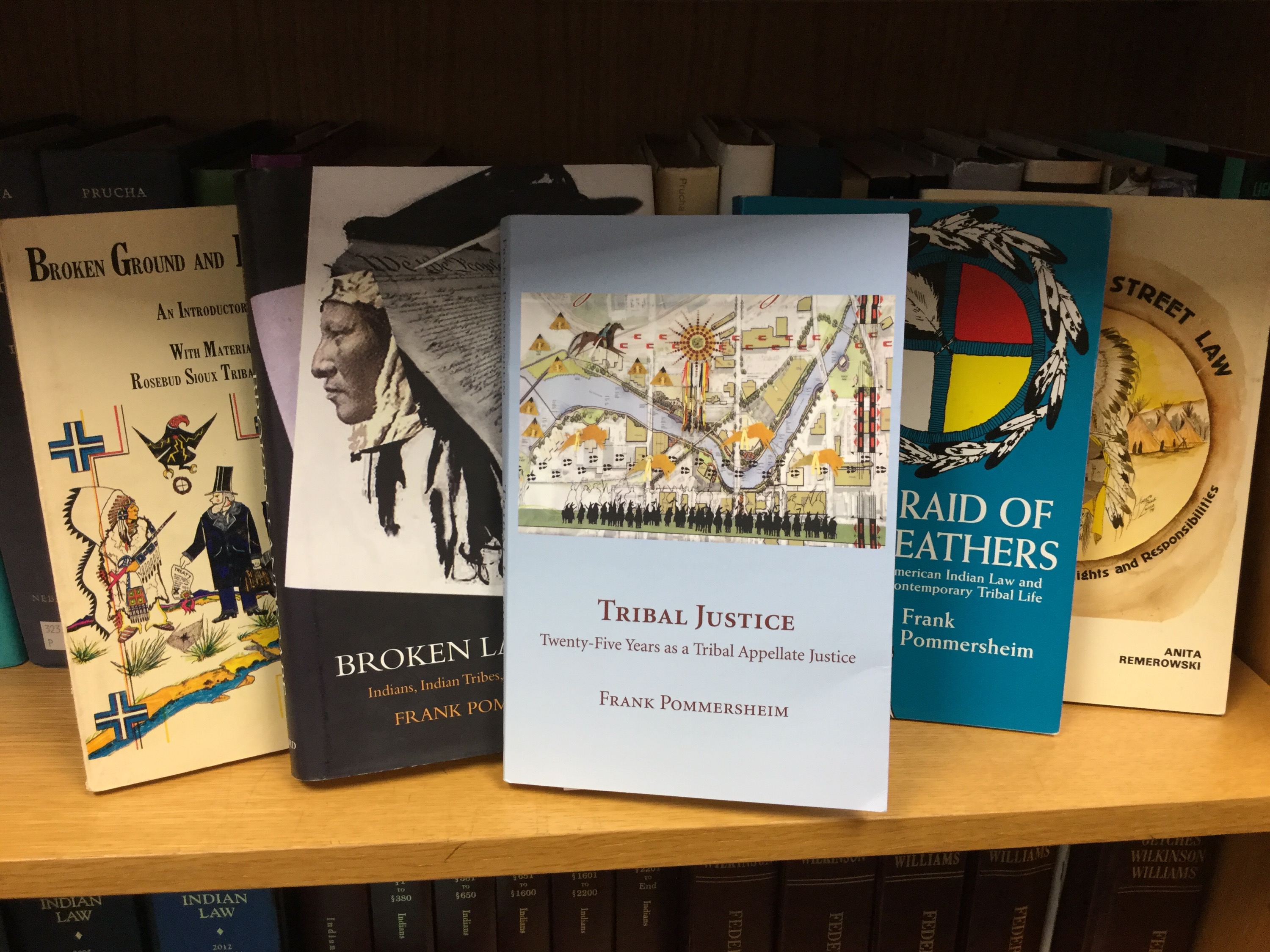
New on the Turtle Talk Bookshelf: Frank Pommersheim’s Tribal Justice

Here:

Blurbs:

“Frank Pommersheim is the modern apotheosis of Ksa, Nanaboozhoo, Quetzalcotl, Athena, John Marshall, and the Buddha—all legends of judicial wisdom. Tribal Justice is a powerful culmination of his career work so far, and gives us all hope for another quarter century of his judgment, experience, and calm thoughtfulness. As the Buddha (probably) said, Pommersheim ponders from the stars and judges from the sky, yet speaks from the heart and writes for the land.” — Matthew Fletcher, Professor of Law, Michigan State University College of Law

“Every Tribal Judge should read this book. Written from the perspective of an able and seasoned Tribal Appellate Justice, it shares judicial perspective that is unique to members of the Tribal Judiciary. Justice is sacred. Native Justice is rooted in a world view that is starkly different than that of dominant society. We serve in Tribal communities but must deal with misguided federal law. This writing gives us guidance. Miigwetch, Frank!” — Michael Petoskey, Chief Judge, Pokagon Band of Potawatomi

“Professor Pommersheim’s new book […] is a soul-searching and compelling look at the importance of tribal courts of appeals in the development of a body of tribal law that is responsive both to the needs of tribal citizens, who adhere to traditional notions of justice, and the non-Indian community, with well-reasoned court decisions that lay out clear parameters for law and order in tribal communities. By examining individual cases from several different tribal communities, one of which was examined by the US Supreme Court and one which is about to be critiqued, Professor Pommersheim demonstrates himself to be an indispensable player in the advancement of tribal justice in numerous communities. Having been involved in some of the cases chronicled in the book, and having served with Professor Pommersheim on appellate courts for approximately 18 years, I have seen first-hand Professor Pommersheim’s commitment to ensuring that tribal appellate courts serve the needs of all litigants in tribal courts.” — BJ Jones, Chief Judge Sisseton-Wahpeton Oyate Tribal Court; Director Tribal Judicial Institute, University of North Dakota School of Law

“Only a poet could so seamlessly intertwine memoir, practical how-to, and grand vision in one remarkable book about law and life in Indian country. Tribal Justice is deeply compelling, taking the reader on a more than quarter-of-a-century ride through an extraordinary career devoted to tribal law and the people from which it springs.” — Angela Riley, Professor of Law, UCLA School of Law

“Professor and Justice Frank Pommersheim has once again written an inspiring book […] to be read and reread. His current writing and appellate opinions provide an essential guide to understanding tribal courts, specifically appellate courts. Justice Pommersheim’s book is a must read by all legal and judicial practioners and tribal, federal and state leaders to understand the importance of the Tribal judiciary in protecting and enhancing the sovereignty of tribal nations. Respectfully, he shares his life with Indian people in a most graceful, intellectual, and poetic manner and emphasizes that justice, freedom and equality is for all.” — Cheryl Demmert Fairbanks (Tlingit-Tsimpshian), Esq., Justice for the Inter-Tribal Court of Appeals for Nevada and White Earth Nation; Visiting Professor of Law, University of New Mexico’s Southwestern Indian Law Clinic

Who Won American Indian Law and Policy, 2014, Second Round, Bracket 3 of 4

Now we move on to the quarterfinals of Category 3, People and Parties.

#1 Hon. Diane Humetewa v. #8 Bill Wood

Hun, Judge Humetewa only won 89 percent of votes. Has she already presided over the criminal cases of 11 percent of TT readers and their friends and families? 🙂

I think Professor Wood’s in for a rough quarterfinal. Sorry brother. But you beat Dollar General, getting nearly two-thirds of the vote!

#4 Sarah Deer v. #5 Hon. Kevin Washburn

In a battle of two geniuses, Prof. Deer prevails with 70 percent of the vote. In the battle of two feds, the assistant secretary prevails with 71 percent. This next round is going to be a clash of titans.

#2 Justice Sonia Sotomayor v. #10 Frank Pommersheim

We believe that, based on the fact that Justice Sotomayor only won 90 percent of the vote, our alum J.S. voted at least five times. 🙂

Justice Sotomayor will face Frank Pommersheim, who narrowly defeated Judge Canby, who did not, as far as I know, get much of the haiku vote, with 55 percent of the vote.

This sets up my favorite match-up — a tale of two New Yorkers! Erin Lane, where are you?

#3 Hon. Keith Harper v. #11 Structuring Sovereignty

Ambassador Harper won easily over Chris Deschene, with 69 percent of the vote. The win of the authors of Structuring Sovereignty by a 71 percent to 29 percent vote was somewhat surprising (to me anyway). I guess it’s too late to Bear Down, Arizona.

Who Won Indian Law and Policy 2014? First Round Bracket — 6 of 8

Second part of the third category, people and parties.

# 2 Justice Sonia Sotomayor

Everyone’s favorite Supreme Court Justice. Wrote scholarly and compelling concurrence in the Bay Mills matter. Wrote amazing dissent in the affirmative action case.

v.

# 15 McAllen Grace Brethren Church

Won Fifth Circuit case, along with Lipan Apache members, which held that the Eagle Act regs might violate RFRA.

# 7 Hon. William Canby

Just published the sixth edition of his legendary Nutshell. He’s legendary too.

v.

# 10 Frank Pommersheim

Professor, lawyer, tribal judge, poet. Posted all of his tribal court opinions online, an absolutely incredible resource. Still stirring things up in South Dakota.

# 3 Hon. Keith Harper

Confirmed as Ambassador to the United Nations Human Rights Council. Went right after violence against Indigenous women and girls.

v.

# 14 Chris Deschene

An amazing year, so far unsuccessfully challenging the Diné language requirement to run for tribal office at Navajo.

# 6 Robert A. Williams, Jr.

Probably should get his own category that we could parse out through the years, but this year was on Moyers. Force of nature.

# 11 Dean Stacy Leeds and Prof. Angelique EagleWoman

Yeah, time passes quicker than I thought. Turns out their great book, “Mastering American Indian Law,” was a 2013 masterpiece. Ok.

The real # 11 — Authors of “Structuring Sovereignty”

My favorite book of 2014, Structuring Sovereignty is a wonderful scholarly survey of modern tribal constitutions. Melissa Tatum, Miriam Jorgensen, Mary Guss, and Sarah Deer (a second appearance in the game).

News Coverage of Frank Pommersheim Talk on Tribal-State Relations in South Dakota

Here is “Tribal-state relations improved, not healed.”

An excerpt:

Billy Mercer of Sioux Falls, who was among those attending Sunday’s forum, said the forum gave him a firm understanding of what happened during statehood at the county level.

He also took a moment to ask whether the mayor or any of the legislative candidates were attending the meeting.

He found out there were none and said that disappointed him.

“Nobody was here on the political level,” Mercer said. “They are quick to point out a park where alcoholic Native Americans are hanging out, but when you have people here who are Native American trying to discuss things, on a functional level, they’re not here. That’s discrimination.”

Tribal Justice Frank Pommersheim Goes Digital: 25 Years as a Tribal Judge

Here (PDF):

Opening page for lib guide w pic