Gerald Torres has published “No Ordinary Lawsuit: The Public Trust and the Duty to Confront Climate Disruption–Commentary on Blumm and Wood” in the American University Law Review Forum.
Gerald Torres
New Scholarship by Gerald Torres on American Indian Blood
Gerald Torres has published “American Blood: Who is Counting and For What?” in the St. Louis University Law Journal‘s most recent symposium issue.
An excerpt:
For Indians, the problem of “who counts” is complex. That it could be asked at all reveals that asking “who counts?” is an artifact of power. The question could be whether Indians have “American blood”? Could they be part of the political community that was being created by Europeans in North America? Or could it mean who counts as an Indian for other reasons? These are not as radically divergent questions as they might first appear because they both pivot around the deeper inquiry: who is counting and for what? And because of the nature of the political culture of the new United States, “who counts” also necessarily implicates the question of race. Thus for Indians, the question is not merely whether they are a “race.” The question for Indians and other indigenous people is whether they will have access to the power that attaches to their being a nation and not just another “race” or ethnicity.
Atlantic.com: The Most Important Supreme Court Cases You’ve Never Heard Of
Here.
Thanks to Gerald Torres, Elk v. Wilkins makes the list:
Gerald Torres, professor, University of Texas School of Law
In 1879, John Elk renounced his allegiance to his American Indian tribe to go live among the citizens of Omaha. But when he tried to register to vote, the registrar claimed that he was not a citizen. No one disputed that Elk was born within the territorial limits of the United States, but in 1884’s Elk v. Wilkins, the Court ruled that the citizenship clause of the Fourteenth Amendment did not apply to Elk or others like him. The Indian Citizenship Act of 1924 changed this, but the case remains relevant to today’s birthright debate. Some suggest that the children of undocumented immigrants have no more claim to citizenship than Elk did. They are wrong.
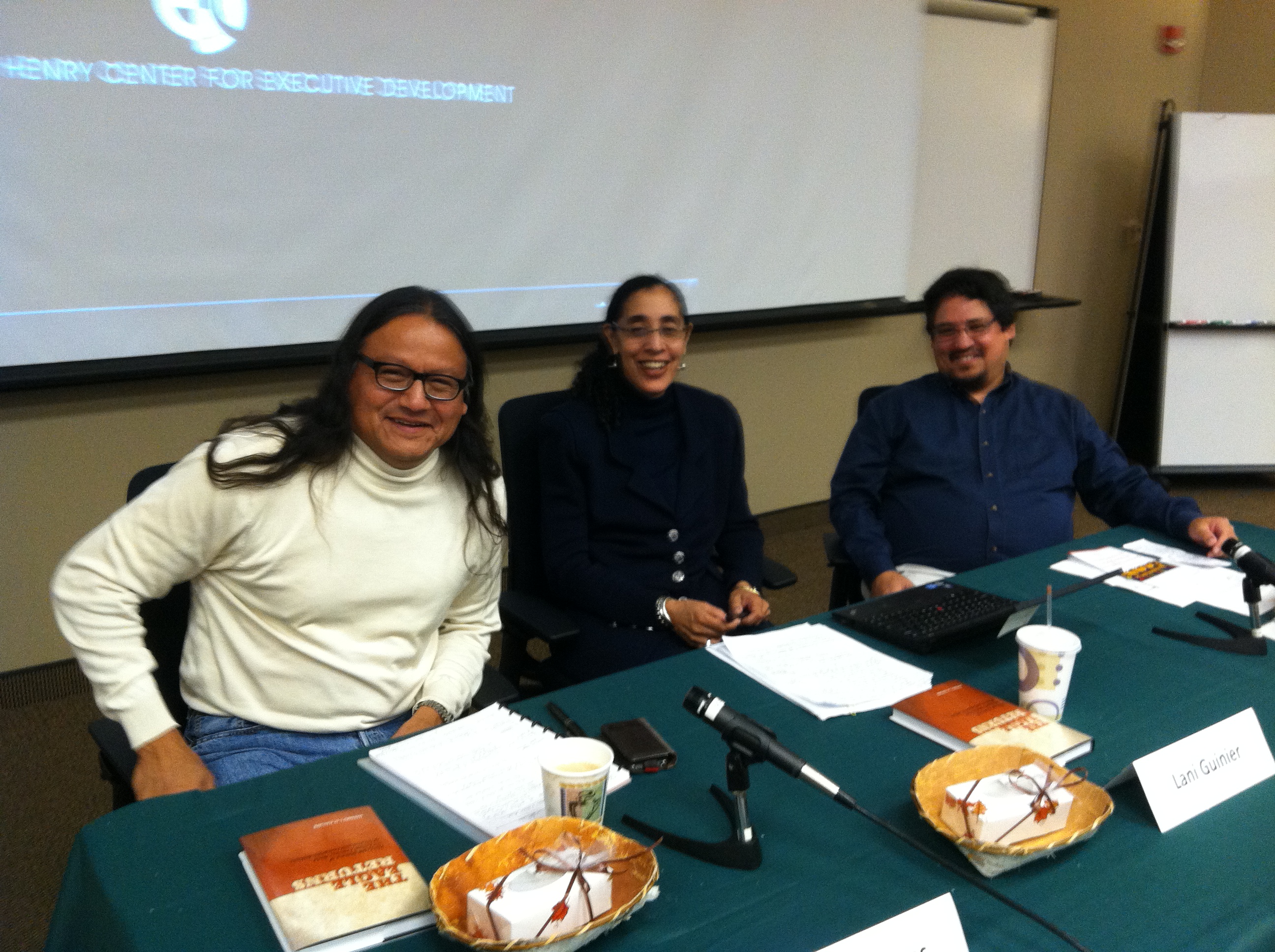
“Indian Tribes and Human Rights Accountability” Panel 6
Gerald Torres, Lani Guinier, and Joe Gone.
 Turtle Talk
You must be logged in to post a comment.