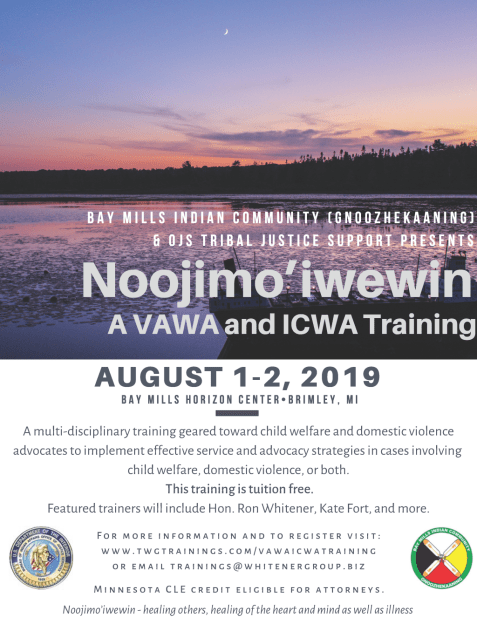
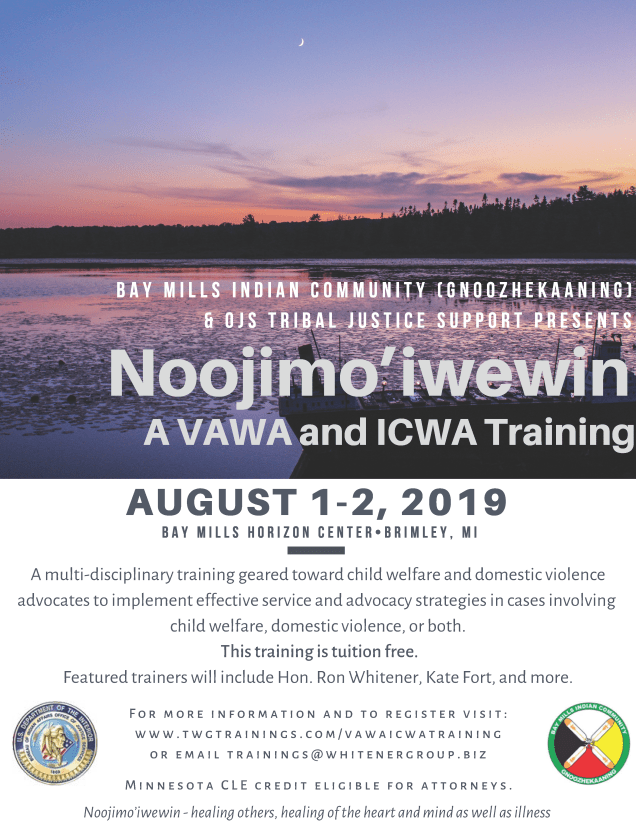
Noojimo’iwewin: A VAWA and ICWA Training

noonjimoiwewin_-a-vawa-and-icwa-training


Join this free training

August 1-2, 2019

at the Bay Mills Resort & Casino in Brimley, MI

A multi-disciplinary training geared toward child welfare and domestic violence advocates to implement effective service and advocacy strategies in cases involving child welfare, domestic violence, or both.

Register here and check out the Facebook event page.

Featured trainers include Hon. Jocelyn Fabry, Chief Judge, Sault Ste. Marie Tribe of Chippewa Indians; Rachel Carr, Executive Director, Uniting Three Fires Against Violence; Hon. Ron Whitener, Chief Judge, The Tulalip Tribes; Kate Fort, Director, Indian Law Clinic, Michigan State University Law, Indigenous Law Program; Lenny Hayes, Executive Director, Tate Topa Consulting, LLC and more. For a complete list of trainers visit the event page.

Brought to you by Bay Mills Indian Community and the OJS Tribal Justice Support.
Noojimo’iwewin – healing others, healing of the heart and mind as well as illness.

Follow up NY Times Article on ICWA

Here.

“I think it means a lot to our foster kids that we’re Cherokee,” said Carney Duncan, a gentle, soft-spoken man whose hair falls below his shoulders. “My mom and dad always helped people and took them in. I have an ‘Uncle Joe’ who is no kin but we took him in. And a ‘brother’ who lived with us who is no blood kin. We help our own. It’s a Cherokee value.”

Intercept Article on ICWA and the Brackeen Case

Here

“Babies don’t get born and run down to the citizenship office and file a petition,” said Matthew Fletcher, director of the Indigenous Law and Policy Center at Michigan State University. When his own child was born, he and his partner took a year to register him as a tribal member, in part because he was eligible for more than one tribal nation. “To say that somehow this kid hasn’t been enrolled yet and therefore doesn’t have a political relationship is really quite disingenuous.”

***

Reflecting on the rhetoric used by ICWA opponents like Sandefur, Nicole Adams, a spokesperson for Partnership for Native Children, pointed to the institutions that pushed for the use of boarding schools and adoption for decades before ICWA’s passage. “They were led by very well-intentioned Christian coalitions purporting that Indian children needed to be saved, and they were just the ones to do it. If you look at the rhetoric being put out by some of ICWA’s most staunch opponents, it is eerily and frighteningly similar.”

Indian Law Articles in This Month’s Judicial Notice (New York Court Publication)

Here

4 New York’s Quest for Jurisdiction over Indian Lands by Hon. Carrie Garrow

20 New York State’s Recent Judicial Collaboration with Indigenous Partners: The Story of New York’s Federal-State-Tribal Courts and Indian Nations Justice Forum by Hon. Marcy L. Kahn

34 The Origins and Evolution of the Indian Child Welfare Act by Danielle J. Mayberry

48 Thomas Indian School: Social Experiment Resulting in Traumatic Effects by Lori V. Quigley, Ph.D.

AFCARS Comments Due June 18

Here are the previous posts on the Adoption and Foster Care Analysis and Reporting System.

These comments are to tell the federal government (AGAIN) to start collecting basic data on state ICWA cases. While we would like the original rule to stand (and say so in the model tribal comments), there is also an opportunity to request very specific data elements that are less complicated or confusing than the ones currently offered.

If you would like information on this issue or model tribal comments, please email Jack Trope (information handouts), Delia Sharpe (model comments), or me (both/either). If you are a law professor interested in signing on to excellent comments, email Seth Davis at Berkeley.

jtrope@casey.org

delia.sharpe@caltribalfamilies.org

fort@law.msu.edu

sdavis@law.berkeley.edu


Noojimo’iwewin: A VAWA and ICWA Training

Please join the Bay Mills Indian Community for this multi-disciplinary, tuition-free training geared toward child welfare and domestic violence advocates to implement effective service and advocacy strategies in cases involving child welfare, domestic violence, or both. Minnesota CLEs are available for this training.

This training will be in Brimley, Michigan on August 1-2, 2019. For more information, please see the Save the Date below or visit the website.

Noonjimoiwewin_ A VAWA and ICWA Training

Transfer to Tribal Court Case from Colorado [ICWA]

Here is a case that continues to demonstrate the importance of ensuring a state ICWA law allows transfer of cases post-termination. Navajo Nation intervened and appealed the decision to deny transfer (and to move the children back to the former, non-ICWA compliant foster home, who opposed the transfer to tribal court).

Additional important issues in this case including the appealability of a final order, standing of former foster parents (they had none), and post-termination transfer to tribal court.

We acknowledge that ICWA only addresses a request to
transfer jurisdiction during foster care placement and termination of parental rights proceedings. 25 U.S.C. § 1911(b). It does not mention such a request during preadoptive or adoptive placement proceedings. See id. Even so, the Children’s Code, as it existed at the time the juvenile court denied transfer, permits a juvenile court to consider transfer of jurisdiction to a tribal court “[i]n any of the cases identified in subsection (1) of this section involving an Indian child.” § 19-1-126(1), (4)(a). The cases identified in subsection (1) include “pre-adoptive and adoption proceedings.” § 19-1-126(1).

Active Efforts and Transfer to Tribal Court Case out of Maine [ICWA]

Here.

This is a difficult case, but the opinion does a nice job of outlining how a state and Tribe can work together in a state court ICWA case to provide active efforts when reunification with the father would be essentially impossible (based on the facts provided). The Court also correctly identifies legal standards involved with the father’s attempt to transfer the case to tribal court.

2018 Annual ICWA Case Law Update

Here you go!