Michigan COA Conditionally Reverses ICWA Matter for Lack of Proper Notice

Here is the opinion:

In re Mull

An excerpt:

In these consolidated appeals, respondent-mother S. Greene and respondent-father J. Mull each appeal the trial court’s order that terminated their parental rights. The court terminated respondent-mother’s parental rights to all four children under MCL 712A.19b(3)(b)(i), (g), (j), and (k)(iii), and terminated respondent-father’s parental rights to his three children under MCL 712A.19b(3)(b)(ii), (g), and (j). Because the trial court did not follow the precise notice requirements of the Indian Child Welfare Act (ICWA), we conditionally reverse the termination order with respect to both respondents only as to this issue, and remand for further proceedings consistent with this opinion.

Press Release: “Keweenaw Bay Indian Community stands 500 strong at Eagle Mine Court of Appeals Hearing”

Keweenaw Bay Indian Community stands 500 strong at Eagle Mine Court of Appeals Hearing (PDF)

For Release: June 5, 2014

Contact: Donald Shalifoe, Sr., Tribal President

Phone: 906-353-6623

Baraga, MI — About 500 members of the Keweenaw Bay Indian Community (KBIC) KBIC Drummingstood united around the importance of keeping their waters clean from contamination associated with sulfide mining on June 3, 2014 at the Michigan Court of Appeals.  Oral arguments were heard involving the Eagle Mine, Michigan’s first permitted sulfide mine in the Upper Peninsula.
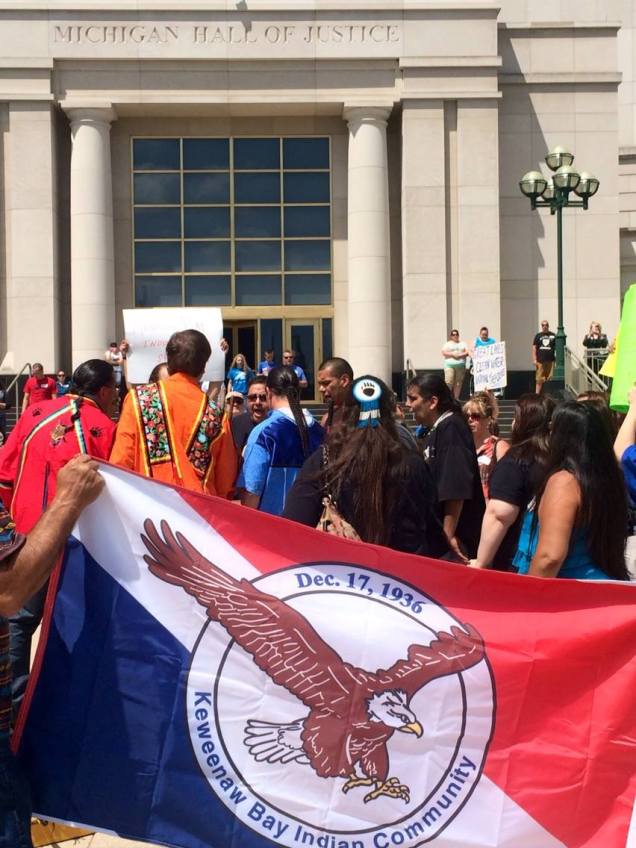
“This is the first time in our generation that the community as a whole came together to fight for true sovereignty and engage in spontaneous government participation.  The goal of the new moving-forward Tribal Council is to bring transparency and involvement to the Anishinaabeg (the people),” said Donald Shalifoe, Sr., KBIC’s Ogimaa (Chief).

Many tribal members carpooled and traveled about eight hours to line up for the 10:00 a.m. Lansing hearing.  KBIC’s remarkable presence overwhelmed the Michigan Hall of Justice whose staff reported it was their largest turn out ever for a court hearing.

Tribal leaders and elders observed the hearing from within the court room, while hundreds watched and listened to the proceedings in an overflow video conferencing room.  Traditional drumming and singing resounded outside the building following the hearing.

KBIC’s Vice President Carole LaPointe remarked “it was a very educational experience for our membership and youth.”

The Anishinaabeg band has opposed the Eagle Mine development, located on Treaty of 1842 ceded homeland, since it was first permitted by the Michigan Department of Environmental Quality (MDEQ) in 2006.

Unsettled concerns involve the mining regulatory process, improper permitting and inadequate assessment of impacts to the area environment, cultural resources and water quality, including groundwater contamination and the potential for perpetual acid mine drainage upstream from Lake Superior.

Tribal member Jeffery Loman said “the hearing today is another testimony to the fact that inadequate regulation and collusion between industry and government results in endless litigation.”

One aspect of the evolving case questions what qualifies as a “place of worship” under Michigan’s sulfide mining statute.  An initial ruling by Michigan Administrative Law Judge Richard Patterson recommended mitigation of impacts to an Anishinaabeg sacred place, Migi zii wa sin (Eagle Rock), but the MDEQ made a final permit decision asserting only built structures are places of worship.

Discriminatory enforcement of Michigan law has led to substantial degradation to KBIC’s sacred site.  This includes obtrusive mine facilities and a decline access ramp into the base of Eagle Rock, non-stop noise and activity, and hindered traditional access and use.  Spiritually significant high places like Eagle Rock are used in solitude by the Anishinaabeg for multi-day fasting, vision quest and ceremony.

Despite the passage of the American Indian Religious Freedom Act of 1978, Native people still struggle to protect their remaining sacred places in the face of extractive development agendas.  “It is a shame that the United States of America, proudly founded upon values of religious freedom, has trouble guaranteeing this right to all of its nation’s first people,” said tribal member Jessica Koski.

KBIC anticipates a decision from the Michigan Court of Appeals within six months.  The Eagle Mine’s timeframe for production start-up is the end of 2014.  “While the court deliberates, it is important to remember that regardless of the outcome, we are in the right for standing up for the Yellow Dog Plains.  We hope the court understands their decision will have long lasting implications for this place, as well as other areas that are slated for mining,” said Emily Whittaker of Big Bay, Michigan who gathered alongside KBIC and other locally affected residents.

The Michigan Court of Appeals ruling will be an important precedent for additional sulfide mining proposals threatening Michigan’s Upper Peninsula and waters of the Great Lakes.


###

Michigan Court of Appeals Opinion on MIFPA and ICWA Notice

The Michigan COA interpreted In re Morris to require a conditional reversal when the parent asserted that his grandmothers were Native and:

It is unclear from the record exactly how or why the caseworker came to the conclusion, reflected in the case service plans, that the minor child is not an Indian child for purposes of 25 USC 1912(a); some elaboration would have been appropriate given the father’s assertion. There is no indication that an inquiry or investigation was made specifically with respect to the father’s claim made at the preliminary hearing, nor an explanation in regard to why the father’s claim was being discounted, assuming it was evaluated or pondered in the first place, such that the ICWA notice requirement was not triggered. Of special concern to us is that the initial case service plan, in its summarization of the trial court’s preliminary hearing order, made no mention of the court’s command that the caseworker “make necessary inquiry and/or notification as to possible Native American Indian heritage.” Furthermore, there is no clear confirmation by the court itself that its initial concerns of whether the child is an Indian child were alleviated. Moreover, the father’s assertion concerning the Native American heritage of the minor child’s paternal great-grandparents fits within the parameters of the examples given by the Morris Court, quoted above, that would trigger the need to serve notice. Morris, 491 Mich at 108 n 18. Finally, petitioner itself concedes that conditional reversal is necessary in order to determine whether the minor child is an Indian child under the law.

Opinion here.

Michigan COA Decides ICWA/MIFPA Active Efforts/Qualified Expert Witness Appeal

Here is the opinion:

In re Arnold


Michigan COA Reverses ICWA Notice: Casual Disregard of ICWA/MIFPA by Wayne County Court and State Workers/Attorney

Here is the opinion in In re Harrell/Harrell-Marls:

In re Harrell

An excerpt:

At a pretrial hearing, the assistant attorney general, respondent’s attorney, and the trial court discussed whether one of the parties was of American Indian heritage for the purposes of the ICWA:

The Court: All right, the petition is authorized. The children have been placed with relatives. What else? I guess—is that it? Did anyone ever ask is there any . . . American Indian heritage in this family? American Indian heritage?

Ms. Safran (attorney for respondent): Do you have any Indian heritage in your family?

The Court: Cherokee, Chippewa.

Ms. Safran: There might be some grand—on the grandmother’s side, what was it? Some time—some type; attenuated.

Ms. Trott (attorney for petitioner): Ms. Topp was told no at the other—

Ms. Safran: Well, we didn’t have all the parties.

Ms. Topp (case worker): I talked to [respondent], as well, in the police station[,] and I was told no.

Ms. Safran: She doesn’t think—

The Court: You don’t have any kind—are you sure it’s American, or, any idea what we’re talking about? I mean, what kind of Indian? Cherokees, Chippewa? I mean, there’s a whole bunch.

Unidentified speaker: I don’t—I don’t know; I can ask.

The Court: And . . . what relative? Grandma? Great-grandma?

Ms. Safran: Your Honor, can we get a date because . . . they want me in [Judge] Slavens[’ courtroom] and I can’t believe it.

The Court: You’ve got to wait just one second. All right, you can investigate and see. That’s pretty distant; great-grandma is pretty far back. So, I’m not gonna demand that we send  notice.

Ms. Trott: This is on the paternal side? Or maternal? Of which father?

The Court: On the mother’s side or father? It better be a maternal because right now—all right. You have the right to have this heard by a referee as to all the children . . . or by a judge with or without a jury, and, of course, continued right to an attorney at all hearings.  We’re setting this for trial?

Ms. Trott: Yes.

It is clear from the record that the trial court had information, however  slight, “suggesting that [a] child, a parent of [a] child, or members of a parent’s family are tribal members,” which was one of the five situations the Supreme Court listed as  “sufficient to trigger tribal notice.” In re Morris, 491 Mich at 108 n 18. Specifically, respondent’s attorney informed the court that “there might be some [Indian ancestry] on the grandmother’s side.” Because it is for the tribes to determine a child’s eligibility for membership, In re Fried, 266 Mich App 535, 540; 702 NW2d 192 (2005), the trial court clearly erred when it found that the possibility of Indian heritage in a great-grandmother of one or more of the minor children was too remote to justify the notice required by the ICWA and MCL 712B.9(1).

Conditional Reversal on Notice Case from Michigan COA

Here.

We acknowledge that there was an effort to comply with the notice requirements. On October 14, 2011, petitioner sent a notification for each child, identifying the children’s tribal affiliation as Sault Ste. Marie Tribe of Chippewa and/or Blackfoot, to respondents, the Sault Ste. Marie Tribe of Chippewa, and the Midwest Bureau of Indian Affairs in Fort Snelling, Minnesota. The notices state that they were sent by registered mail, return receipt requested. However, there is no return receipt in the record before us.

Unpublished Active Efforts Decision from the Michigan COA

Here.

With some troubling language, given this was an abuse and neglect case:

fn 4
In this appeal, the parties have not directly addressed whether respondent father ever had “custody” of the children, or whether respondent father is part of an “Indian family” within the meaning of ICWA or MIFPA. For purposes of this appeal only, we assume that respondent father was a parent from whose custody the Indian children were removed, within the meaning of 25 USC 1914 and MCL 712B.39. We further assume that mother, respondent father, and the children comprise an “Indian family” within the meaning of ICWA and MIFPA. Cf. In re SD, 236 Mich App 240, 244; 599 NW2d 772 (1999) (holding that no “active efforts” were required when the family had already been broken up at the time the proceedings began); Adoptive Couple v Baby Girl, ___ US ___; 133 S Ct 2552, 2563-2564; 186 L Ed 2d 729 (2013) (same).

Conditionally Reversed for ICWA Notice Case out of Michigan

Here.

It is clear from the record that the trial court had information, however slight, “suggesting that [a] child, a parent of [a] child, or members of a parent’s family are tribal members,” which was one of the five situations the Supreme Court listed as “sufficient to trigger tribal notice.” In re Morris, 491 Mich at 108 n 18. Specifically, respondent’s attorney informed the court that “there might be some [Indian ancestry] on the grandmother’s side.” Because it is for the tribes to determine a child’s eligibility for membership, In re Fried, 266 Mich App 535, 540; 702 NW2d 192 (2005), the trial court clearly erred when it found that the possibility of Indian heritage in a great-grandmother of one or more of the minor children was too remote to justify the notice required by the ICWA and MCL 712B.9(1).

Michigan COA Holds that ICWA is Inapplicable to Mackinaw Band Ottawa and Chippewa Members

Here is the opinion:

In re Thibeault

Unpublished Michigan ICWA Notice Case

Michigan’s practice of automatically proceeding as if the child is NOT an Indian child unless told otherwise by a tribe will eventually cause problems.

In re Vanostran(pdf)

For our current purpose, what is important
from this Court’s prior decision is that we ultimately conditionally reversed the trial court order terminating respondents’ parental rights to SKV and remanded the case to the trial court only for “resolution of the ICWA-notice issue.” Id.at page 4. On remand, the trial court held several administrative review hearings. The trial court submitted an order dated March 8, 2013, indicating that at the review hearing held on January 23, 2013, the Department of Human Services complied with the statutory notice requirements tothe four Native American Indian tribes mentioned as a possible connection to the biological father of SKV who was later adopted by respondent father. As of February 19, 2013, one of the tribes had responded that there was no evidence to support that SKV was a descendent of that tribe. The order further stated that on February 14, 2013, another of the tribes responded that SKV was neither registered nor eligible to registeras a member of that tribe. The other tribes had not responded. As a result, the trial court ordered that none of the Native American Indian tribes identified as having a possible connection to SKV have responded that the child is eligible for membership in their tribe and/or that they wish to intervene in this matter. The trial court thus ordered, “The Court having previously made findings that there was clear and convincing evidence of statutory grounds to terminate the parental rights of [respondents], and that it was in the best interest of the minor child to terminate their parental rights, reinstates the Order Following hearing to terminate Parental Rights of the parents to [SKV].”