National Native American Bar Association Resolution on Indian Law in State Bar Exams

Here.

An excerpt:

NOW THEREFORE BE IT RESOLVED, that the National Native American Bar Association hereby urges all states to include or maintain Indian law on their respective bar examinations, especially those states with large Indian populations such as Alaska, Washington, Oregon, California, Idaho, Montana, Colorado, Arizona, New Mexico, Nevada, Utah, North and South Dakota, Oklahoma, Minnesota, Wisconsin, Michigan, New York, Connecticut, Maine, North Carolina, South Carolina, Virginia, Georgia, Louisiana and Florida.

National NABA Issues Resolution Declaring Lawyers Assisting Tribal Disenrollment without Due Process are in Violation of the Ethical Rules

Here. An excerpt:

WHEREAS, Native Americans’ right of tribal citizenship is being increasingly divested or restricted without equal protection at law or due process of law, or any effective remedy for the violation of such rights, most commonly through a tribal process known as “disenrollment.”

NOW THEREFORE BE IT RESOLVED, that the National Native American Bar Association hereby denounces any divestment or restriction of the American indigenous right of tribal citizenship, without equal protection at law or due process of law or an effective remedy for the violation of such rights.

NOW THEREFORE BE IT RESOLVED, that the National Native American Bar Association hereby declares that it is immoral and unethical for any lawyer to advocate for or contribute to the divestment or restriction of the American indigenous right of tribal citizenship, without equal protection at law or due process of law or an effective remedy for the violation of such rights.

National Native American Bar Association Study Released

WWW.NATIVEAMERICANBAR.ORG
For Immediate Release, April 6, 2015
Contact: Mary L. Smith (202) 236-0339

NNABA RELEASES HISTORIC RESEARCH STUDY OF
NATIVE AMERICAN ATTORNEYS

Phoenix, AZ. — Today, the National Native American Bar Association (NNABA) and NNABA Foundation released the results of the first-of-its-kind research study on Native American attorneys. This research is the only comprehensive research regarding Native American attorneys across all practice settings where each and every of the over 500 survey respondents identified as Native American.

One of the powerful findings of this study is that Native Americans often feel invisible and share an overarching perspective that their experiences are not valid or real. In addition to documenting the failure of traditional diversity and inclusion efforts to reach Native American attorneys, the study sheds light on unique challenges facing American Indians. Native Americans are clearly behind even other underrepresented groups in terms of inclusion, retention, and representation.

“This comprehensive research is not only the first – but the only – research that examines the experiences of Native American attorneys across all practice settings. It presents a stark portrait of an entire group of attorneys systematically excluded from the legal profession,” said Mary Smith, NNABA President. “It is clear that traditional diversity and inclusion programs are simply not working for Native American attorneys. NNABA hopes that this research will be used to build a more robust pipeline of Native American attorneys and to work toward the full inclusion of Native Americans in the legal profession.”

Highlights of the research include:

  • The survey captured information from 527 Native American attorneys, approximately 20% of the 2,640 Native American attorneys in the United States.
  • The most satisfied attorneys were working in the tribal sector, and the least satisfied attorneys were working for the federal/state government or law firms; however, tribal politics/cliques, overwhelming workloads, and not being able to make an impactful difference were cited as primary sources of dissatisfaction even in the context of being generally satisfied.
  • Over 40% of the attorneys overall in the study reported experiencing demeaning comments or other types of harassment based on their race, ethnicity, and/or tribal affiliation; and 33.63% reported experiencing one or more forms of discrimination based on their race, ethnicity, and/or tribal affiliation.
  • Women were more likely than men to report demeaning comments and/or harassment based on gender (38% to 3%); discrimination based on gender (35% to 4%); denial of advancement or promotional opportunities due to gender (21% to 3%); and denial of appropriate compensation due to gender (29% to 1%).
  • Over 76% of the attorneys in this study reported that more awareness and understanding of issues faced by Native Americans would have a positive impact on their careers. In comparison, only 60% of the attorneys felt that more effective implementation of diversity and inclusion policies in their workplace would have a positive impact on their careers. This is not surprising given the ways diversity and inclusion initiatives have largely ignored the issues and concerns of Native American attorneys.

For more information and to view the full report and the executive summary, go tohttp://www.nativeamericanbar.org/native-american-attorney-study/.

Founded in 1973, NNABA serves as the national association for American Indian, Alaska Native, and Native Hawaiian attorneys, judges, law professors and law students. NNABA strives for justice and effective legal representation for all American indigenous peoples; fosters the development of Native American lawyers and judges; and addresses social, cultural and legal issues affecting American Indians, Alaska Natives, and Native Hawaiians.

For more information contact 480-727-0420 or visit www.nativeamericanbar.org.

NNABA Survey on Native American Attorneys

PARTICIPATE IN GROUNDBREAKING RESEARCH ON NATIVE AMERICAN ATTORNEYS!  SURVEY IS NOW LIVE!


The National Native American Bar Association (NNABA) is now embarking upon a  comprehensive research study that sheds light on the experiences of Native American attorneys and paints a full picture of Native American attorneys across all settings including private practice; government practice in state, federal and tribal arenas; the judiciary; corporate legal departments; and academia. This research will result in a first-of-its-kind study. Ultimately, the findings from this study will be used to develop educational material and programs that will help improve the retention and advancement of Native American attorneys in the legal profession.

The survey should take you no more than 15-20 minutes to complete, and can be taken by any attorney that identifies as American Indian/Native Alaskan. Given the fact that a study of this magnitude has never been done, it is critical that we capture every one of your voices.

Please do take the time to complete this survey and feel free to forward it to any of your legal colleagues that identify as American Indian/Native Alaskan.

You can start the survey by clicking on the link below. The survey has been developed and distributed in conjunction with the research and consulting firm, Nextions. The survey is being distributed through Nextions’ secure and confidential survey site, and no one but the researchers and staff at Nextions will see any individual data from the surveys. Data will only be reported in the aggregate, so we encourage you to share your thoughts and experiences candidly.

SURVEY LINK:  Please cut and paste the following link onto your browser

http://www.surveymethods.com/EndUser.aspx?7F5B372E7834232D78

If you have questions about the survey, you can contact the National Native American Bar Association at either adminassistant@nativeamericanbar.org or executivedirector@nativeamericanbar.org. Alternately, you may reach out to Jessica Shoemaker at Nextions (Jessica@nextions.com | 312.922.0226). We thank you in advance for your time and energy in contributing to this groundbreaking study.

For more information contact 480-727-0420 or visit www.nativeamericanbar.org.

NNABA Resolution Supporting the Free Exercise of Indigenous Religion by American Indian, Alaska Native and Native Hawaiian Prisoners in Domestic Detention Facilities

Here:

NNABA Resolution 2013-3

Excerpts:

NOW THEREFORE BE IT RESOLVED, that the National Native American Bar Association calls upon the United States, all fifty American states and the District of Columbia – including federal and state executive, agency, legislative, corrections and judicial officials and employees – to:

(a) Take all reasonable and any least restrictive steps to commend, support and facilitate incarcerated American Indigenous Peoples’ freedom to believe, express and exercise traditional indigenous religion,

(b) Denounce or cease any unduly burdensome or patently illegal or illegitimate federal, state or local government restriction upon incarcerated American Indigenous Peoples’ freedom to believe, express and exercise traditional indigenous religion, and

(c) Explore how federal, state and American indigenous governments can jointly develop and advance shared penological goals in regard to incarcerated American Indigenous Peoples.
NOW THEREFORE BE IT FURTHER RESOLVED, that the National Native American Bar Association calls upon the American Bar Association, Federal Bar Association and state and local bar associations, the National Congress of American Indians, regional inter-tribal associations and individual American indigenous governments, the United States Attorney General and Department of Justice, the American Correctional Association and American Association of State Correctional Administrators, and the United Nations Special Rapporteur on the Rights of Indigenous Peoples, to also formally call upon the United States, all fifty American states and the District of Columbia, to:

(a) Take all reasonable and any least restrictive steps to commend, support and facilitate incarcerated American Indigenous Peoples’ freedom to believe, express and exercise traditional indigenous religion,

(b) Denounce or cease any unduly burdensome or patently illegal or illegitimate federal, state or local government restriction upon incarcerated American Indigenous Peoples’ freedom to believe, express and exercise traditional indigenous religion, and

(c) Explore how federal, state and American indigenous governments can jointly develop and advance shared penological goals in regard to incarcerated American Indigenous Peoples.

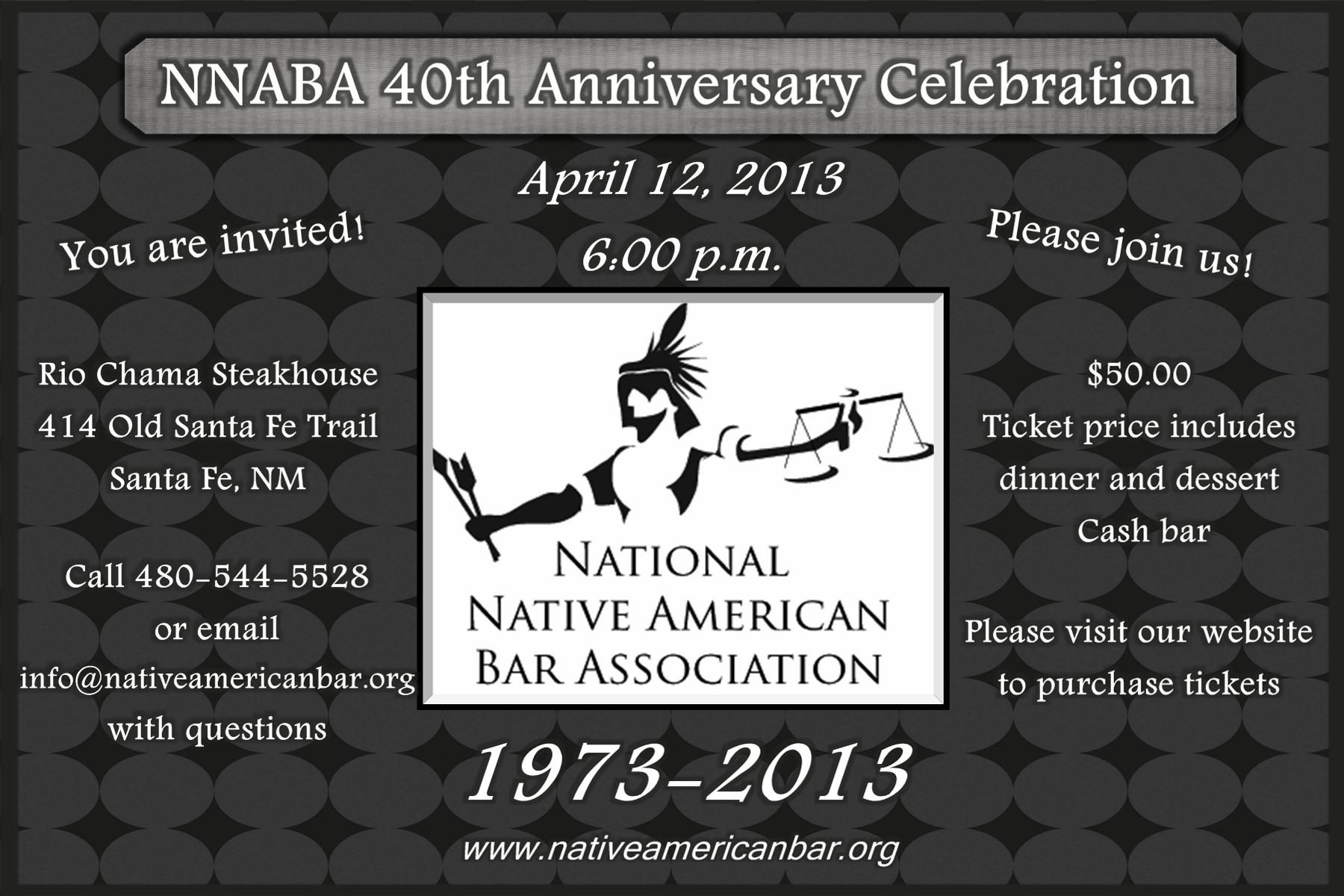
NNABA 40th Anniversary Celebration — April 12 — Santa Fe

NNABA INVITE_FINAL

40th Celebration Sponsorship Letter

Sponsorship Reservation Form

Sponsorship Levels

NNBA Supports DOJ Investigation into Killing of Ditidaht Carver

The statement from the National Native American Bar Association can be found here. An excerpt:

The National Native American Bar Association (NNABA) condemns the killing of John T. Williams by a Seattle Police officer in August of 2010. Williams was a talented Ditidaht First Nations carver who for many years endured the significant challenges facing homeless Native people in Seattle. His killing has outraged the Tribal community and raised serious concerns about equal justice and Seattle Police Department accountability.

The following is a story about the investigation from earlier this month in the Seattle Times:

Two Seattle police officers have agreed to cooperate in the FBI’s investigation into the fatal shooting of woodcarver John T. Williams by a former officer, but only after they were subpoenaed to appear before a federal grand jury, according to police officials.

and

The U.S. Department of Justice (DOJ) and FBI are investigating whether Birk violated Williams’ civil rights.

The federal review into the shooting is separate from the Justice Department’s broad civil-rights investigation of the Police Department announced in March. That federal investigation is focused on allegations related to use-of-force and biased policing.

Opposition to the Anti-Sharia Law Movement

Here is the ICT article.

And resolutions from the National Native American Bar Association and the Coalition of Bar Associations of Color:

NNABA Resolution 2011-4

CBAC_2011_Resolution on the Law of International Law or the L

NNABA Meeting Agenda at Fed Bar — April 6

Here is the agenda: Agenda.