Andrew Cohen on SCT Voting Rights Case Amicus Briefs (and the Navajo Amicus Brief)

Here. An excerpt:

We tend to think of the mission of the Voting Rights Act as focusing exclusively upon the plight of black Americans. But the federal statute has been a grace note to Hispanic organizations and American Indians as well. National Latino groups filed a powerful brief with the justices. And the Navajo Nation filed an amicus brief in this case, and it is poignant for its reminder that while white Americans were discriminating against black Americans they also were discriminating against Native Americans. The Navajo Nation writes:

Indian people have endured a century of discrimination and overcome new obstacles each generation in order to exercise the right to vote in state and federal elections. Nowhere have these struggles been more prevalent than in the Section 5 covered jurisdictions of Apache, Navajo and Coconino Counties in Arizona the home of the Navajo Nation and Todd and Shannon Counties in South Dakota the home of the Rosebud and Oglala Sioux. The amici curiae file this brief to elucidate the importance that the Voting Rights Act and, in particular, Section 5 preclearance, has had in overcoming the purposeful efforts to disenfranchise Indian voters.

While passage of the Voting Rights Act in 1965 ended certain means of discrimination, Indians continued to be denied the right to vote through a variety of new strategies. As part of the 2006 reauthorization process, Congress obtained evidence that Indians continued to be disenfranchised by voting schemes, polling place discrimination and ineffective language assistance. The 2006 reauthorization was a legitimate Congressional response to the disenfranchisement. Protected by the Section 5 preclearance, voter registration and turnout have increased, but new challenges have arisen that require continued vigilance.
Navajo Nation Declares State of Emergency

The Navajo Nation is facing such severe water shortages due to frozen waterlines, run-down water storage containers and weather-damaged water systems that President Ben Shelly has declared a state of emergency for the reservation.

He signed an emergency resolution on Friday January 25 after the Commission on Emergency Management passed it unanimously, according to a statement from the Navajo Nation.

Link to article from Indian Country Today:

http://indiancountrytodaymedianetwork.com/mobile/2013/02/01/frozen-navajo-nation-declares-state-emergency-over-damage-induced-water-shortages-147421


D.C. Circuit Briefs in RCRA Claims against US in Navajo Uranium Mining Contamination

Here are the materials in El Paso Natural Gas Co. v. United States:

El Paso Natural Gas Co. Brief

Navajo Nation Brief

Federal Answer Brief

El Paso Natural Gas Co. Reply

Navajo Nation Reply

Materials from an earlier D.C. Circuit appeal (the Mill Tailings Act Appeal) are here.

US Tax Court Rejects Navajo Elder’s Claim that Nephew is Dependent under Tribal Common Law

Interesting case, this Begay v. Commissioner.

The court rejects Religious Freedom Restoration Act and Equal Protection claims, holding that a Navajo elder’s care of a nephew is insufficient to confer the required status for deductions under the Internal Revenue Code.

Here is the argument:

Although petitioner concedes that TD is not her qualifying child under section 152(c)(2), she argues that the exclusion from the section 152(c)(2) relationships of certain obligatory clan-based relationships in Navajo culture violates her constitutional rights under both the Free Exercise Clause of the First Amendment to the Constitution and the Fifth and Fourteenth Amendments to the Constitution. According to petitioner, in Navajo culture and tradition children are not only children of the parents; they are also children of the clan. Petitioner submits that a Navajo clan consists of the first clans of the child’s mother, father, maternal grandfather, and paternal grandfather and that the clan relationship may extend beyond the foregoing if, for example, the child is adopted.

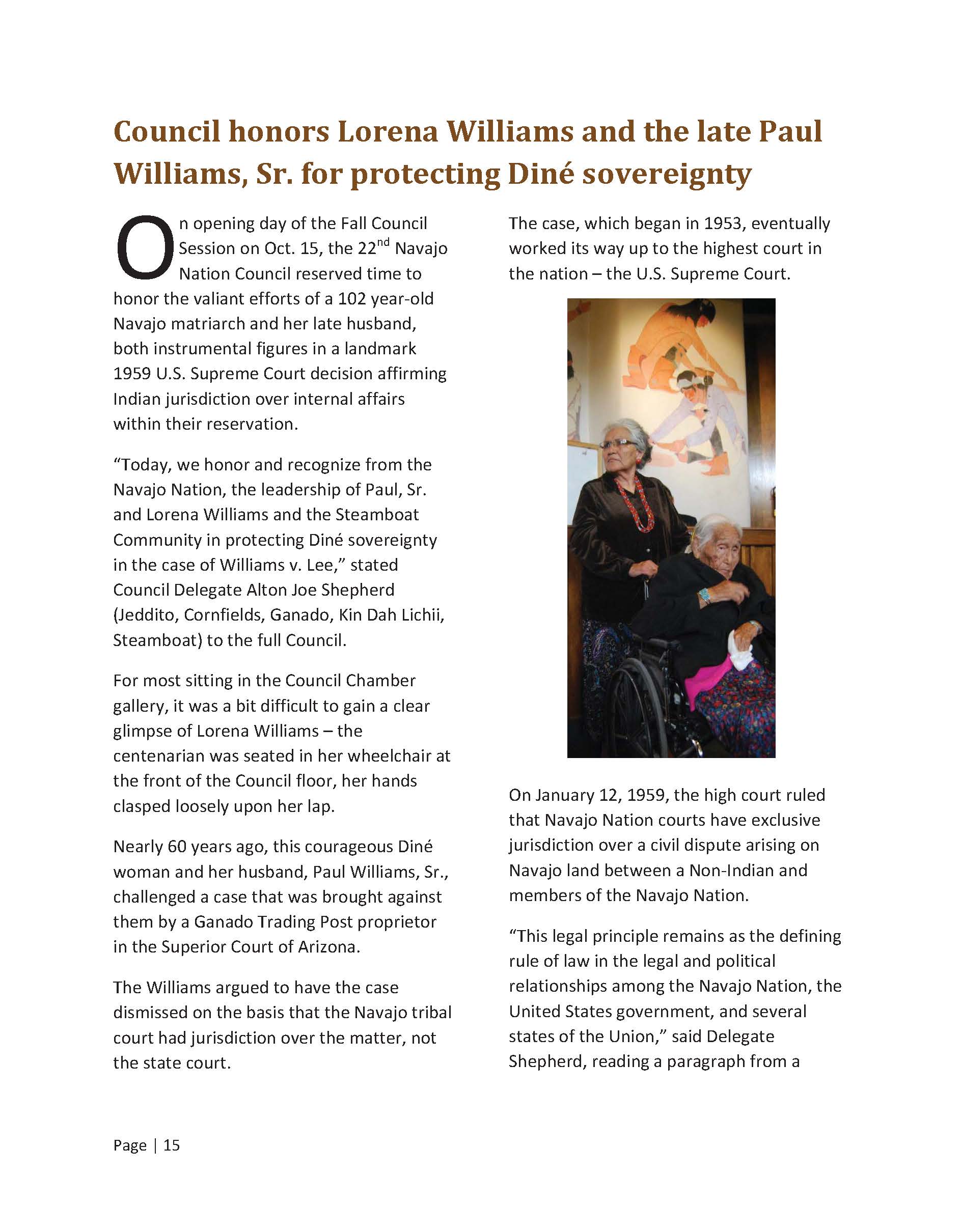
Navajo Tribal Council Honors Lorena Williams (from Williams v. Lee)

An excerpt from Naataji Nahata Hane, Fall 2012 (Naataji Nahata Hane, Fall 2012):

The Nation: How Hard is it for a Navajo Elder to Get a State ID?

Pretty difficult, it appears.

Here.

Tenth Circuit Vacates Criminal Sentence of Two Navajo Members and Remands for Resentencing

Here is the opinion in United States v. Joe.

An excerpt:

We therefore hold that the district court erred when it enhanced Defendants’ offense levels for physical restraint of the victim as well as enhancing for the use of force against her. The government, which has the burden of proof of showing harmlessness, see United States v. Kieffer, 681 F.3d 1143, 1169 (10th Cir. 2012), has not argued that this error was harmless. Our cases lead us to the conclusion that it was not. If the government had argued that this error was harmless, no doubt that argument would have been centered on the fact that the district judge varied downward from the incorrectly calculated guidelines range to reach the sentence that he concluded was most appropriate in view of all of the factors listed in 18 U.S.C. § 3553(a). We have, however, emphasized the importance of the guideline range as the starting point in the process. See, e.g., Kieffer, 681 F.3d at 1170. We said there that “where the beginning point for a sentencing court’s analysis of the § 3553(a) factors is measurably wrong, the ending point usually will result from an incorrect application of the Guidelines.” Id. (emphasis in original). The government has not argued that the error is harmless, and we believe that the error is not obviously harmless. As explained herein, we remand for resentencing in both of these appeals.

Ninth Circuit Panel Withdraws Sanctions against Howard Shanker (Atty in San Francisco Peaks Case)

Here:

174 Order Withdrawing Sanctions

The order with the sanctions included is here. En banc petition and amicus brief seeking the withdraw of the sanctions are here and here.

NYTs Article on the Impact of the 2012 Drought on Navajo Horses

Here.

Navajo Nation Brief in New Mexico SCT Redistricting Case

Here:

Navajo Brief in NM SCT Voting Rights Act Case

The New Mexico Supreme Court’s prior order in this case is here.

Navajo’s briefs in that case is here:

Navajo Brief in NM Voting Rights Act Case

Navajo Response Brief