The Court granted the petition with no limitations, so the issues are not limited the way the government and four tribes requested. Arguments will be held next term (terms start in October, so after October, 2022).
Supreme Court
Biden’s SCT Nominee is Ketanji Brown Jackson
The only Indian law opinion we can find that Judge Brown Jackson wrote was in Fredericks v. Dept. of the Interior, a dispute over gas royalties at Fort Berthold.
The second Indian law opinion we found after actually making an effort to look is Mackinaw Band v. Jewell, where the court ordered the tribe to exhaust administrative remedies in a federal recognition suit:
Judge Brown Jackson also wrote an opinion in a pro se prisoner FOIA request to the Bureau of Indian Affairs, Kovalevich v. BIA. Judge Brown Jackson also rejected a facial challenge in Rothe v. Dept. of Defense to Section 8(a) of the Small Business Act that benefits many tribes and tribal businesses. In Sierra Club v. Army Corps, she excused the government from having to prepare an Environmental Impact Statement to assess environmental impacts from the approval of a domestic pipeline, a case that recalls the Dakota Access decision, which reached the opposite conclusion.
Judge Brown Jackson clerked for Justice Breyer in the 1999 Term, when Rice v. Cayetano was decision (Breyer went the wrong way on that one).
Judge Brown Jackson also clerked for First Circuit Judge Selya from 1999 to 2000. Judge Selya wrote the opinion in Ninigret Development v. Narragansett Indian Wetuomuck Housing Authority, where the court rejected a tribal sovereign immunity defense from a contract dispute.
Newsy [Allison Herrera]: “Supreme Court Justice Stephen Breyer’s Complicated Indian Law Legacy”
Here:

Idle Thoughts about Bingo. . .
Yesterday, Justice Kagan asked about what bingo is:
There seems to be dispute whether this type of bingo by machine is the same as the bingo we know, people in a room calling out numbers.
p. 18, line 25 — p. 19, lines 1-3
In a colloquy with the tribe’s counsel, the Chief Justice also wondered aloud:
CHIEF JUSTICE ROBERTS: What would — what — what would you say it looks like?
p. 22, lines 4-25 — p. 23, lines 1-11
MR. MARTIN: I would say it looks like an electronic bingo machine that has a bingo —
CHIEF JUSTICE ROBERTS: What makes it look like a bingo machine?
(Laughter.)
MR. MARTIN: Well, there’s a — let me
CHIEF JUSTICE ROBERTS: There’s a name on it that says bingo?
MR. MARTIN: Well, there’s actually a card and you can switch the cards by pushing a button to change the cards that you’re playing. Now, are there reels and lights that look — that would characterize —
CHIEF JUSTICE ROBERTS: Are there people —
MR. MARTIN: — people would characterize it — yes.
CHIEF JUSTICE ROBERTS: — calling out numbers and — people, somebody saying, you know, B-12 or —
MR. MARTIN: There — there in fact is part of our operations, Your Honor. My tribe’s operations is live-called bingo and it’s also one of the things the State of Texas —
CHIEF JUSTICE ROBERTS: But that’s something different than the slot — slot machine bingo, right?
MR. MARTIN: It is different than the electronic machines, Your Honor, but they’ve complained about all of it.

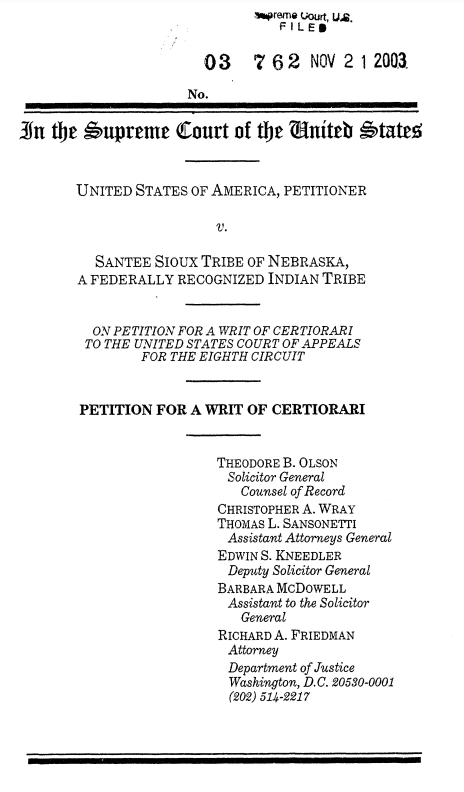
The law of these bingo slot machines has effectively been settled for nearly 20 years after the Supreme Court denied cert in a pair of petitions from the United States on this question (which later led to regulations that effectively codified the rulings from the courts below that the government lost):

What is Class II bingo, a Supreme Court Justice might ask? Well, the General Counsel for the National Indian Gaming Commission is there to offer answers:

A Bit More on the “Indian Canon” Talk in the Ysleta Argument
What is the origin of the “Indian canon” asked Justice Alito?
Quick answer: The Constitution. The default interpretative rules in federal Indian law are rooted in separation of powers. The Constitution grants plenary power in Indian affairs to Congress. When Congress enacts a statute implementing its Indian affairs powers to benefit an Indian tribe, say, the Ysleta del Sur Pueblo Restoration Act, the Article III judiciary must defer to Congress’s Indian affairs powers and interpret the statute to reflect Congress’s wishes. The Ysleta restoration act is the epitome of an Indian affairs statute designed to benefit an Indian tribe. For the Supreme Court to interpret that statute to the advantage of the State of Texas on such a critically important point is for the Court to wildly overstep its place as a separate branch of government. Is that really so difficult?
Justice Kavanaugh asked a softball that should have ended with an answer like the one above (well, maybe not the last line):
JUSTICE KAVANAUGH: So that suggests you need more of a clear statement, and those usually — those clear statement rules usually reflect some constitutional or quasi-constitutional value, due process, extraterritorial structure, the structure of the country. What would that reflect here, that principle you just described?
p. 62, line 25 — p. 63, lines 1-7
This was NOT the answer we got:
MR. YANG: Well, I think it — it reflects that Indian tribes are sovereign nations, that they have before the founding of this country. And, you know, the Court’s opinion in Bay Mills tracks some of this. So, you know, whatever you think about the — canons in general and whether that should be, you know, plain statement, just, you know, tip the balance in ambiguity, the Indian canon, at least when we’re talking about tribal sovereignty and the application of state law on tribal lands, that does have a strong pedigree and I think ultimately it traces to the fact these are sovereign nations.
p. 63, lines 8-21
The fact that Indian tribes are sovereigns is true (so are states and so are foreign nations), but doesn’t answer whether the Court should privilege substantive canons favoring tribes over states. It’s a non-answer in the end, and allows room for a states’ rights oriented judge to toss up their hands and say, let’s give this one to the states so I can fulfill my political commitments without being too obvious about it.
“Welcome to the world of Cabazon”: Ysleta del Sur Pueblo Oral Argument Transcript + Initial Commentary
Here is the transcript. Background materials.
The meaning of the word “prohibited” in section 107 of the restoration act matters a great deal to this case. As Justice Kagan noted in a question to the tribe’s counsel:
It’s not the normal use of the word “prohibited.” It’s a Cabazon use of the word “prohibited.”
p. 11, lines 8-10
Justice Breyer asked an involved question that sort of encapsulates the issue:
I’m curious about the bingo machines. But if — suppose that IGRA applied. And suppose that Texas had a law which said you can play bingo up to — the one the Chief gave, up to $1,000, but not for more than 1,000. That’s a crime. Well, IGRA says, seems like the same problem. It — it — it — it says you have to have, I guess, gaming activity on Indian lands is okay if — if you have a compact or under 3, I guess, or something. If the gaming activity is conducted within a state, which does not as a matter of criminal law and public policy prohibit the gaming activity. All right, so isn’t it the same problem? I mean, because they do prohibit it over $1,000 but they don’t prohibit it under $1,000, but that you want to call regulation, but IGRA doesn’t seem to use the word regulation.
pp. 24, lines 11-25 — p. 25, lines 1-6.
Justice Alito, perhaps taking up a thread started by the Chief Justice, who wondered how a machine that looked like a video game can be considered bingo, asked about a hypothetical game called “dingo”:
Well, I’m puzzled by both your argument and by Cabazon. And, in particular, by how a court is going to decide whether these machines, which I don’t have a very clear picture of in my mind, are bingo or not bingo. If they are not bingo, they’re something else. Let’s say they’re dingo. . . . And how do you decide whether this thing is bingo. I mean, just like the platonic ideal of bingo?
p. 26, lines 13-20, p. 27, lines 7-9
Justice Kagan sort of came to the tribe’s rescue when she pointed out:
Because I guess I would have thought that your answer to Justice Alito was like: Welcome to the world of Cabazon. Sorry. You know? And that’s it. And it wouldn’t really depend on at all on whether there were experts about slot machines. So — so that’s sort of random thoughts, but, I mean, this is just the world of Cabazon and how do we take that into account?
p. 31, lines 16-24
Counsel for the tribe was spared the deep questions about this case, which were left to the United States. These questions were deeply unsettling, even to the SG’s attorney. The Chief Justice seemed concerned that the indeterminacy of the word “prohibited” was going to lead to a lot of litigation in federal court:
Mr. Yang, I think your office is going to be very busy over the next ten years explaining why the word “prohibited,” in 18 U.S.C. whatever, still covers, you know, activities, possession of whatever, even though it’s permitted at some level, right? I mean, it’s prohibited to possess a certain amount of whatever, but, you know, at — at a level of personal use or medical whatever, it’s okay, then you can’t prohibit it at all.
p. 40, lines 5-15
Well, anyone in a PL280 state will tell you it’s not the feds’ problem, the state supreme courts are the ones who have created all the problems with inconsistent interpretations, and SCOTUS does not work to resolve any of them.
In perhaps the most shocking moment of argument, Justice Gorsuch speculated that the indeterminacy in the definition of “prohibited” might be cause to overrule Cabazon(!):
And what would be the negative consequences, in the government’s view, if any, if we were to elide this distinction, ignore it, and overrule Cabazon?
p. 42, lines 12-15
The government’s attorney’s response says it all:
Wow.
p. 42, line 16

There was a real response that followed, a response that would make sense to a Court that is not right now involved in a total reworking of fundamental constitutional law principles:
If the Court — first of all, I don’t think that’s before the Court. This has been a fundamental distinction that’s existed in the law of — of tribal sovereignty and tribal lands for decades upon decades. Again, it goes back before Cabazon. So that’s the Public Law 280 context.
p. 16, lines 16-22
Or maybe it was a slow day for the Court and it needed to offer some idle speculation about ending the case that has propped up tribal economic development for nearly a half century to keep things interesting.
But no. There’s more. Justice Alito wondered where the so-called “Indian canon” comes from and implied that he’s not a fan of a canon that he implies runs afoul of the principle that “statutes . . . mean what the words of the statute are generally understood to mean. . .”:
One other question. You refer to the Indian canon, those who favor the interpretation of statutes to mean what the words of the statute are generally understood to mean, have some question about some of these substantive canons. Now some of them, like the Rule of Lenity, have a long history. What do you think is the basis for this Indian canon?
p. 54, lines 24-25 — p. 55, lines 1-7.
Government’s counsel suggested the Court could rule for the tribe and ignore the canon, but Justice Alito wasn’t having it:
That doesn’t really answer my question. What is the origin of this? Is it your — is it your argument that throughout history Congress has always framed statutes in a way that are favorable to Indian tribes?
p. 55, lines 24-25 — p. 56, lines 1-10
The answer is not pleasing to someone who advocated yesterday for Indian law specialists to be hired in the SG’s office:
MR. YANG: Not — my research for this case, unfortunately, has not gone that far back. I don’t have the original — no one has challenged the Indian canon’s existence here, and we’ve not gone back to — to form an argument for it, Your Honor.
p. 56, lines 5-10
Enough for now. Taking a break.
SCOTUS Denies Cert in Three [I Mean Four] Indian Law Cases; Still Waiting on Brackeen
Here is today’s order list.
The petitions denied were Big Sandy’s tax case, Jamestown S’Klallam’s U&A-related petition, and Self v. Trinidad Rancheria, another immovable property exception case. [UPDATE: Oops, forgot Dakota Access.]

Strict Scrutiny Podcast (Briefly) Previews Denezpi
Here, starting around 37:00. The hosts highlighted the Indian Law Scholars amicus brief filed by the NYU-Yale American Indian Sovereignty Project (and Jenner & Block).

Fletcher and April Youpee-Roll will guest on this week’s Strict Scrutiny to recap tomorrow’s argument.
SCOTUS Hearing List for Tuesday’s Arguments + A Little Presidents’ Day Commentary
Here is the announcement on the advocates who will argue for the tribe and the individual Indian parties on Tuesday.

Background materials on the Ysleta del Sur Pueblo case here.
Background materials on the Denezpi case here.
I have a few notes.
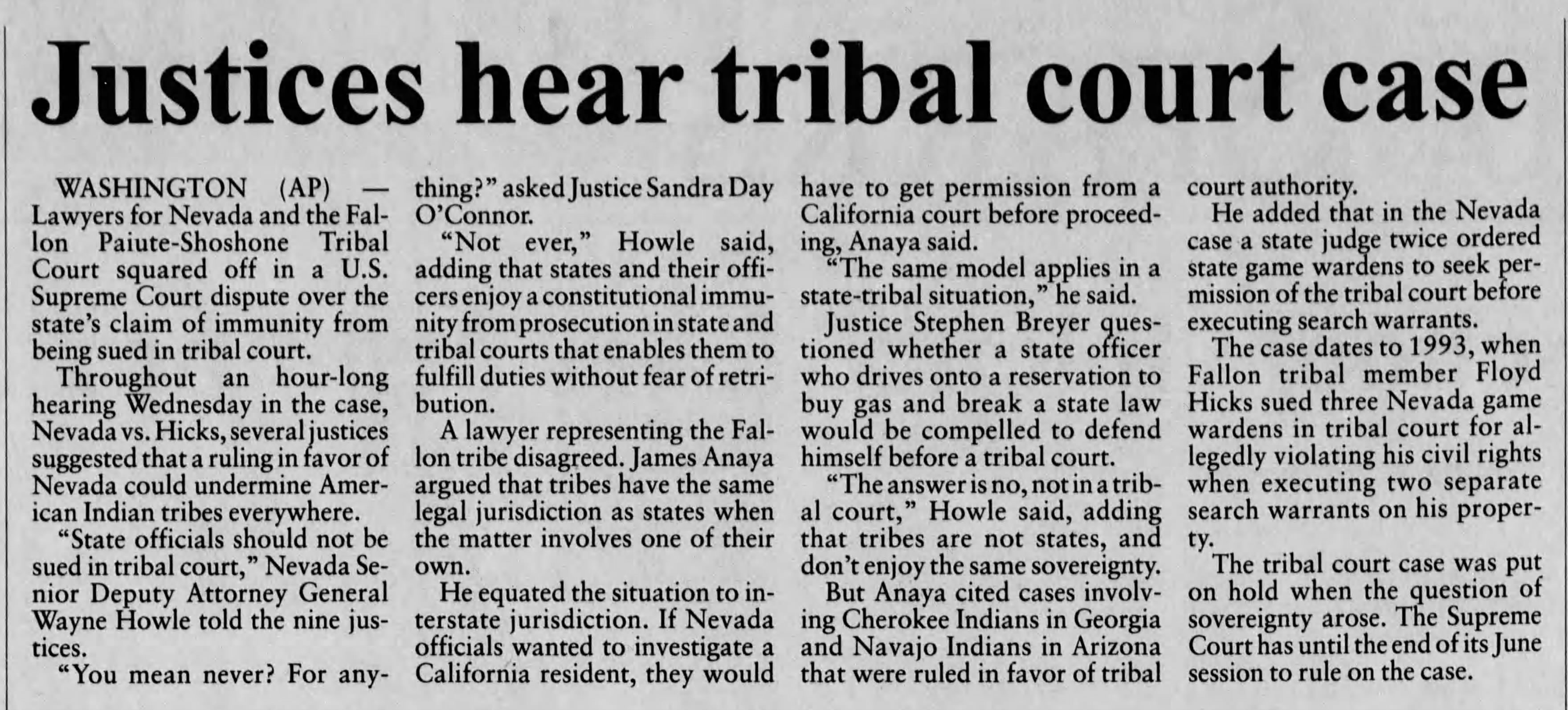
By my count, after James Anaya argued Nevada v. Hicks, after Tuesday there will have been 37 individual Indian or tribal parties represented at oral argument in the Supreme Court. None of those parties were represented by an American Indian advocate. In only two cases did a woman represent the Indian or tribe — just over 5 percent of cases, a truly pathetic figure. [No Native advocates argued for other parties, either.]
To be sure, the end of Native oral advocacy was intentional. It can be traced to the establishment of a new national strategy adopted by tribal leaders and national orgs in 2001. That strategy that privileged members of the Supreme Court Bar — a small, exclusive group of elite and privileged lawyers — to argue those cases instead of relatively inexperienced advocates.
Continue readingCert Petitions Filed on Habematolel Pomo of Upper Lake Internet Lending
Here is the petition in Treppa v. Hengle:
Questions presented:
- Whether a court can invalidate an agreement to have an arbitrator resolve questions of arbitrability (a “delegation clause”) based on the court’s interpretation of a separate choice-of-law provision.
- Whether sovereign immunity bars private plaintiffs from suing tribal government officials, in their official
capacities, for alleged violations of state law
Lower court materials here.
Here is the petition in a related case, Asner v. Hengle:
Question presented:
Can a federal court refuse to enforce the delegation clause of an arbitration agreement on the ground that a choice-of-law provision applicable to the arbitration agreement as a whole prospectively waives federal rights?
 Turtle Talk
You must be logged in to post a comment.