When Congress settled the Catawba Indian Nation’s land claims in 1993, it imposed federal requirements on who could become a citizen. Specifically, the Catawba Indian Tribe of South Carolina Land Claims Settlement Act of 1993 stated that, “[t]he Tribe shall have the right to determine future membership in the Tribe; however, in no event may an individual be enrolled as a tribal member unless the individual is a lineal descendant of a person on the final base membership roll and has continued to maintain political relations with the Tribe.” (Emphasis added.)
Those requirements helped identify recipients of settlement payments, but the payments ended decades ago, while the federal restriction remained.
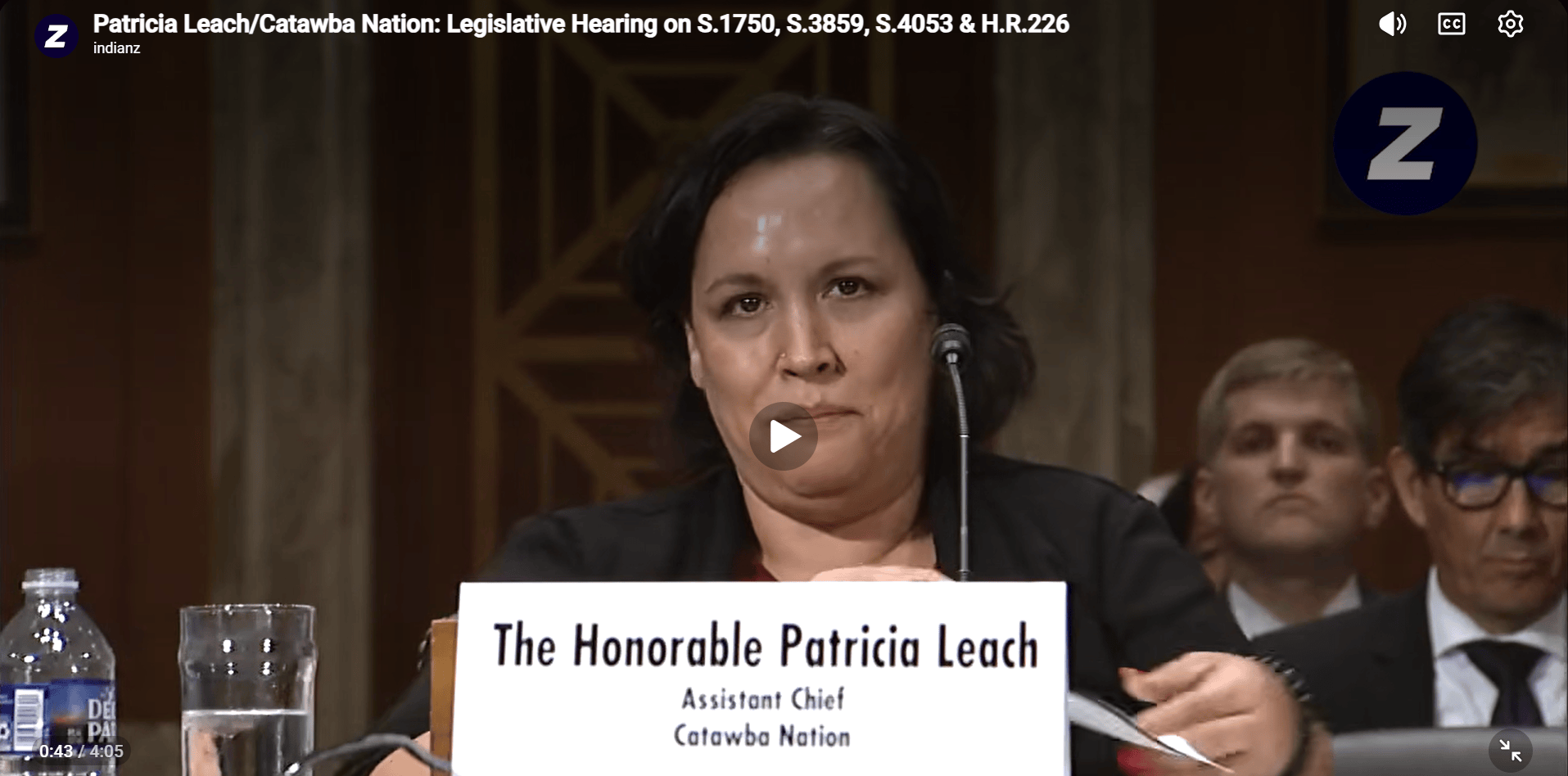
Now Catawba is asking Congress to remove it. Assistant Chief Patricia Leach testified that S. 3859 would return citizenship decisions to the Nation’s Constitution and laws. If passed, the bill would strike the clause from the 1993 land claims settlement act limiting enrollment to individuals who are lineal descendants of persons on the final base membership roll and who have continued to maintain political relations with the Tribe.
The larger issue is Tribal power over membership. A federal rule created to distribute settlement money in a land claims settlement act in 1993 became an enduring restriction on Catawba’s power to define its own political community.
A portion of Assistant Chief Patricia Leach’s testimony is here:
What the Bill Does
S. 3859 strikes a portion of a single sentence from Section 7(d) of the Catawba Indian Tribe of South Carolina Land Claims Settlement Act of 1993. That clause currently prevents the Nation from enrolling any new citizen unless that person is a lineal descendant of an individual on the 1962 final roll and has maintained “continued political relations” with the Tribe.
If enacted, the bill would restore to the Catawba Indian Nation the authority to determine its own citizenship criteria under its Constitution. That authority is one of the most basic attributes of tribal sovereignty, respected by the Federal government for virtually all Tribal Nations. The bill does not rewrite the Nation’s Constitution, does not create any new federal program, and does not affect any other provision of the Settlement Act.
Why the Bill Is Needed
Congress enacted the Settlement Act in 1993 to resolve the Nation’s longstanding land claims, restore the federal trust relationship, and provide for a monetary settlement. The federal enrollment language in Section 7(d) was included in that settlement context. It helped identify a fixed number of individuals entitled to share in settlement-related distributions and provided an administrable federal standard at that time.
Those monetary distributions were completed decades ago. The federal restriction has outlived that purpose. Today, it no longer serves as a settlement-administration tool. Instead, it operates as a continuing federal limitation on the Nation’s ability to define its own political community.
The provision also includes the phrase “continued political relations,” a standard that is undefined in the Act and difficult to administer. Tribal staff must determine whether an applicant has demonstrated a sufficient political connection to the Nation, even though that standard is not clearly defined by Congress. Removing this language will allow the Nation to administer citizenship through its own Constitution and laws rather than through an outdated federal overlay.


You must be logged in to post a comment.