Provide Comments on WI Pro Hac Vice for ICWA Attorneys Pending Rule

Well, since I did the California post yesterday on this, multiple people from Wisconsin reminded me that we all need to submit supportive comments there. Many thanks to NL for spelling it out in an email so I can just cut and paste it here (ie making it easy for me):

Over in Wisconsin, we have a pending ICWA pro hoc vice rule petition that could use some more supporting comments, especially from adjacent states!  You can find the petition here (https://www.wicourts.gov/scrules/1804.htm).

The process for submitting a comment is as follows:

To submit a comment:

I. Submitting a comment to a rules petition
A comment to a pending rule petition shall be submitted in hard copy (include one original and nine copies). The paper copies shall be mailed to the Clerk of the Supreme Court, P.O. Box 1688, Madison, WI 53701.

A person submitting a comment shall e-mail an electronic copy of the comment in MS Word format MS Word to the Office of the Clerk of the Supreme Court at clerk@wicourts.gov and carrie.janto@wicourts.gov.

II. Contents of comment
The comment shall identify the rule petition to which it relates.

III. Service of comment on petitioner
A copy of the comment shall be forwarded to the petitioner in a timely manner. See the rule petition for the name and contact information of petitioner.

https://www.wicourts.gov/scrules/1804.htm
 

Rapid City News Article on Pennington Co ICWA Procedures

Sometimes the results change a little even when a court decision goes the wrong way: County to Stick with Current ICWA Hearing Procedures

Tribal Law and Policy Institute is Hiring!

Announcement here: Program Specialist Job Announcement_Tribal Law and Policy Institute

Education and/or Experience:

Required: Bachelor’s degree; experience or demonstrated expertise in tribal justice systems and/or problem-solving courts

Preferred: Juris Doctorate, Master’s degree, or other applicable advanced degree

Strongly preferred: Four (4) years of programmatic development/implementation and/or direct services delivery; previous experience with American Indian and Alaska Native communities; basic knowledge of federal Indian Law and polices; and experience and/or demonstrated expertise in at

  •  Healing to Wellness Courts
  •  historical trauma and trauma-informed care
  •  cultural adaptations to evidence-based practices and programming
  •  strategic planning and action plan development
  •  tribal-state collaboration coordination
  •  prevention, intervention, and treatment programs
  •  systemic, community-wide, public health strategies and responses

California Eliminates Pro Hac Vice Barriers for ICWA Cases

In a celebrate-the-victories post, the state with the most number of ICWA cases has removed major barriers for out of state ICWA attorneys. California notoriously had some of the highest pro hac fees and tightest limitations on the number of appearances an attorney can make. When I was started poking around about the idea of court rule changes, California always rose to the top. Thanks to California Tribal Families Coalition (CTFC) and their ED, Delia Sharpe, California passed both a bill (to eliminate fees) and a court rule (to eliminate association with local counsel). Here is the CTFC press release.

If California (and Washington and Michigan and Minnesota and Nebraska and Oregon) can get this done, so can your state. There’s a whole crew of in-house ICWA attorneys backing you up–send us an email.


Spurr v. Pope Decision in WD Michigan [Tribal Court Jurisdiction to Issue PPO]

33_Opinion and Order

Briefing here:
21 Motion for PI
22 Response
23 Reply
26 DCT Briefing Order
30 Motion to Dismiss
31 Response
32 Reply

GAO Report on Native Youth Involvement in the Juvenile Justice System

Here

However, more Native American youth were involved in the federal system than their percentage in the nationwide population (1.6 percent). For example, of all youth arrested by federal entities during the period, 18 percent were Native American. According to Department of Justice (DOJ) officials, this is due to federal jurisdiction over certain crimes involving Native Americans. Comprehensive data on Native American youth involvement in tribal justice systems were not available for analysis. GAO’s analysis showed several differences between Native American and non-Native American youth in the federal justice system. For example, the majority of Native American youths’ involvement was for offenses against a person, such as assault and sex offenses. In contrast, the majority of non-Native American youths’ involvement was for public order offenses (e.g., immigration violations) or drug or alcohol offenses. On the other hand, in state and local justice systems, the involvement of Native American and non-Native American youth showed many similarities, such as similar offenses for each group.

via Indianz

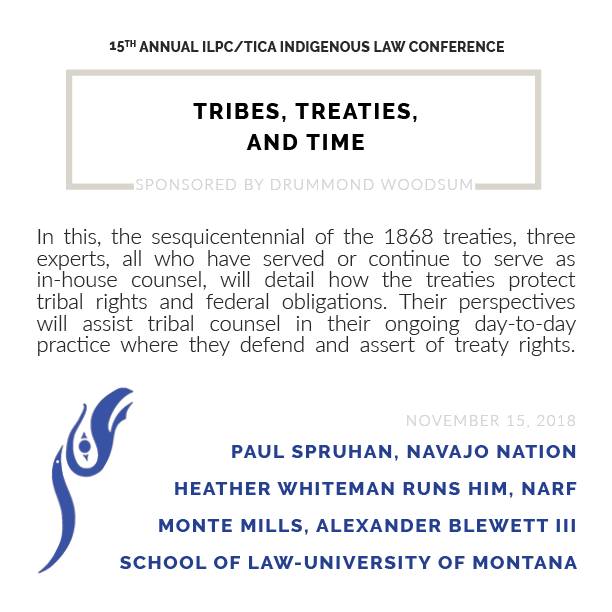
ILPC/TICA 2018 Conference Nov. 15-16: First Panel

Unsure of whether to attend the ILPC/TICA Conference this fall? Over the next week, we’ll be giving you inside peeks into the panels we’re very proud to host. Register and come visit us on the banks of the Red Cedar this fall:

And remember: CLEs applied for (10 standard, 1.5 ethics, 1 elimination of bias)

Eighth Circuit Dismisses Oglala Sioux v. Fleming Under Abstention Doctrine

Here.

This is the long running (initiated before Adoptive Couple v. Baby Girl) case that is attempting to address the due process and ICWA violations against Native families in Pennington Co., South Dakota. Brought by Oglala Sioux, Rosebud Sioux and two individual tribal citizen mothers on behalf of a class of similarly situated parents, this case has highlighted the disturbing practices of the county (which, even more disturbingly, are not that surprising to trial level practitioners in our child welfare system). The District Court had found for the plaintiffs at each stage, and found specifically that abstention/Younger doctrine did not a apply to this case. The Eighth Circuit found differently.

Setting aside the due process claims for the sake of this point, ICWA itself creates a right of action under 25 USC 1914 (a parent, custodian, or tribe may petition a court of competent jurisdiction to invalidate any cases in violation of 1911 [jurisdiction], 1912 [notice/active efforts/burden of proof], or 1913 [voluntary proceedings]). This right, however, has often been limited by federal courts under abstention doctrines, which means the state courts that are causing the abuses of the law are the only places to address the abuses of the law. As the Court states, “Although the plaintiffs complain that state court proceedings do not afford parents an adequate opportunity to raise broad constitutional challenges under the Due Process Clause, they have not established that South Dakota courts are unwilling or unable to adjudicate their federal claims.” There are a number of federal cases on ICWA–that is, ones that are attempting to demonstrate a violation of the law–that end up with a hollow 1914. See Yancey v. Bonner, 2008 WL 4279760 (W.D. Okla. 2008), Navajo Nation v. LDS Family Services, 2006 WL 3692662 (D. Utah 2006), Kickapoo Tribe of Oklahoma v. Rader, 822 F.2d 1493 (10th Cir. 1987)

I’d also note while the Court said “[t]he relief requested would interfere with the state judicial proceedings by requiring the defendants to comply with numerous procedural requirements at future 48-hour hearings,” those procedural requirements are ones required by both the Constitution and the Indian Child Welfare Act.

The ICWA Appellate Project filed an amicus brief on behalf of the Navajo Nation, Cherokee Nation, the ICWA Law Center, NICWA and NCAI in this case.

Tribal Comments Needed for Notice for Proposed Model Family Foster Home Licensing Standards

Here is the link. Comments are due by October 1.

By April 1, 2019, title IV-E agencies, which include all states and 12 tribes, must provide the HHS specific and detailed information about:

○ Whether the state or tribal agency foster family home licensing standards are consistent with the model licensing standards identified by HHS, and if not, the reason; and

○ Whether the state or tribal agency waives non-safety licensing standards for relative foster family homes (pursuant to waiver authority provided by section 471(a)(10)(D) of the Act), and if so, how caseworkers are trained to use the waiver authority and whether the agency has developed a process or provided tools to assist caseworkers in waiving these non-safety standards to quickly place children with relatives.

At this stage, HHS is trying to identify the model by which the state and direct IV-E tribes will be measured against. In this notice, the Children’s Bureau provides what they would like to use as that model: “We are proposing one set of standards for comment to apply to relatives and non-relatives, as well as state and tribal title IV-E agencies.”

The model appears problematic at best and is causing concern among both state and tribal IV-E workers and attorneys. As just one example, “i. A continuous supply of safe drinking water. ii. A properly operating kitchen with a sink, refrigerator, stove, and oven;”. We have families in Michigan that do not have a continuous supply of safe drinking water right now. What does “continuous supply” mean if you have to haul water? What is “properly operating”. There are many, many provisions like this in the model (like a functional literacy requirement), and if your tribe is concerned about getting homes licensed by either state or direct tribe IV-E agencies, this will affect you. I don’t see any comments submitted yet, or cannot access them, but if we receive good models or see ones submitted, I will post them as examples.

NICWA’s website further states: “There is no penalty for states or tribes that use different foster care standards than the national ones, but NICWA has raised concerns about how these will be used in future technical assistance and training with tribes by ACF. In addition, the national standards have not adequately taken into consideration unique cultural issues for AI/AN children and families and issues related to tribal authority to establish foster care standards.”

NYT: Interest Groups [Alaska Native Tribes Mostly] Turn Up Pressure on Senators Before Kavanaugh Vote

From the New York Times

“We view ourselves in solidarity with our native Hawaiian brothers and sisters,” said Richard J. Peterson, the president of the Tlingit and Haida Indian tribes. “The fact that he questions their validity tells us that he is going to do the same with us.”

***

Alaska Natives have been strong supporters of Ms. Murkowski. The Alaska Federation of Natives, the largest statewide Native organization in Alaska representing 186 federally recognized tribes, raised $1.6 million dollars and grass-roots support for her in 2010, when she ran a write-in campaign for re-election after a Tea Party challenger beat her in the Republican primary.

“We helped most Alaskans learn how to spell ‘Murkowski,’” Mr. Peterson joked.