Motions for Reconsideration in Oglala Sioux v. Van Hunnik Denied

After losing a partial summary judgment in March, the state defendants filed motions to reconsider. Those have now been denied. The order is here.

The DSS Defendants miss the point of the court’s findings. The issue is not what the Indian parents knew about the reasons their children were initially removed from the parents’ custody, but rather the factual basis supporting continued separation of the family. This is the information mandated for disclosure to the parents and for consideration by the state court judges in  determining whether continued separation of the family is necessary under ICWA. (Docket 150 at pp. 27-28).

The court acknowledged the DSS Defendants claimed to have provided the ICWA affidavit. See id. at p. 13. What was troubling to the court and justified the findings made on the issue was that “disclosure of an ICWA affidavit and petition for temporary custody to a parent was not mentioned in 77 out of 78 cases.” Id. at pp. 13-14. Then in seven cases there were specific references in the transcripts to complaints by the parents or the Tribe’s counsel that they had not received the documents allegedly justifying continued placement with DSS. Id. at pp. 14-15.


Nebraska Supreme Court Decides Transfer to Tribal Court ICWA Decision

Here.

In a 4-3 decision (though all the justices unanimously would overturn the lower court denial of transfer), the Court uses the 2015 Guidelines and the Nebraska ICWA to overturn the lower court decision not to transfer based on the late stage of the proceedings, and denies the State’s attempt to use best interests in a jurisdictional determination:

In our consideration of whether good cause existed to overrule the motion to transfer, we find the amended BIA guidelines persuasive and instructive. The BIA guidelines were amended during this appeal, and we find them applicable to the case at bar. We hold that a determination that the proceeding is at an advanced stage is no longer a valid basis for finding good cause to deny a motion to transfer jurisdiction to a tribal court. We conclude that the overruling of the motion to transfer denied Appellant a just result.

***

We decline the State’s invitation to change our holding in In re Interest of Zylena R. & Adrionna R., 284 Neb. 834, 825 N.W.2d 173 (2012), for several reasons. First, we note that the amended BIA guidelines expressly provide that it is inappropriate for state courts to conduct an independent analysis of the best interests of the Indian child in determining placement preferences. While this preclusion of a best interests analysis did not specifically refer to transfers of cases to tribal courts, the BIA guidelines further state that whenever a parent or tribe – seeks to transfer the case to tribal court, it is presumptively in the best interests of the Indian child to transfer the case to the jurisdiction of the Indian tribe. Second, we find that the context of the U.S. Supreme Court’s statement in Adoptive Couple v. Baby Girl, supra, did not indicate that the Court intended to impose the best interests standard on motions to transfer.

Since ICWA was passed, there have only been fourteen cases where the appellate court reverses the lower court and orders transfer (out of 133 transfer cases total). There have been 9 cases the appellate court has reversed the lower court’s denial and ordered a hearing consistent with the decision.

The State also engaged in some shenanigans regarding the timing of the procedures:

The juvenile court found that the State had met its burden of showing good cause because the proceeding was at an advanced stage. It reasoned that usually, the date for determining whether the case was at an advanced stage would be the date of the filing of a motion to terminate parental rights. Because the State withdrew its motion for termination of parental rights on January 6, 2015, the court concluded that May 16, 2013, was the date of the State’s petition for adjudication. Using May 16, 2013, as the starting date, it concluded that the proceeding was at an advanced stage.

The juvenile court expressed concern that an Indian parent could play “an ICWA trump card at the eleventh hour” to transfer the case to tribal court. But we point out that the State’s dismissal of its motion to terminate parental rights to avoid a transfer leaves an Indian child suspended in uncertainty. If the State sought a termination of parental rights, the party seeking transfer could file a new motion to transfer and the State could again dismiss the termination proceeding. The juvenile court’s conclusion that the matter was in an advanced stage stemmed from the State’s voluntary dismissal of the termination proceeding.

Finally, there is an extensive partial concurrence and dissent joined by three Justices, explaining that the Court’s reliance on the 2015 Guidelines is due to their alignment with the Nebraska ICWA (most recently amended in 2015), and a lengthy discussion of how Nebraska should define “good cause” in the transfer provision. Ultimately, the dissent/concurrence stated:

In summary, I agree with the majority that the mere advanced stage of the proceeding should no longer be good cause to deny a motion to transfer to tribal court. But because we announce a significant change in the law today, I respectfully disagree with the majority’s disposition of this case, and suggest the better disposition would be to vacate, and remand for further proceedings, and in doing so, I would provide further guidance on the applicable standard of review, the appropriate quantum of proof, and the proper parameters of good cause to deny a transfer under ICWA and NICWA. For these reasons, I both concur and dissent in the opinion of the court.
Tribal Title IV-E Consultation Calls with Children’s Bureau

Via NICWA

Children’s Bureau to Host Tribal Consultations

Title IV-E Conference Calls Scheduled for March 8th and 10th

 On February 12, 2016, the Children’s Bureau of the U.S. Department of Health and Human Services announced two tribal consultation calls regarding a new round of Title IV-E Foster Care program development grants. Title IV-E funds placement activities related to foster care, relative guardianship, adoption, and independent living services.

 This consultation opportunity comes after a 2015 General Accountability Office study of tribes’ experiences in developing a Title IV-E Foster Care program. NICWA strongly encourages any tribe that has an interest in the program to participate in the consultation or submit written comments. Tribal members are encouraged to forward this announcement on to their tribal leaders to help publicize this opportunity.

See the GAO report here.

 There have been fewer than expected tribes participating in the program to date. The consultations will provide interested tribes with information on the Title IV-E program and a chance to share their concerns or questions regarding Title IV-E and the development grants. 

 The bureau will hold tribal consultation calls to discuss this opportunity on two dates:

  • Tuesday, March 8, 2016 (11:00 am PT; 2:00 pm ET)
  • Thursday, March 10, 2016 (11:00 am PT; 2:00 pm ET)

The call-in number for both consultation calls is: 1-888-220-3087, Passcode: 8699239

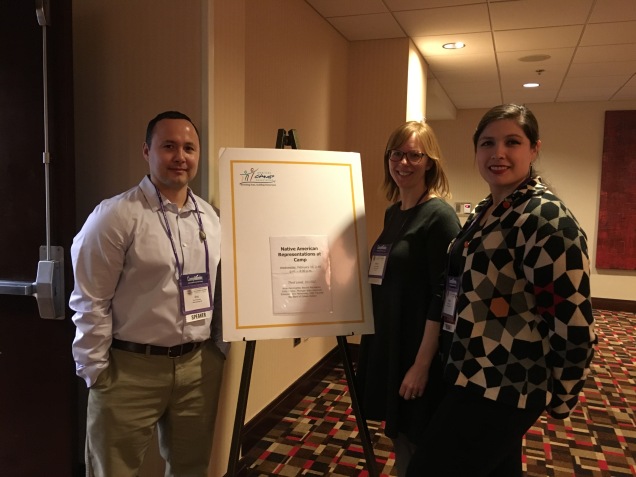
Presentation on Native Representations at the American Camp Association National Conference

Eric Hemenway, Anne Henningfeld, and Emily Proctor outside their well-attended panel.

IMG_0571

Law Review Article on Principal Briefs in Supreme Court Cases (Inc. Adoptive Couple v. Baby Girl)

Here.

Given the decision of NCFA to appeal the recent win in the Eastern District of Virginia to the Fourth Circuit this may be useful (if frustrating) reading.

As always, Adoptive Couple v. Baby Girl materials, including briefs, law review articles, and cases, are here.

ICWA Case out of Idaho Supreme Court

Here.

In this case, the trial court ordered the Shoshone-Bannock Tribes to pay half of the cost of the child’s attorneys fees, sanctioned the Tribes for not turning over membership information in response to the adoptive couple’s motion to compel, barred the Tribes from presenting information on the child’s status as an Indian child, barred the Tribes from enrolling the child, and granted attorney’s fees request from the adoptive couple.

In 2015.

On August 12, 2015, the trial court granted the Does $863 in costs and $35,000 in attorney fees against the Tribes, and further granted Child’s counsel $6,056.25 in fees against the Tribes. The Tribes initially challenged the lower court’s discovery and sanction rulings, as well as its ultimate grant of petition for adoption and attorney fees. The Does cross-appealed, challenging the Tribes’ intervention in the matter. The Tribes have since dropped their challenge to the adoption and the Does correspondingly dropped their challenge to the Tribes’ intervention. What remains now is the Tribes’ assertion that the lower court’s discovery rulings, injunction, sanctions, grant of fees, and failure to find Child an Indian child were in error. The Does request attorney fees on appeal pursuant to Idaho Appellate Rule 11.2(a) and Idaho Code section 12–121.

All of these were ultimately overturned by the Idaho Supreme Court in the decision.

Published Burden of Proof ICWA/MIFPA Case out of Michigan Court of Appeals

Here.

As set forth above, the relevant provisions of the ICWA and the MIFPA are essentially identical; that is, each requires proof by “clear and convincing evidence” to remove an Indian child and place him or her into foster care, 25 USC § 1912(e), MCL 712B.15(2); proof sufficient to satisfy the trial court that active efforts have been made to terminate parental rights, 25 USC § 1912(d), MCL 712B.15(3); and proof “beyond a reasonable doubt” that continued custody will harm the child, 25 USC § 1912(f); MCL 712B.15(4). Thus, as with its federal counterpart, the Legislature, in enacting the MIFPA, set forth specific evidentiary standards in MCL 712B.15(2) and (4), while declining to do so in MCL 712B.15(3). The inevitable conclusion, therefore, is that, like Congress, the Legislature intended for the “default” evidentiary standard applicable in child protective proceedings—i.e. clear and convincing evidence—to apply to the findings required under MCL 712B.15(3) as to whether “active efforts” were made to prevent the breakup of the Indian family. Accord In re JL, 485 Mich. at 318–319; In re Roe, 281 Mich. at 100–101. Therefore, because a default standard of proof applies to MCL 712B.15(3), it is not unconstitutionally vague.


Canadian Human Rights Tribunal Releases Decision on Discrimination Against Children Living on Reserves

Here is the decision.

AANDC’s [Aboriginal Affairs and Northern Development Canada] design, management and control of the FNCFS [First Nations Child and Family Services] Program, along with its
corresponding funding formulas and the other related provincial/territorial agreements have resulted in denials of services and created various adverse impacts for many First
Nations children and families living on reserves.

Here is the media coverage.

This is a tremendous and long-fought victory for the First Nations and Family Caring Society, who brought the claim, and Cindy Blackstock, the executive director of the Society and incredible driving force behind the claim.

ICWA Placement Preferences Case out of Alaska

Here.

The superior court again concluded that [grandparents] were not an appropriate placement because of their attitude and failure to give Caitlin’s medical equipment to OCS.

***

The superior court’s finding that the grandparents were an unsafe placement is supported by substantial evidence in the record. We therefore affirm the superior court’s decision to deny placement with [grandparents].

ICWA Placement Preference and Burden of Proof Case Out of Oklahoma Supreme Court

Here.

The Honorable Wilma Palmer, Special Judge, for the District Court of Tulsa County, ordered the transfer of a minor child S.A.W., from a foster home to a home compliant with the Indian Child Welfare Act. The State, natural father, natural mother, child, and foster mother appealed. The Court of Civil Appeals reversed the order of the district court and the Cherokee Nation sought certiorari. We previously granted certiorari. We hold that appellants failed to satisfy their burden that natural father was not a member of his tribe. The Cherokee Nation met its burden to show that the child was subject to the Indian Child Welfare Act. We hold that when a tribe fails to provide timely temporary foster care with an ICWA-compliant home and an ICWA-noncompliant family seeks a permanent placement, the trial court should consider harm to the child resulting from a tribe’s untimely motion to move the child to an ICWA-compliant home. We hold the proper standard for a party showing a need for an ICWA-noncompliant child placement is clear and convincing evidence, and that appellants met this burden. We reverse that portion of the trial court’s order directing an ICWA-compliant placement. We hold that the appellants’ additional arguments for challenging application of the ICWA are insufficient and affirm the trial court in part, and remand for additional proceedings.