The Atlantic Article on Climate Change and Yup’ik Fishing

Here.

“Subsistence is living from the land,” said Flynn. “It’s what we’ve always done. We go hunt ducks and seals in the ocean in the springtime. Ptarmigan. Salmon. My great-grandfather and grandfather told us we have to be very careful what we catch. God made them for everyone. I was living subsistence even when I was in the military. My whole life. I make a fish camp every year and dry 30, 40 kings. I set a net last summer but there was too much closure. Things have been rough.”

“And how did it feel not to be able to catch enough?” Davis asked him.

“I have a grandchild, 2 years old—” He paused and rubbed his eyes. Several other men in the gallery also began to cry. “My grandson said to me, ‘When we gonna go check the net?’ And I couldn’t say anything.”

Michael Cresswell, a state trooper, leaned over and whispered in my ear: “This is momentous. This is climate change on trial.”

Via J.S.
Council of Canadians Report on Drinking Water in Canada

Report here. Website here.

On Notice for a Drinking Water Crisis in Canada is a report by Council of Canadians water campaigner Emma Lui that provides an overview of the drinking water advisories in effect in each of the provinces, territories and in First Nations. As of January 2015, there were at least 1,838 drinking water advisories in effect, including 1,669 drinking water advisories in communities across Canada and 169 drinking water advisories in 126 First Nation communities. It also provides a summary of the threats to drinking water sources across Canada.

Interesting Post at American Indians in Children’s Literature

A redundant title, given that Debbie Reese’s blog is always interesting, and people should just be reading it all the time–so here’s an excuse to call attention to it again. This post describes the response of a game designer to her criticism of one of his game designs. And it’s hopeful and positive.

Bar Exam Scholarships for Students Who Intend to Practice Indian Law in Oklahoma

Here.

Deadline May 8,2015

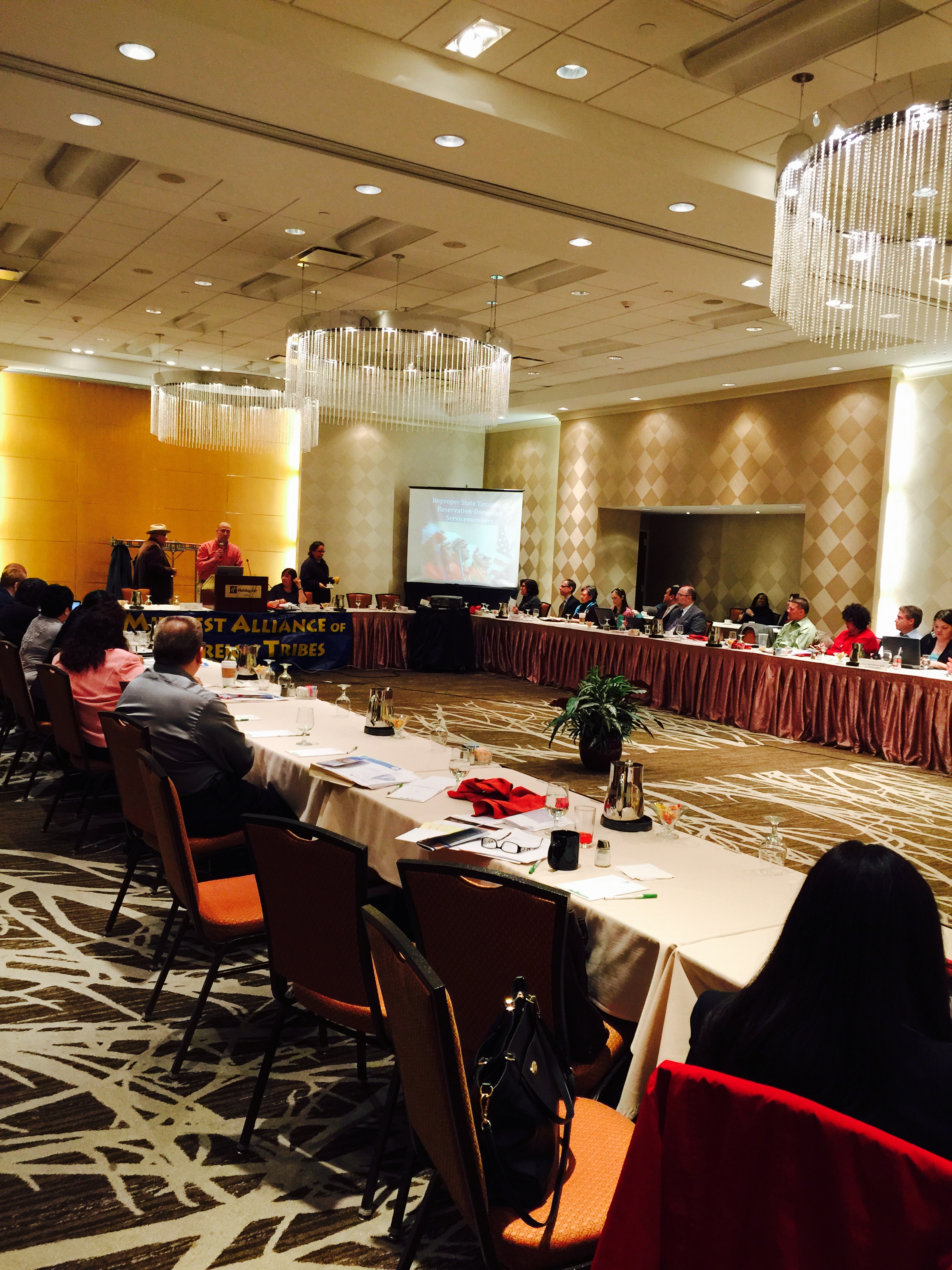
Midwest Alliance of Tribes, Impact Week in Washington D.C.

Multiple MSU ILPC alums in attendance, taking pictures of each other–Peter Vicaire, Veterans Affairs, speaking; photo by Karrie Wichtman, Rosette.

FullSizeRender

NICWA Webinar on Updated BIA Guidelines

This Friday at 10am PDT (1pm EDT). Register here. No cost.

A major development in tribal child welfare policy was announced on February 25, 2015. The Bureau of Indian Affairs announced that it had revised–effective immediately–the Guidelines for State Courts and Agencies in Indian Child Custody Proceedings for the first time since 1979. NICWA is hosting a free webinar on Friday, March 13, 2015, at 10 a.m. PDT to explain the revisions.

We encourage ICWA advocates, tribal and state child welfare workers, tribal and state attorneys, parents’ attorneys and judges to take the time to read the full updated guidelines. We also encourage discussion of these important changes to regularly scheduled meeting agendas, to hold new meetings and trainings to discuss these guidelines’ effects on their practice, and to disseminate these guidelines widely.


Job Posting: Law Office Administrator at NARF

Here.

JOB SUMMARY: Manages the day-to-day operations of the law office and, in that capacity, maintains responsibility for personnel administration (including compensation and insurance benefits) network and communications systems, physical facilities, and legal support functions. Provides administrative support for the Executive Director and the Litigation Management Committee. The LOA identifies and plans for the changing needs of the organization, shares responsibility with the appropriate senior managers for strategic planning, and contributes to cost-effective management throughout the organization.
See the full job description at: http://www.narf.org/contact-us/join-team/

ANNUAL SALARY RANGE: $75,530 + depending on experience. Generous benefits.

APPLICATION PROCEDURE:
Applications will be considered in the order that they are received. Submit resume with application letter and names and addresses of up to three references no later than April 30, 2015 to:
Katrina Mora, Administrative Assistant
katrina@narf.org
NATIVE AMERICAN RIGHTS FUND
1506 Broadway
Boulder, CO 80302-6296

Ysleta del Sur Pueblo Held in Contempt over Gaming

Order here.

Materials here.

Job Opening at DOJ OJP–Senior Native American Policy Analyst

Posting here.

AGENCY MARKETING STATEMENT:

  • Are you interested in working for a cutting edge agency with a mission to improve public safety, and the fair administration of juvenile justice? If so, the Department of Justice (DOJ) Office of Justice Programs, (OJP), is seeking a high performing individual to serve as a Tribal Senior Policy Advisor providing advice and guidance to resolve, implement, or manage program or policy issues that involve tribal youth programs.


NOTES:

  • This position is located in the Department of Justice (DOJ), Office of Justice Programs (OJP), Office of Juvenile Justice and Delinquency Prevention (OJJDP). OJJDP is focused on juveniles in crisis from serious, violent, and chronic offenders to victims of abuse and neglect. Charged by Congress to meet this challenge, OJJDP collaborates with professionals from diverse disciplines to improve juvenile justice policies and practices. OJJDP accomplishes its mission by supporting states, local communities, and tribal jurisdictions in their efforts to develop and implement effective programs for juveniles. The Office strives to strengthen the juvenile justice system’s efforts to protect public safety, hold offenders accountable, and provide services that address the needs of youth and their families. The incumbent provides advice and guidance to resolve, implement, or manage program or policy issues that involve major areas of complexity in approach or methodology; prepares short- and long-range planning guidance in accordance with broad program policies and objectives; prepares guidance based on analyses of interrelated issues of effectiveness, efficiency, and productivity of substantive mission-oriented programs in one or more of the OJJDP specific policy areas that have a direct impact on the lives of American Indian and Alaska Native youth (e.g. adapting a developmental approach to juvenile justice reform nationwide; responding to the key recommendations from the Attorney General’s Task Force on American Indian/Alaska Native Children Exposed to Violence; family/youth engagement; child protection; juvenile justice system improvement; and delinquency prevention).


DUTIES:

  • Plans, develops, and implements program/project development activities that affect broad mission areas related to Tribal Juvenile Justice. Participates in the design and development of new Tribal Juvenile Justice programs/projects, including preparation of scopes of work for design studies; selection of study contractors; and review and approval of completed design studies. Coordinates and collaborates with senior level management/programmatic staff of other OJP and DOJ offices on all comprehensive community-based and system development programs, with a particular emphasis on American Indian and Alaska Native youth.
  • Provides expert guidance in the resolution of complex problems or issues impacting DOJ American Indian and Alaska Native programs, such as crosscutting OJJDP issues involving other DOJ components or federal agencies. Participates in the analysis of OJP-wide projects and programs. Coordinates with DOJ’s Office of Tribal Justice.
  • Serves as an authoritative expert in analyzing legislation and developing standards, regulations, or policies that impact DOJ and OJP-wide programs involving American Indian and Alaska Native youth. Coordinates or synthesizes a cross section of criminal and juvenile justice issues with policy considerations that reflect a balance, and that meet the mission and needs of OJP/OJJDP programs.
  • Plans and develops strategies for maximizing the potential of outreach project opportunities, enhancing OJJDP’s visibility and interactions with its primary constituencies, including Congress and juvenile justice and tribal interest groups. Maximizes OJJDP’s outreach with other constituencies, including the corporate/profit sector, related non-profit organizations, other federal government agencies, local and state governments, and interested local community groups. Conceives and recommends entrepreneurial and innovative projects and activities or recommends the means of broadening and strengthening existing projects and activities that find a common ground with a widening range of stakeholders and build support for OJJDP with the general public. Makes clear and convincing oral presentations to individuals and groups, explaining facts and ideas which actively promote and advance OJJDP’s programs. Serves as a spokesperson by cultivating and maintaining effective relationships with organizations involved in tribal youth, juvenile justice and child protection issues and programs.

Commission to Eliminate Child Abuse and Neglect Fatalities Public Meeting

Here.

Arizona Public Meeting

March 25 – 26

Meeting Times:

  • Wednesday, March 25: 8:00 a.m.–4:00 p.m. MST
  • Thursday, March 26: 8:00 a.m.-12:30 p.m. MST

**Please note that Arizona does not observe Daylight Saving Time.**

Meeting Agenda: CECANF was established to develop a national strategy and recommendations for reducing fatalities resulting from child abuse and neglect. The purpose of the March 25-26 meeting is for Commission members to explore key issues related to addressing and preventing child abuse and neglect fatalities in Indian Country. It will include presentations and discussions related to issues of jurisdiction, data collection and data sharing, and the quality and quantity of services. Speakers will include Tribal leaders, Federal agency representatives, and practitioners. Commission members will then continue discussing the work plans of the Commission subcommittees, the information that they have obtained to date, and emerging high-level recommendations.

Attendance: Individuals interested in attending the meeting in person or via webinar and teleconference must register in advance (see link below). The meeting site is accessible to individuals with disabilities. Members of the public will not have the opportunity to ask questions or otherwise participate in the meeting, either on the phone or in person. Comments or testimony can be submitted online.