Royal v. Murphy Cert Petition (Death Penalty & Muscogee Reservation Boundaries)

Here:

Cert Petition

Question presented:

Whether the 1866 territorial boundaries of the Creek Nation within the former Indian Territory of eastern Oklahoma constitute an “Indian reservation” today under 18 U.S.C. § 1151(a).

Lower court materials here.

UPDATE:

Environmental Federation Of Oklahoma Inc Amicus Brief

OIPA Amicus Brief

US Amicus Brief Royal v. Murphy

Murphy BIO FINAL

No. 17-1107 Murphy Reply — Final

Federal Court Rejects Stockbridge-Munsee Effort to Restart Litigation against Ho-Chunk Nation Compact, Denies Motion for Sanctions

Here are the materials in Stockbridge-Munsee Community v. State of Wisconsin (W.D. Wis.):

76 motion to file amended complaint

78 wisconsin opposition

81 ho-chunk nation opposition

83 motion for sanctions

84 stockbridge-munsee reply

85 stockbridge-munsee opposition to motion for sanctions

88 dct order

Prior post here.

Tenth Circuit Vacates Arbitration Award Favoring Citizen Potawatomi in Liquor Sales Dispute with Oklahoma

Here is the opinion in Citizen Potawatomi Nation v. State of Oklahoma.

Briefs:

Appellant brief

Citizen Potawatomi brief

Reply

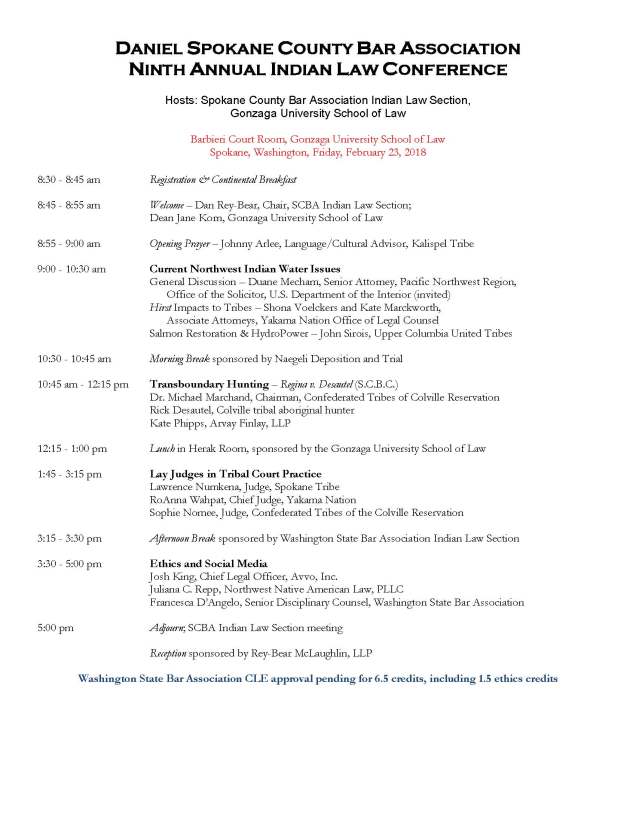
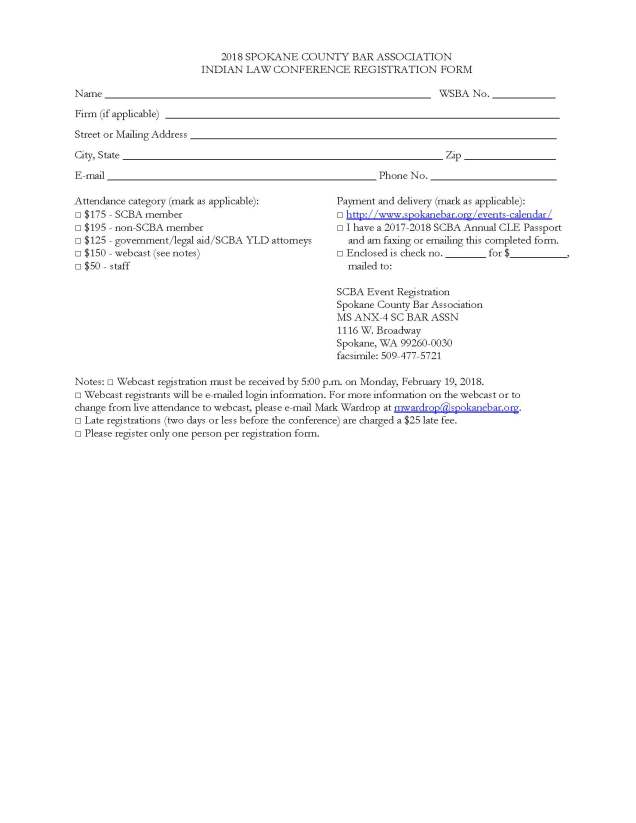
Spokane County Bar Association Indian Law Section 2018 CLE

Here (PDF):

2018-02-01 SCBA ILS conference agenda - regis form_Page_12018-02-01 SCBA ILS conference agenda - regis form_Page_2


Tribal Opposition to Trump Administration’s Motion to Change Venue in Bears Ears Matter to Utah

Here is the pleading in Hopi Tribe v. Trump (D.D.C.):

Doc. 26 Plaintiffs’ Opposition to Federal Defendants’ Motion to Transfer 2018-02-01

The motion is here.

NYTs: “Indians in the Hamptons Stake Claim to a Tiny Eel With a Big Payday”

Here.

New Scholarship on Responsible Resource Development

Carla FredericksKathleen FinnErica Gajda and Jesse Heibel have posted “Responsible Resource Development: A Strategic Plan to Consider Social and Cultural Impacts of Tribal Extractive Industry Development,” forthcoming in the Harvard Journal of Gender and Law.

Here is the abstract:

This paper presents a strategic, solution-based plan as a companion to our recent article, Responsible Resource Development and Prevention of Sex Trafficking: Safeguarding Native Women and Children on the Fort Berthold Reservation, 40 HARV. J.L. GENDER 1. (2017). As a second phase of our work to combat the issues of human trafficking and attendant drug abuse on the Mandan, Hidatsa and Arikara Nation (MHA Nation), we developed a strategic plan to better understand the time, scale, and capacity necessary to address the rising social problems accompanying the boom of oil and gas development there. During our process, we discovered, through multiple engagements with tribes, that similar negative impacts of rapid economic development are occurring throughout the United States. In particular, many tribes are deeply concerned about the rapid increase in human trafficking on and near their reservations coincident with the entrance or re-entrance of the extractive industries. 

The paper is a generalized strategic plan for tribes and other stakeholders to consider in combating the social impacts of extractive industry development. Although the plan is designed to be universal in scope and aspires to assist tribes throughout the country, it does not purport to take into account the unique complexities of individual Indian communities. The history, values, and research are examined to develop a process that will best suit a Native approach to each of the solutions presented, informed foremost by our relationship with the tribal community on Fort Berthold, as well as other tribes nationally. A cornerstone of the plan is that services that center on cultural identity and draw upon family connections are a preferred approach for Native peoples. Further, any approach to trafficking of Native women and children must take account of the colonial genesis of trafficking, generational trauma, and other risk factors.
Michalyn Steele on Congressional Powers and Sovereignty in Indian Affairs

Michalyn Steele has posted “Congressional Power and Sovereignty in Indian Affairs” on SSRN. The paper is forthcoming in the Utah Law Review.

Here is the abstract:

The doctrine of inherent tribal sovereignty — that tribes retain aboriginal sovereign governing power over people and territory — is under perpetual assault. Despite two centuries of precedential foundation, the doctrine must be defended afresh with each attack. Opponents of the doctrine of tribal sovereignty express skepticism of the doctrine, suggesting that tribal sovereignty is a nullity because it is not unfettered. Some pay lip service to the doctrine while undermining tribes in their exercise of inherent sovereignty. Underlying many of these legal fights is confusion about both the nature of tribal sovereignty and the justifications for its continuing existence. Under current federal law, tribes are domestic, rather than international sovereigns. Tribes retain significant powers but are subject to the ultimate sovereignty of the United States. The sui generis status of Indian tribes in the American legal landscape generates important and difficult questions: which governing powers do tribes retain and where does the power to answer that question reside in the federal system? How are disputes about the scope of tribal authority to be resolved?

As the debate about what powers tribes may exercise (and over whom) continues into its third century, it is critical to reexamine the origins of the doctrine of inherent tribal sovereignty as a settled principle of federal law and to articulate the principles that ought to guide the development of that principle in the future. Setting the metes and bounds of the doctrine of tribal sovereignty in federal law and policy belongs to the political branches. This Article suggests legal principles that ought to guide the federal political branches in the exercise of the Indian Affairs power and the trust responsibility to address the scope of tribal inherent authority. First, this Article examines the legal roots and branches of the doctrine of inherent tribal sovereignty, demonstrating that the doctrine remains a vital principle of federal law. Second, this Article analyzes the nature of contemporary assaults on the doctrine of inherent tribal authority by all three branches of the federal government, states, and private actors. Third, this Article suggests principles that ought to guide Congress in exercising its Indian affairs power to clarify and affirm the bounds of tribal sovereignty in federal law and in carrying out the federal trust responsibility to tribes.

Highly recommended.

IRS Advance Notices for Indian Taxpayers and Alaska Native Settlement Funds

Here:

IRS Advance Notices

Coyote Valley Band of Pomo Indians Sues Pharmaceutical Companies [complaint now included]

Here is the complaint in Coyote Valley Band of Pomo Indians v. McKesson Corp. (Cal. Super.):

coyote valley v. mckesson complaint – conformed copy