Very interested, and sad.
Here.
Very interested, and sad.
Here.
Here is the opinion in Abdow v. Attorney General (Mass. Sup. Jud. Ct.).
We posted links to briefs here.
An excerpt:
The issue presented on appeal is whether an initiative petition meant to prohibit casino and slots gambling and abolish parimutuel wagering on simulcast greyhound races meets the requirements set forth in art. 48 of the Amendments to the Massachusetts Constitution and, therefore, may be considered by voters at the November Statewide election. The Attorney General concluded that it did not and, accordingly, declined to certify it for inclusion on the ballot. The plaintiffs, ten Massachusetts voters who submitted the proposed initiative for certification, filed a complaint challenging the Attorney General’s decision and sought an order requiring the Attorney General to certify the petition. We conclude that the Attorney General erred in declining to certify, and grant the requested relief so that the initiative may be decided by the voters at the November election.
Here are materials in Tlingit-Haida Regional Housing Authority v. United States Department of Housing and Urban Development (D. Colo.):
An excerpt:
On March 4, 2008, Plaintiff Tlingit–Haida Regional Housing Authority (“Tlingit–Haida” or “the Tribe”) filed this action for judicial review under the Administrative Procedure Act, 5 U.S.C. § 701 et seq., claiming that the Defendants (collectively “HUD”) violated the Native American Housing Assistance and Self–Determination Act of 1996 (“NAHASDA”), 25 U.S.C. § 4101 et seq., by reducing the number housing units counted as Formula Current Assisted Stock (“FCAS”) for the calculation of the Tribe’s share of the annual Indian Housing Block Grant (“IHBG”) and recapturing IHBG funds which the Tribe had received in past years for those units. Tlingit–Haida filed an amended complaint for declaratory and injunctive relief on June 17, 2010, requesting various and alternative forms of relief, including the disgorgement of recaptured funds.
***
FURTHER ORDERED that final judgment shall enter requiring the Defendants to restore to Plaintiff Tlingit–Haida Regional Housing Authority the amount of $1,139,658, for Indian Housing Block Grant funds that were illegally recaptured from the Plaintiff for fiscal years 1998 through 2002. Any such restoration shall be in addition to the full IHBG allocation that would otherwise be due to the Plaintiff under the Native American Housing Assistance and Self–Determination Act (“NAHASDA”) in a given fiscal year as calculated without application of the amount of the Judgment; it isFURTHER ORDERED that Defendants shall make restoration of the IHBG funds from all available sources, including, but not limited to the funds set aside for Plaintiff’s benefit by stipulation of the parties on March 6, 2008 and ordered by this court in an Order entered on March 18, 2008 in the amount of $1,499,887[.]
Here is the opinion in American Indian Model Schools v. Oakland Unified School District (Cal. App.):
An excerpt:
The American Indian Model Schools (AIMS) operates three public charter schools in the City of Oakland (Oakland). The Oakland Unified School District (the District) decided to revoke AIMS’s three charters after an independent audit uncovered evidence of conflict of interest violations, fiscal mismanagement, and improper use of public funds at the three charter schools. Funding of the charter schools was to halt while AIMS appealed the revocation decision.
AIMS filed a writ petition in the superior court against the District and others (collectively, defendants),1 challenging the District’s revocation of its charters. AIMS also requested a preliminary injunction to stop the implementation of the revocation order during the appeal process.
The trial court granted in part AIMS’s request for a preliminary injunction. The court highlighted the outstanding scholastic achievements of the students at AIMS’s three charter schools and the harm these students and schools would suffer if instruction were interrupted and the schools were no longer able to operate. The court concluded that the hardships weighed in favor of granting a preliminary injunction and that AIMS had demonstrated a likelihood of prevailing at trial because the record did not contain substantial evidence that the District complied with the requirements under Education Code section 47607, subdivision (c)(2).2 The court issued a preliminary injunction to maintain the status quo pending resolution of the appeal of the revocation decision.Defendants appeal from the preliminary injunction order, arguing that the trial court abused its discretion in finding that AIMS is likely to prevail at trial. Defendants maintain that section 47607, subdivision (c)(2) requires the District to consider academic achievement but the trial court incorrectly interpreted this provision as requiring the District to make findings supported by substantial evidence that it complied with this provision. Defendants also challenge the trial court’s interpretation of section 47607, subdivision (i), and claim that issuing an injunction, which requires continued funding to the charter schools during the pendency of AIMS’s appeal, contravenes the mandate of section 47607, subdivision (i). Additionally, defendants maintain that the court failed to give sufficient deference to the District’s decision when it ruled AIMS was likely to prevail on the merits, that the court usurped the jurisdiction of the State Board of Education (the SBE), and that the court should not have issued any ruling in the absence of the California Department of Education (the CDE), which they maintain was an indispensable party.
We are not persuaded by defendants’ arguments and affirm the order granting the preliminary injunction.
Here is the New York Times’ excellent article, “Flying 3 Flags and Seeking One Banner: The Diverse Heritage of the San Antonio Spurs’ Patty Mills.”
Call for Papers for the AALS Annual Meeting
Friday, January 2 – Monday, January 5, 2015, Washington DC
The AALS Indian Nations and Indigenous Peoples Section invites submissions on the topic “Bay Mills and the Future of Sovereign Immunity” for the Section’s 2015 AALS conference panel. Please submit abstracts (preferred to received full papers) to the Section Chair, Alex Pearl, at alex.pearl@ttu.edu by August 1, 2014. We anticipate interpreting the topic broadly, so please submit if you are doing work related to this concept. The Section Executive Committee will inform you if you have been chosen to be on the panel by September 1, 2015 so that you will know in time for the Spring Law Review submission cycle.
Each summer NARF hosts the summer clerkship program, a ten to twelve week program 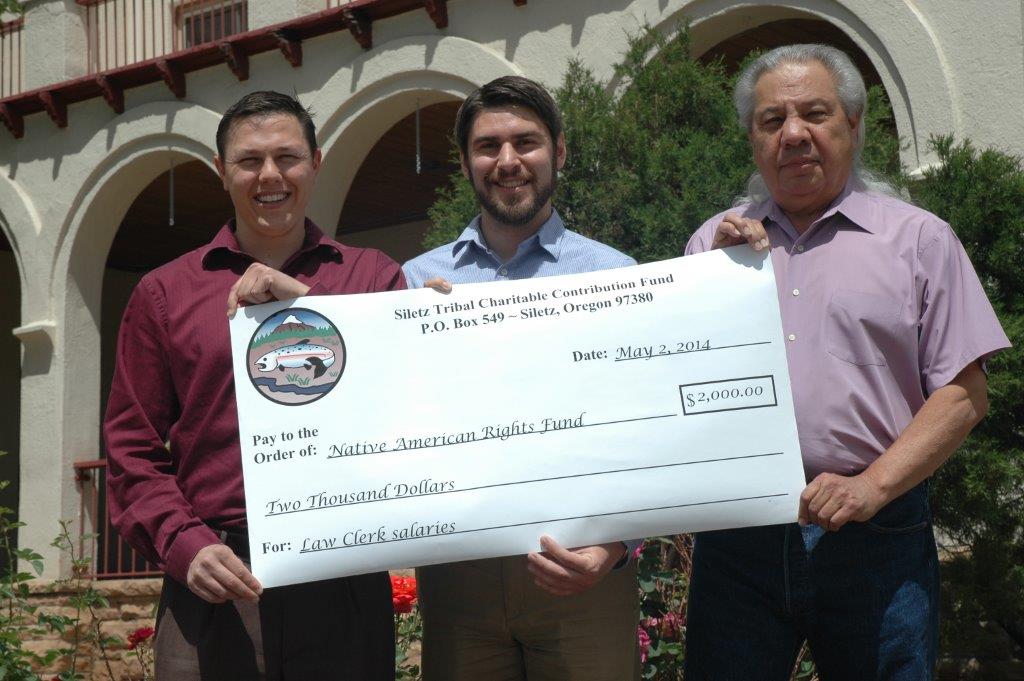 for second year law students. Unlike most law clerk projects that consist mainly of legal research and writing, NARF’s projects are extremely challenging because NARF practices before federal, state, and tribal forums, and because most of its cases – whether at the administrative, trial, or appellate level – are complex and involve novel legal issues.
This summer the law clerk program was supported by a grant from the Confederated Tribes of Siletz Indians through the Siletz Tribal Charitable Contribution Fund. This summer NARF has six law clerks – two in the Alaska office, one in the D.C. office, and three in the Boulder office. Law Clerk Hunter Cox (Prairie Band of Potawatomi Nation), was chosen to be the recipient of this grant due to his recent and impactful work collaborating with NARF attorney Steve Moore to protect the rights of Native high school students to wear their eagle feathers during their graduation ceremony.
Earlier this month, NARF, California Indian Legal Services (CILS), and the American Civil Liberties Union (ACLU) of Northern California advocated on behalf of Native students in Lemoore, California, who wanted to wear eagle feathers at their graduation ceremony. The gift of an eagle feather is a great honor and is typically given to recognize an important transition in a young person’s life. Many graduates are given eagle feathers in recognition of their educational journey and the honor the graduate brings to his or her family, community, and tribe. Hunter, along with Steve, CILS, and ACLU, sent a letter on the students’ behalf requesting the school district to allow the students to wear their eagle feathers during graduation. After initially denying the students requests, the school district relented once receiving the letter, and allowed the students to wear their feathers despite originally denying the students request.
To read the letter sent on the students’ behalf, click here. And, to read the press about the students wearing their feathers, click here.
NARF thanks the Confederated Tribes of Siletz Indians and the Siletz Tribal Charitable Contribution Fund for its grant to further the NARF law clerk program, which allows Native law students to make an impact on Indian law and to Native people during their term at NARF.
CONTACT: For questions regarding eagle feathers – Steve Moore, Native American Rights Fund – 303-447-8760
For questions about NARF’s Law Clerk Program – Matthew Campbell, Native American Rights Fund – 303.447.8760
Here are the materials so far in Stifel, Nicolaus & Company, Incorporated v. Lac Courte Oreilles Band of Lake Superior Chippewa Indians of Wisconsin (W.D. Wis.):
10 LCO Motion to Dismiss or Stay
13 LCO Tribal Court Motion to Dismiss or Stay
29 Joint Stipulation re Stay of Tribal Court Proceedings
30 DCT Order Allowing Dismissal of Prior Motions wo Prejudice
38 Stifel Motion for Summary J
An excerpt:
Plaintiff Stifel, Nicolaus & Company, Inc. (“Stifel”) seeks equitable reformation of its Bond Purchase Agreement with defendant Lac Courte Oreilles Band of Lake Superior Chippewa Indians of Wisconsin (the “Band”), as well as a declaratory judgment that the Band may not proceed to sue Stifel in a currently-pending action in Lac Courte Oreilles Tribal Court. Before the court now is plaintiff’s motion for summary judgment on both claims. (Dkt.# 37.) Based on the undisputed facts of record, the court holds that Stifel is entitled to reformation of the Bond Purchase Agreement, but also concludes that the Band may proceed with its pending claims against Stifel in Lac Courte Oreilles Tribal Court. Although Stifel has had ample opportunity to do so already, because the Band did not affirmatively move for summary judgment, the court will give Stifel yet another opportunity to proffer additional evidence, if any, that the forum selection clause in the Bond Purchase Agreement clearly precludes the Band from proceeding in Tribal Court.
Here (PDF):

Here is the opinion in Stockbridge-Munsee Community v. New York:
Briefs are here.


You must be logged in to post a comment.