Download agenda and presenter bios here.
Link to registration here.
As a courtesy notice, the below Request for Proposals are available on the Federal Business Opportunities website. Please note, they are advertised as 100% Indian Small Business Economic Enterprise Set-aside in accordance with the Buy Indian Act.
Please direct all questions to the Contracting Officer listed on the solicitation.
Join us for a webinar on Apr 07, 2016
10:00 AM Alaska Time
11:00 AM Pacific Time
12:00 PM Mountain Time
1:00 PM Central Time
2:00 PM Eastern Time
Register now!
https://attendee.gotowebinar.com/register/435037542002716929
Many Tribes are exploring how federal Title IV-E funds can best meet their child welfare program needs. Some Tribes are considering direct access to Title IV-E, while others are engaged in or considering Tribal-State IV-E agreements and contracts. The federal Children’s Bureau, joined by the Chickasaw Nation of Oklahoma and the new Capacity Building Center for Tribes, will share detailed information about Title IV-E considerations for Tribes who may be seeking to operate a Title IV-E program, either directly or through agreements. The discussion will focus on federal Title IV-E regulations as well as Tribe’s experience in direct access.
The FBA Indian Law Section’s Lawrence R. Baca Lifetime Achievement Awardees have been announced. There are co-awardees this year: Prof. Charles Wilkinson and the late Prof. Bill Rice.
Nottawaseppi Huron Band of the Potawatomi Asserts Authority to Prosecute All Persons, including Non-Indians, for Domestic Violence
Local Tribe to Implement Violence Against Women Act Jurisdictional Provisions
Pine Creek Indian Reservation, Athens, MI – Today, the Nottawaseppi Huron Band of the Potawatomi announces implementation of a new tribal government law that enables tribal police and justice officials to investigate and prosecute certain domestic violence crimes committed by non-Indians in Indian country. Non-Indians who live or work on the reservation or have a marriage or dating relationship with a Native person may now be subject to tribal jurisdiction for domestic and dating violence crimes and criminal violations of certain protection orders. Individuals who commit these crimes in Indian country can be arrested by tribal police, prosecuted in tribal court, and sentenced to prison. Individuals prosecuted under the new tribal law will have a right to an attorney. If the defendant cannot afford an attorney, one will be provided by the tribe.
This is part of the Tribal Council’s larger effort to take a stand against violence in the community—and domestic violence, in particular—because of the huge toll it has taken on Native families and youth.
“Domestic violence is a uniquely local crime that has long deserved a local solution, and now we have one,” said Tribal Council Chair Homer A. Mandoka. “We will no longer stand by and watch our Native women be victimized with no recourse. I’m here to put the community on notice, perpetrators will be held accountable.”
The federal law that authorizes these recent actions by the Nottawaseppi Huron Band of the Potawatomi is the Violence Against Women Reauthorization Act of 2013 (VAWA 2013). Signed into law on March 7, 2013, VAWA 2013 marked a victory for Native women, tribal leaders, women’s rights advocates, and survivors of domestic abuse everywhere. For the first time since the U.S. Supreme Court stripped tribal governments of their criminal authority over non-Indians in Oliphant v. Suquamish Indian Tribe (1978), VAWA 2013 restored tribal inherent authority to investigate, prosecute, convict, and sentence non-Indians who assault their Indian spouses or dating partners in Indian country. This aims to fill a longstanding jurisdictional gap on tribal lands that has for far too long put Native women at risk and kept the hands of tribal law enforcement tied.
Crimes committed outside of Indian country, between two strangers, between two non-Indians, or by a person without sufficient ties to the Nottawaseppi Huron Band of the Potawatomi are not covered by this new authority.
This new law is necessary because violence against Native women has reached epidemic proportions*, and the old system of forcing tribes to rely exclusively on far away federal—and in some cases, state—government officials to investigate and prosecute crimes of domestic violence committed by non-Indians against Native women is not working. Prior to VAWA 2013, the Indian woman who was beaten by her non-Indian husband on tribal land had nowhere to turn for protection: tribal law enforcement had no authority to intervene because the perpetrator is a non-Indian; the State had no authority to intervene because the victim was an Indian; and the Federal Government—the body with exclusive jurisdiction—had neither the will nor the resources to intervene in misdemeanor level domestic violence cases. VAWA 2013 is an attempt to remedy this broken system.
As President Obama said when he signed VAWA 2013 into law, “Tribal governments have an inherent right to protect their people, and all women deserve the right to live free from fear.” The Nottawaseppi Huron Band of the Potawatomi agrees, and it’s doing its part to ensure the safety of native women and of everyone on the reservation.
About the Nottawaseppi Huron Band of the Potawatomi
The Nottawaseppi Huron Band of the Potawatomi is a federally recognized Tribal government with nearly 1,100 enrolled Tribal members. The Potawatomi name is a derivation of Bodéwadmi, meaning a people of the fire or a people who make or maintain fire, both of which refer to the role of the Potawatomi as the keepers of the Council fire in an earlier alliance with other Tribes in the area. The Tribe’s main offices are located at the Pine Creek Indian Reservation in Athens Township, with additional offices in Grand Rapids, MI, to better serve our Tribal members. The government employs more than 150 employees who work for various departments among the Tribe including Tribal Police, Tribal Court, Housing, Environment, Membership Services, Communications, Human Resources, Finance, Public Works, Planning, Health & Human Services, and the Gaming Commission.
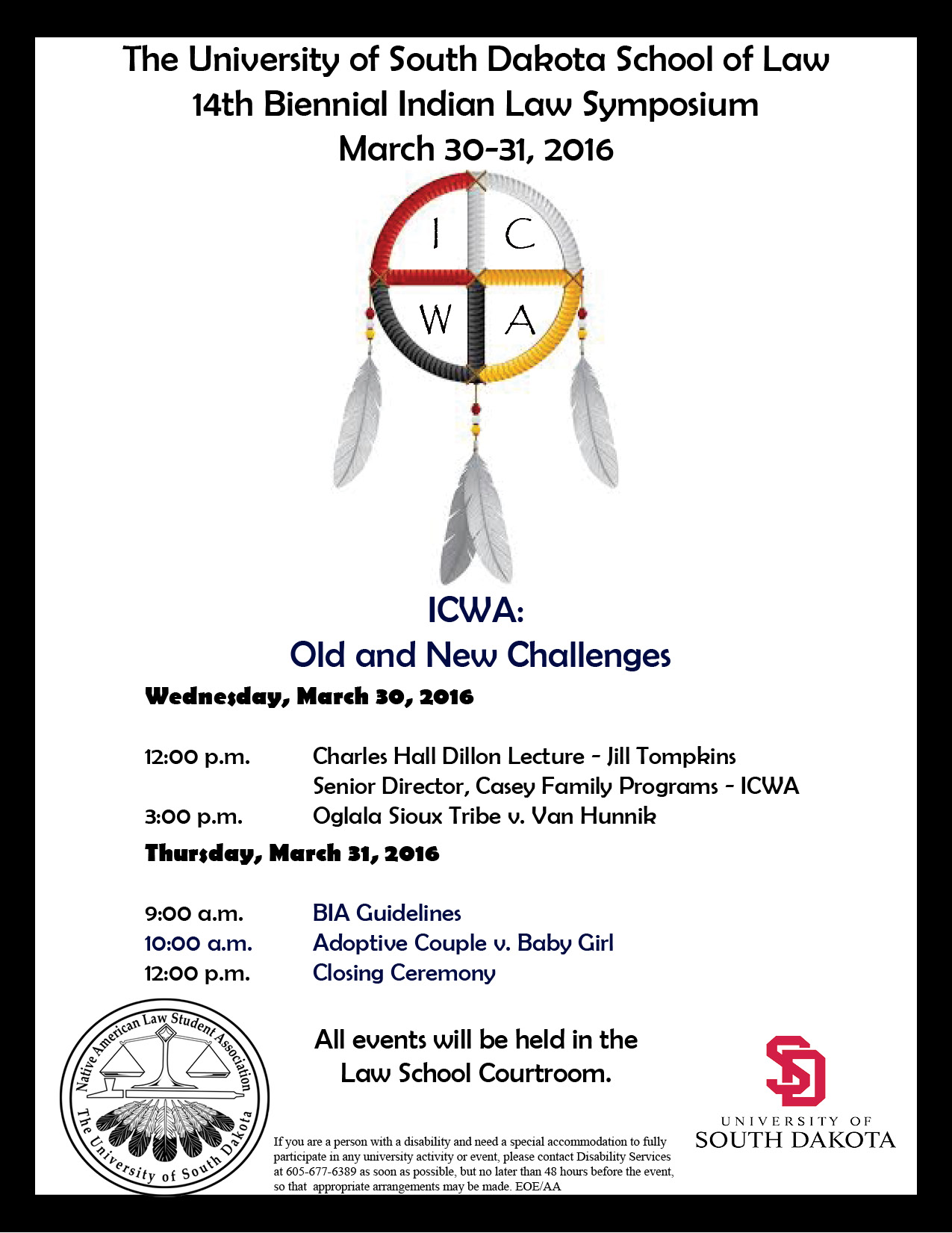
Link to details and registration here.
The local NALSA chapter is hosting “Indian Child Welfare Act: Old and New Challenges” March 30-31 at the University of South Dakota.
The Alaska Native Women’s Resource Center, Indian Law Resource Center, National Congress of American Indians, National Indigenous Women’s Resource Center, and Native Women’s Association of Canada are co-sponsoring an event to be held during the NGO-Forum of the Commission on the Status of Women’s 60th Session.
The event will take place on Tuesday, March 22nd at 4:30 p.m., at the United Nations Church Center Chapel.
More information can be found here.

Download the agenda and registration form here.
The MAIBA CLE Committee announces the 2016 Indian Law Conference will be held on Friday May 6th at the Mystic Lake Casino Hotel. An excellent program has been scheduled with several national speakers and cutting edge topics. Please note that Professor Sarah Deer will be honored at the reception Friday afternoon.
Their co-sponsor, Minnesota CLE, is again handling registration. Please find the attached brochure, which includes the agenda. You can view the same material and register by using the following link:
Cambridge, Mass, March 3, 2016 – The Honorable Allie Greenleaf Maldonado and Prof. Angela Riley are among 25 inspiring women who will be honored during Harvard Law School’s third Annual International Women’s Day Celebration, organized by the Harvard Women’s Law Association (WLA) and Harvard Law and International Development Society (LIDS). Judge Maldonado is the Chief Judge of the Little Traverse Bay Bands of Odawa Indians (LTBB). Judge Maldonado is a Co-Chair of the first Tribal State Federal Judicial Forum, and a nationally recognized expert on the Indian Child Welfare Act (ICWA) and the Michigan Indian Family Preservation Act (MIFPA).
Honorees were selected from nominations submitted by Harvard Law School students, faculty and staff.
As part of the celebrations, Judge Maldonado will be featured in a portrait exhibit, which will be displayed in the halls of the law school from February 29th- March 11th.
In addition to the portrait exhibit, the WLA and LIDS will be hosting a lunch event recognizing the honorees. The event will take place at the law school on Tuesday, March 8th from 12:00-2:00pm.
Speakers at the March 8 event include Elizabeth Warren, U.S. Senator from Massachusetts; Mindy J. Roseman, Director of International Programs and Gruber Program on Global Justice and Women’s Rights at Yale Law School; and Roxanne Conlin, one of the first women ever to be named U.S. Attorney, and the first female president of the Association of Trial Lawyers of America.
More information about the event is available at https://orgs.law.harvard.edu/womeninspiringchange/
The website includes portraits of all this year’s honorees, as well as honorees in previous years.
For more information, contact: Anna Andreeva (aandreeva@jd17.law.harvard.edu) and Alice Prinsley (aprinsley@jd17.law.harvard.edu).
 Turtle Talk
You must be logged in to post a comment.