Elwha Klallam Tribe Seeks Full-Time Prosecutor (Western Washington)

I am in-house Counsel at Elwha, and it is a great place to work. Please spread the word if you know anyone who might be interested.


JOB ANNOUNCEMENT: TRIBAL PROSECUTOR

The Lower Elwha Klallam Tribe seeks a full-time Tribal Prosecutor to prosecute criminal activity, juvenile delinquency, child dependency (child abuse and neglect), fish and wildlife offenses, traffic offenses, and other civil offenses as directed by the Tribe.

Nature of Practice: This staff member works with the Elwha Public Safety Commission, the Tribal Police Department, the Indian Child Welfare Program, the Probation Office, the Lower Elwha Housing Authority, and other tribal agencies to help assess tribal interests and provide vigorous and effective prosecution of crimes, juvenile delinquency and status offenses, child abuse and neglect, fish and wildlife offenses, civil exclusion matters, traffic offenses, and other appropriate civil offenses occurring within tribal jurisdiction. The prosecutor also provides legal support to the Tribal Police Department, ICW, Probation, Domestic Violence Program, and other tribal agencies in submitting and supporting their cases in Tribal Court. The prosecutor will also work with the Office of General Counsel to provide strategic planning support and assistance on tribal justice and victimization issues. The Prosecutor reports to and is supervised by the Tribe’s General Counsel.

Minimum Qualifications:

  • A law degree from an accredited law school and a license to practice law (lawyers licensed by a state other than Washington must acquire a Washington license within nine months of hire).
  • Strong negotiation and interpersonal communication skills, litigation experience, and an ability to thrive in an interdisciplinary and cross-cultural work environment.
  • A commitment to restorative justice.

Location: The Tribal Prosecutor’s office is located in the Elwha Klallam Justice Center, located about five miles west of Port Angeles, Washington. Port Angeles is a small historic town located on the Strait of Juan de Fuca and just a few miles from Olympic National Park. The office is approximately 85 miles west of Seattle.

Salary: Depends on experience. Full-time compensation includes medical and dental, retirement savings plan, and other fringe benefits.

Application: The Tribe would like to hire a lawyer for this position as soon as possible. Submit a cover letter, a current resume, at least three professional references, and a writing sample to (e-mail preferred):

Trent S.W. Crable, Associate General Counsel

Lower Elwha Klallam Tribe

2851 Lower Elwha Road

Port Angeles, Washington 98363

E-mail: trent.crable@elwha.nsn.us

Save the Date — “The Secret Life of Tribal Courts: How to Run a Successful Community-Based Court”

Hosted by the Michigan Indian Judicial Association and Little Traverse Bay Bands of Odawa Indians, October 11-12.

Attorney Job Postings at Swinomish

Details are below. I used to be a Tribal Attorney in this office, and it was a great job.

Tribal Prosecutor posting

Tribal Attorney listing

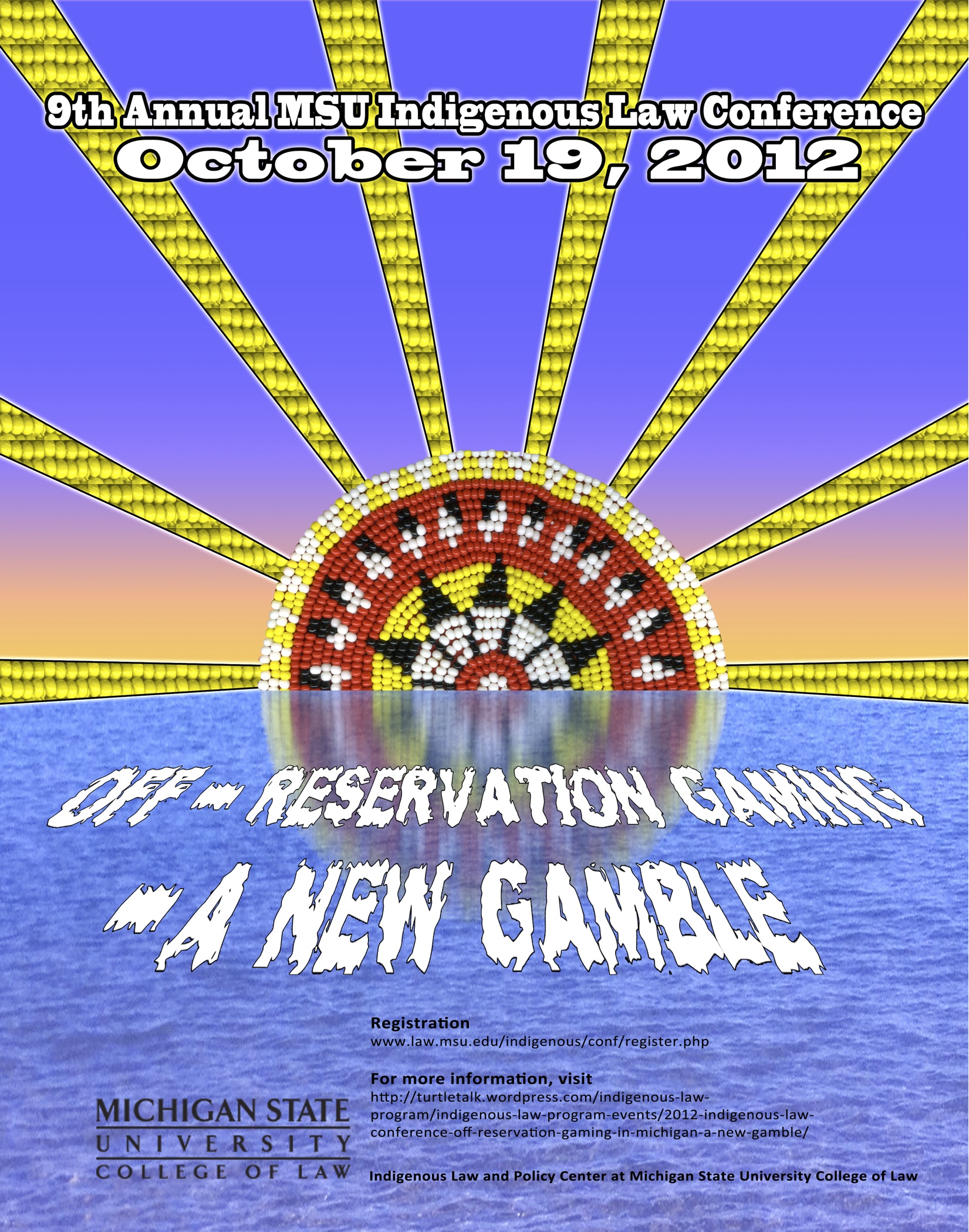
2012 ILPC Annual Conference–Off Reservation Gaming in Michigan

October 19th, at the Law College in East Lansing.

Registration here.

Schedule & additional details here.


Poster by Ken Akini, ILPC Fellow.

Beadwork by Mary Hemenway, Little Traverse Bay Bands of Odawa Indians

New Book by Rob Williams: “Savage Anxieties”

Book website here. From the site:

From one of the world’s leading experts on Native American law and indigenous peoples’ human rights comes an original and striking intellectual history of Western civilization and the idea of the savage that sheds new light on how we understand ourselves and our contemporary society. Throughout the centuries, conquest, war, and unspeakable acts of violence and dispossession have all been justified by citing civilization’s opposition to the savagery of the tribe. Robert Williams, award winning author, legal scholar, and member of the Lumbee Indian Tribe, proposes a wide-ranging reexamination of the history of the Western world, told from the perspective of civilization’s war on tribalism as a way of life. In Savage Anxieties, Williams shows us how the language of savagery used by the West to talk about the human rights of the world’s indigenous peoples is in dire need of reappraisal.
Buy it.

New Book — “Mni Sota Makoce: The Land of the Dakota”

Book website here.

More details about the book: and the authors from the website:

Much of the focus on the Dakota people in Minnesota rests on the tragic events of the 1862 U.S.–Dakota War and the resulting exile that sent the majority of the Dakota to prisons and reservations beyond the state’s boundaries. But the true depth of the devastation of removal cannot be understood without a closer examination of the history of the Dakota people and their deep cultural connection to the land that is Minnesota. Drawing on oral history interviews, archival work, and painstaking comparisons of Dakota, French, and English sources, Mni Sota Makoce tells the detailed history of the Dakota people in their traditional homelands for at least hundreds of years prior to exile.

“Minnesota” is derived from the Dakota phrase Mni Sota Makoce, Land Where the Waters Reflect the Clouds—and the people’s roots here remain strong. Authors Gwen Westerman and Bruce White examine narratives of the people’s origins, their associations with the land, and the seasonal round through key players and place names. They consider Dakota interactions with Europeans and offer an in-depth “reading between the lines” of historical documents—some of them virtually unknown—and treaties made with the United States, uncovering misunderstandings and outright deceptions that helped lead to war in 1862.

Dakota history did not begin with the U.S.– Dakota War of 1862—nor did it end there. Mni Sota Makoce is, more than anything, a celebration of the Dakota people through their undisputed connection to this place, Minnesota, in the past, present, and future.

Gwen Westerman is professor of English and Humanities at Minnesota State University, Mankato.

Bruce White is author of We Are at Home: Pictures of the Ojibwe People.

Foreword by Glenn Wasicuna

Available September 2012 from Minnesota Historical Society Press

Paper, 296 pages, 50 B&W illustrations, 15 color images, $16.99

Pre-Order on Amazon, Powells, or B&N

For more information on the U. S. -Dakota War of 1862, please visit www.usdakotawar.org

Interview with Gwen Westerman about her artwork.

Bruce White’s website


Carlisle, PA Symposium — Oct. 5-6, 2012

Here.

Carlisle is a major site of memory for many Native peoples. Our hope is that this symposium will bring together Native and non-Native scholars, leaders, artists, and community members to share their work, concerns, and perspectives. Collaboratively we want to create a space for sharing, reflection, creativity, and scholarly work. A number of invited speakers will address the following themes as they relate to Carlisle and the region: sites of memory; indigenous educational issues; relocation (or forced migration); trauma and memory: historical and intergenerational; reclamations: culture, language, and land; narratives: oral, written, and visual.

The conference is free, except for the events below, and open to the public. Advance registration is necessary.

  • Friday evening, October 5: Lakota dinner – $25 (advanced registration)
  • Tour of Carlisle Industrial Indian School  – $5 (advanced registration for transportation)

For research questions related to the Carlisle Industrial Indian School and former students, click here.

CIIS map created by Jacqueline Fear-Segal for the 2000 Pow Wow

University of Washington Indian Law Symposium Announcement and Agenda — Sept. 6-7, 2012

Here is the full brochure:

IndianLawSymposiumBrochure


Two Announcements from Interior

WASHINGTON, D.C. – As part of President Obama’s commitment to fulfilling this nation’s trust responsibilities to American Indians and Alaska Natives, the Office of the Secretary of the Interior will have the Secretarial Commission on Indian Trust Administration and Reform hold a public Webinar meeting on Monday, August 13, 2012.

Details for registering here. (pdf)

WASHINGTON – The Bureau of Indian Affairs Office of Justice Services (OJS) will hold the second of six training sessions to improve the trial advocacy skills of tribal court prosecutors, defenders and judges on August 14-16, 2012, in Ignacio, Colo. This training session, which will focus on domestic violence, was originally scheduled to take place in Durango.
The training is being conducted under the Tribal Court Trial Advocacy Training Program, a joint effort by the Department of the Interior and the Department of Justice that furthers the mandate of the Tribal Law and Order Act of 2010 (TOLA) to strengthen tribal sovereignty over criminal justice matters on federal Indian lands by strengthening the skills of those who practice within the tribal court system.

Details here