Joint Interior-Justice Tribal Court Advocacy Programs for Tribal Prosecutors

Here:

Interior Press Release on Trial Ad Programs

Trial Advocacy Training Announcement (Great falls, MT)

Trial Advocacy Training Announcement (Ignacio, CO)

From the press release:

A pilot training session on domestic violence held by the OJS and the ATJ in August 2011 in Rapid City, S.D., proved so successful that the OJS and its federal partners provided funding for seven additional sessions. The first of those, which focused on illegal narcotics, was held March 13-15, 2012, in Phoenix, Ariz. Each of the six remaining sessions, to be held through the rest of 2012 and into 2013, will focus on one training topic. The schedule for the coming sessions is:

• July 24-26, 2012, Duluth, Minn.
• August 14-16, 2012, Durango, Colo.
• September 11-13, 2012, Great Falls, Mont.
• October 2-4, 2012, Seattle, Wash.
• October 23-25, 2012, Chinle, Ariz.
• January 15-17, 2013, Albuquerque, N.M.

BIA to hold Sacred Sites Listening Sessions.

The official announcement can be found here.

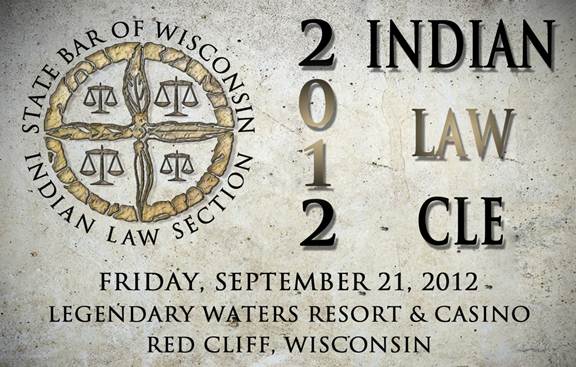
Wisconsin Indian Law CLE Announcement — Sept. 21, 2012


Continue reading

California Indian Law Assoc. 12th Annual Conference Save the Date

Here:

CILA.SaveTheDate2012

Indigenous Law Journal Call for Submissions: Oct. 1, 2012 Deadline

Details here:

Call for Submissions Fall 2012

New Book by Blake Watson on Johnson v. M’Intosh

Buying America from the Indians: Johnson v. McIntosh and the History of Native Land Rights 

Blake A. Watson has served as an attorney with the U.S. Department of Justice and is now Professor of Law at the University of Dayton.

The backstory on the court decision that defined and limited American Indian property rights

The U.S. Supreme Court ruling in Johnson v. McIntosh established the basic principles that govern American Indian property rights to this day. In the case, more than one Anglo-American purchaser claimed title to the same land in what is now southern Illinois. The Piankeshaw Indians had deeded the land twice—once to speculators in 1775, and again, thirty years later, to the United States by treaty. The Court decided in favor of William McIntosh, who had bought the land from the U.S. government. Writing for the majority, Chief Justice John Marshall declared that the “discovery” of America had given “exclusive title to those who made it”— namely, the European colonizers. According to Johnson, the Piankeshaws did not own what they thought was their land. Indeed, no Indian tribe did.

Blake A. Watson’s examination of Johnson v. McIntosh and its impact offers a comprehensive historical and legal overview of Native land rights since the European discovery of the New World. Watson sets the case in rich historical context. After tracing Anglo-American views of Native land rights to their European roots, Watson explains how speculative ventures in Native lands affected not only Indian peoples themselves but the causes and outcomes of the French and Indian War, the American Revolution, and ratification of the Articles of Confederation. He then focuses on the transactions at issue in Johnson between the Illinois and Piankeshaw Indians, who sold their homelands, and the future shareholders of the United Illinois and Wabash Land Companies.

The final chapters highlight the historical legacy of Johnson v. McIntosh for federal policy with regard to Indian lands. Taught to first-year law students as the root of title for real property in the United States, the case has also been condemned by the United Nations and others as a Eurocentric justification for the subjugation of the Indians. Watson argues that the United States should formally repudiate the discovery doctrine set forth in Johnson v. McIntosh.

The thorough backstory and analysis in this book will deepen our understanding of one of the most important cases in both federal Indian law and in American property law.
Colville Staff Attorney Job Posting

The Confederated Tribes of the Colville Reservation, Office of Reservation Attorney, seeks two attorneys with experience and expertise in Indian Law and in working for a tribal government.  Must possess at least five, and preferably ten, years of successful experience as a licensed attorney and provide evidence of expertise in issues related to tribal governmental law and policy. Exceptionally strong research and writing skills are required. Candidates with litigation experience and experience working with Indian tribes are particularly encouraged to apply. Applicants must be admitted to practice before the Washington State Courts upon hire or within one year of hire.

The Colville Reservation, with headquarters in Nespelem, Wash., contains over 1.4 million acres and provides attorneys the opportunity to work on a variety of important Indian law matters. The Office of Reservation Attorney is one of the oldest on-reservation tribal government law offices, with a strong tradition of excellence.

Salary DOE.  The ORA salary for an attorney with ten years’ experience is approximately $94K annually, with increases at all levels based upon years of experience. Generous health and retirement benefits are provided.

Open until filled.  Submit cover letter describing in detail how the applicant meets or exceeds minimum requirements, a resume listing at least three work-related references/contact information, and writing sample to Office of the Reservation Attorney Attn: Alice Koskela, Managing Attorney, P.O. Box 150, Nespelem, WA  99155.

The ORA is an Indian Preference employer.

Umatilla Confederated Tribes Prosecutor Job Posting

Here in PDF: RFP for Prosecutor Services July 2012


Pokagon Band Potawatomi Prosecutor Position Posting

The Pokagon Band of Potawatomi Indians, a federally recognized tribe in Southwest Michigan and Northwest Indiana is seeking a full-time Prosecutor / Presenting Officer. Under the administrative supervision of the General Counsel, the Prosecutor/ Presenting Officer provides criminal and civil law enforcement services to the Band, presents child protection and custody matters in the Pokagon Band Tribal Court, and represents the Band in child custody matters in state courts.  Occasional travel within and outside Michigan and Indiana will be required.

General Position Requirements:

  • 5 – 10 years of experience as a practicing attorney in one or more legal fields relevant to the principal duties of the Prosecutor / Presenting Officer.
  • High level of written and oral communication skills and superior ability to advocate and persuade.
  • Exceptional ability to think on feet and to identify and analyze legal issues and present legal theories.
  • Highly independent and organized and able to manage significant number of active matters simultaneously.
  • Licensed and member in good standing of the State Bar of Michigan.
  • Demonstrated high academic achievement with a 3.0 GPA or higher.
  • Valid driver’s license and able to meet minimum insurance requirements in order to use GSA vehicles.
  • Employment is contingent upon the satisfactory completion of a criminal background investigation and submission to drug and alcohol testing by urinalysis.
  • Never have been convicted of a felony.
  • Have experience in, or within three months of appointment, have training in prosecutorial skills equivalent to training required for prosecutors in Michigan.

Preferred candidates will:  (1) display demonstrated commitment to Indian affairs as shown through significant experience working with Indian tribes or in the area of Indian affairs, including familiarity with the Indian Child Welfare Act, and (2) have previous prosecutorial experience within the Pokagon Band’s ten (10) county service area consisting of the Michigan counties of Allegan, Berrien, Van Buren and Cass and the Indiana counties of La Porte, St. Joseph, Elkhart, Starke, Marshall, and Kosciusko.

Salary is commensurate with demonstrated achievement, experience, and credentials.

For additional information on this position, including the full job description and how to apply, please visit our Careers page at www.pokagonband-nsn.gov/career_opportunities.aspx.

Berkeley Law School Symposium on Legacy of Phil Frickey — Sept. 2012

Fall2012SymposiumWebbanner

A few years before his untimely death the renowned Indian law scholar Phillip Frickey delivered a lecture citing the “failure of scholarship in federal Indian law to grapple with the law on the ground in Indian country” and encouraged his colleagues to educate a judiciary with little knowledge of Native culture.

This symposium will bring together tribal leaders, jurists, Indian law scholars and practitioners to highlight the challenges facing tribal communities today and to explore ways in which the legal academy can contribute to meeting those challenges.

Symposium agenda and registration details to follow.