Here.
44.779033
-85.488319
Here.
Here, from the Indian Law Resource Center:
 Notice of Appeal – Superintendent Decision regarding Secretarial Election
Notice of Appeal – Regional Director Decision regarding Secretarial Election
Appeal of Superintendent Decision with Appendix
Notice of Appeal – Regional Director Decision with Appendix
And here also:
UPDATE — still more materials:
Earlier federal court materials here.
Materials here:
Press release text here:
Twenty-five years to the day after Congress enacted the Indian Gaming Regulatory Act, the Lac du Flambeau Band of Lake Superior Chippewa began a new era of Indian gaming. On October 17, 2013, the Tribe’s governing body voted unanimously to ratify an inter-tribal agreement to create the Tribal Internet Gaming Alliance (TIGA). The agreement, being called an inter-tribal treaty, will organize tribes across the country to both offer and regulate internet and mobile phone gaming. Until laws change, TIGA will accept real-money wagers only from people who are physically present in the member tribes’ jurisdictions, such as patrons at tribal casinos and visitors to other tribal lands. When customers are outside of tribal jurisdiction, the games will be fun-play and will offer casino promotions. Games will be those categorized as class II under IGRA, such as slot-like bingo, traditional bingo, pull tabs, and poker. Because the games are class II, no tribal-state compacts will have to be amended.
Using this strategy, TIGA tribes will jump ahead of the online competition and get extremely valuable experience with real-money wagering before other tribes and gaming operations. The idea for TIGA began among tribes in Wisconsin, Minnesota and Michigan. TIGA developments are now being followed by 28 tribes in 13 states.
Attached you will find: 1) a TIGA Fact Sheet; 2) a media release from the Lac du Flambeau Band of Lake Superior Chippewa; and 3) a copy of the TIGA Treaty.
If you have any questions or would like to have a unique quote, please contact me. I am an Indian gaming attorney at the law firm of Kanji & Katzen, a former Senior Attorney at the National Indian Gaming Commission and a former Assistant Solicitor at the United States Department of the Interior. You may reach me by email or at (202) 261-6528.
Here are the materials in Anderson v. Duran (N.D. Cal.):
Here.
Thomas W. Fredericks Honored with University of Colorado Alumni Award
Boulder, Colorado, 10/25/13. – Last night, the University of Colorado Boulder honored Thomas W. Fredericks of Fredericks Peebles & Morgan LLP, the George Norlin Award, University of Colorado’s most prestigious alumni award. The award recognizes outstanding alumni who have demonstrated a commitment to excellence in their chosen field of endeavor and a devotion to the betterment of society and their community.
The tradition of honoring the University of Colorado Boulder’s Alumni began in 1930 when the Alumni Association wanted to honor the CU president George Norlin and the growing legions of extraordinary alumni. George Norlin was a passionate and courageous activist who fought the rise of extremist racist groups in the United States while others stood idly by and turned a blind eye to the injustice the KKK and Nazi’s inflicted on vulnerable people. The George Norlin Award was created to celebrate Norlin’s spirit of courage, passion, and community activism that he demonstrated despite great personal risk. Since the award was established, the association has been fortunate to recognize several generations of outstanding alumni with the Norlin Award, including President Norlin himself who received his medal in 1939 when he retired after 20 years of presidential service.
Like Mr. Norlin, Mr. Fredericks has passionately and courageously fought for parity and justice for Indians and Indian Tribes in the United States. He was the Economic Opportunity Program Director for the Standing Rock Sioux Tribe. As a liaison between the California Indian Legal Defense Fund and law school, he facilitated the founding of the Native American Rights Fund (NARF) in Boulder, and later became its executive director. He has also served as the Associate Solicitor for Indian Affairs, and later served as the Assistant Secretary of Indian Affairs under President Jimmy Carter. In these roles, he was an essential component of the overall legal policy during the 1970s and influenced policy in a way that survives today. Furthermore, he was instrumental in development tribal and intertribal organizations that allow Indian people to organize and implement their self determination. Now in private practice, he remains as involved in influencing federal policy, self determination, self governance, water/infrastructure/roads/housing/facility/oil/mineral/gas development, as he ever was.
Not only has he passionately and courageously defended his clients’ rights and pursued their interests, he taught many young associates throughout his career, particularly Native American attorneys to do the same. Many of his prodigies advance to important positions and successful careers beyond his firm. At a small ceremony for him yesterday, Mr. Fredericks’ associates thanked him, not only for the opportunity to do meaningful work for Indian tribes across the United States, but also for his guidance and mentorship: “Mr. Fredericks is constantly teaching his associates to be better attorneys, better advocates, and better thinkers” and “he teaches us something new every day; his work has cleared the path for Indian lawyers.” One attorney spoke about how Mr. Fredericks inspired his career choice: “When you see your elder is doing something like Mr. Fredericks has done, it tells you that you can do anything you want to.” Lance Morgan summed it up: “Before I met Tom, I knew about him. He’s a pioneer and every young Indian lawyer knew him. I couldn’t wait to work with him. He has impacted his family, his firm, and those people that have worked for and with him. That triple level of accomplishment is impressive. This is a well-deserved recognition, like a cherry on top of a mountain of a career.”
His friends, family, and community members that came together to honor him said “He has taken care of all of us, his brothers and sisters, the children, and all tribes. He has made sure we have good water and good air. Thank you, brother, for taking care of us.” They continued, “We came to you for advice, and it did not fail that when we listened to you, the tides turned for us. You guide us, you lead us, you help us.”
The George Norlin Award medal was presented to Mr. Fredericks at a standing-room only Awards Ceremony where he delivered a powerful acceptance speech. Martha L. King and Rebecca A. Rizzuti, two of the principal nominators of Mr. Fredericks’ award, said
We set out to lasso a star in the form of the George Norlin Award. What happened, however, was that we learned we barely touched the surface of what he has done in his lifetime. His colleagues, family and friends have way more information on his accomplishments, and we have got to expand our ability to accept that information and do something with it. Judging by the two standing ovations he received and the swarms of people who came up to us afterward, it is clear there is an audience for more information on his work and its impacts in the west and in the Americas.
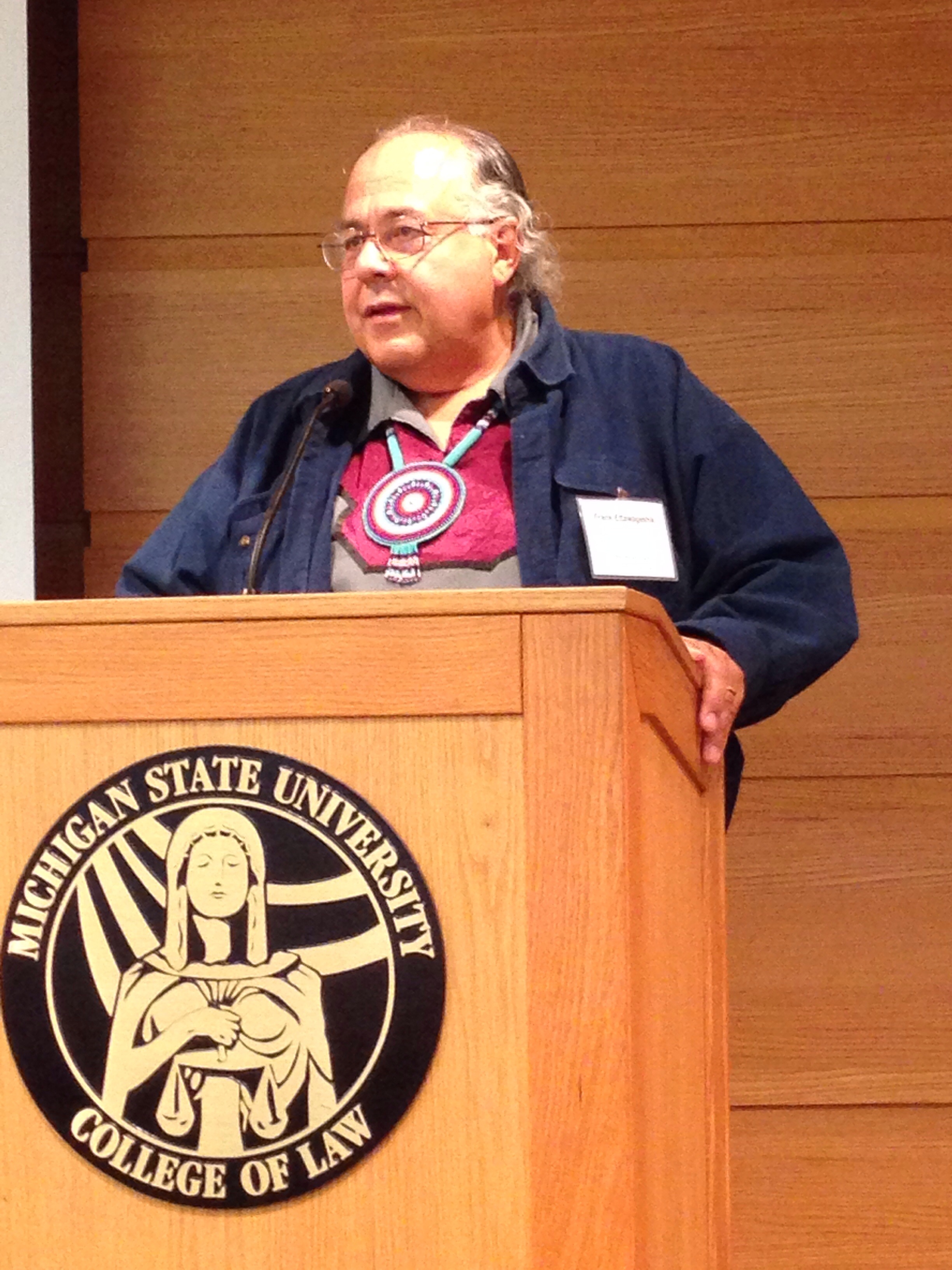
Paul Raphael, Janis Fairbanks, Dylan Miner, Meg Noodin

Also we are please to host the National Native American Law Students Association’s executive board. Sharp, if conservative, dressers.

Victoria Sweet, Heather Howard, and Elizabeth Kronk Warner

Linus Banghart-Linn, ILPC Alum, and the legendary Kate Fort


You must be logged in to post a comment.