Request for Proposals – Court Assessments in Alaska-AVCP & California

As a courtesy notice, the below Request for Proposals are available on the Federal Business Opportunities website. Please note, they are advertised as 100% Indian Small Business Economic Enterprise Set-aside in accordance with the Buy Indian Act.

  • RFQ No. A16PS00308, closes 4/25/2016, BIA Office of Justice Services District IX (California) Tribal Court Assessments
  • RFQ No. A16PS00309, closes 4/25/2016, BIA Office of Justice Services District IX (California) Tribal Court Assessments
  • RFQ No. A16PS00310, closes 4/25/2016, BIA Office of Justice Services District IX (Alaska – AVCP) Tribal Court Assessment

Please direct all questions to the Contracting Officer listed on the solicitation.

Tohono O’odham Assistant Attorney General Vacancy

The Office of Attorney General is now hiring an Assistant Attorney General IV, Health, with at least eight years of relevant experience, including experience in health law.  The Office of Attorney General represents the interests of the Tohono O’odham Nation in tribal, state, and federal venues.

The Nation offers generous benefits including paid holidays, sick and annual leave, low cost medical, dental, and vision insurance.  Applicants must pass a background check.  Send resume, legal writing sample, and three references to Acting Attorney General Laura Berglan via email at laura.berglan@tonation-nsn.gov.

Capacity Building Center for Tribes Webinar on Title IV-E

Tribal Considerations for Title IV-E Access

Join us for a webinar on Apr 07, 2016

10:00 AM Alaska Time
11:00 AM Pacific Time
12:00 PM Mountain Time
1:00 PM Central Time
2:00 PM Eastern Time

Register now!

https://attendee.gotowebinar.com/register/435037542002716929

Many Tribes are exploring how federal Title IV-E funds can best meet their child welfare program needs. Some Tribes are considering direct access to Title IV-E, while others are engaged in or considering Tribal-State IV-E agreements and contracts. The federal Children’s Bureau, joined by the Chickasaw Nation of Oklahoma and the new Capacity Building Center for Tribes, will share detailed information about Title IV-E considerations for Tribes who may be seeking to operate a Title IV-E program, either directly or through agreements. The discussion will focus on federal Title IV-E regulations as well as Tribe’s experience in direct access.

Matthew Fletcher is First Native Plenary Speaker at National Conference

ncjfcj1
Click to enlarge

Here is Matthew with Robert Listenbee, Jr., at the National Council of Juvenile and Family Court Judges’ National Conference on Juvenile Justice in Las Vegas.  Listenbee, Administrator of the DOJ’s Office of Juvenile Justice and Delinquency Prevention, introduced Matthew and encouraged the group to work harder to bring justice for Native children and youth.  Matthew is the first Native plenary speaker that NCJFCJ has had at one of its national conference!  His presentation was “The Crisis in American Indian Juvenile Justice.”

Judge Orders Judicial Notice in Nooksack Disbarrment

Belmont v. Kelly Order Re Resolution 16-28 and Due Process; Granting Motion for Judicial Notice

Excerpt:

Repeatedly, the Court has observed such tactics by Defendants: They rely upon case law where Defendants and their counsel have access to the full record of the case, while refusing such access to Plaintiffs without approval by Tribal Council, a majority of whom are Defendants in this lawsuit.  They rely upon statutes where Defendants and their counsel have full access to the statutes, while refusing such access to Plaintiffs without Tribal Council approval.  E.g., after Defendants claimed that the recall option is open to Plaintiffs, the Council declined to provide Plaintiffs with a copy of amended Title 60, setting forth recall procedures.  And most recently, Defendants delegated to themselves authority for disciplining advocates in the Tribal Court and then, without providing notice and opportunity to be heard, they disbarred attorneys representing their adversaries in litigation.

Update: News coverage here — “Judge rules ‘biased’ tribal council denied disbarred lawyer due process

Yurok Office of the Tribal Attorney Job Postings

The Yurok Tribe, located in Klamath, California, seeks applicants for the General Counsel and Deputy General Counsel positions. Descriptions are attached.

Yurok Human Resources can be reached at 707-482-1350 or hr@yuroktribe.nsn.us.

0766 General Counsel Regular Full Time Klamath $81,823 to negotiable Open Until Filled. Review 4/15/16
0767 Deputy General Counsel Regular Full Time Klamath $70,873-$109,560 Open Until Filled. Review 4/15/16

http://www.yuroktribe.org/departments/personnel/announcements.htm

NHBP Media Release: Violence Against Women Act’s Jurisdictional Provisions

Nottawaseppi Huron Band of the Potawatomi Asserts Authority to Prosecute All Persons, including Non-Indians, for Domestic Violence

Local Tribe to Implement Violence Against Women Act Jurisdictional Provisions

Pine Creek Indian Reservation, Athens, MI – Today, the Nottawaseppi Huron Band of the Potawatomi announces implementation of a new tribal government law that enables tribal police and justice officials to investigate and prosecute certain domestic violence crimes committed by non-Indians in Indian country. Non-Indians who live or work on the reservation or have a marriage or dating relationship with a Native person may now be subject to tribal jurisdiction for domestic and dating violence crimes and criminal violations of certain protection orders. Individuals who commit these crimes in Indian country can be arrested by tribal police, prosecuted in tribal court, and sentenced to prison. Individuals prosecuted under the new tribal law will have a right to an attorney. If the defendant cannot afford an attorney, one will be provided by the tribe.

This is part of the Tribal Council’s larger effort to take a stand against violence in the community—and domestic violence, in particular—because of the huge toll it has taken on Native families and youth.

“Domestic violence is a uniquely local crime that has long deserved a local solution, and now we have one,” said Tribal Council Chair Homer A. Mandoka. “We will no longer stand by and watch our Native women be victimized with no recourse. I’m here to put the community on notice, perpetrators will be held accountable.”

The federal law that authorizes these recent actions by the Nottawaseppi Huron Band of the Potawatomi is the Violence Against Women Reauthorization Act of 2013 (VAWA 2013).  Signed into law on March 7, 2013, VAWA 2013 marked a victory for Native women, tribal leaders, women’s rights advocates, and survivors of domestic abuse everywhere. For the first time since the U.S. Supreme Court stripped tribal governments of their criminal authority over non-Indians in Oliphant v. Suquamish Indian Tribe (1978), VAWA 2013 restored tribal inherent authority to investigate, prosecute, convict, and sentence non-Indians who assault their Indian spouses or dating partners in Indian country. This aims to fill a longstanding jurisdictional gap on tribal lands that has for far too long put Native women at risk and kept the hands of tribal law enforcement tied.

Crimes committed outside of Indian country, between two strangers, between two non-Indians, or by a person without sufficient ties to the Nottawaseppi Huron Band of the Potawatomi are not covered by this new authority.

This new law is necessary because violence against Native women has reached epidemic proportions*, and the old system of forcing tribes to rely exclusively on far away federal—and in some cases, state—government officials to investigate and prosecute crimes of domestic violence committed by non-Indians against Native women is not working.  Prior to VAWA 2013, the Indian woman who was beaten by her non-Indian husband on tribal land had nowhere to turn for protection: tribal law enforcement had no authority to intervene because the perpetrator is a non-Indian; the State had no authority to intervene because the victim was an Indian; and the Federal Government—the body with exclusive jurisdiction—had neither the will nor the resources to intervene in misdemeanor level domestic violence cases. VAWA 2013 is an attempt to remedy this broken system.

As President Obama said when he signed VAWA 2013 into law, “Tribal governments have an inherent right to protect their people, and all women deserve the right to live free from fear.”  The Nottawaseppi Huron Band of the Potawatomi agrees, and it’s doing its part to ensure the safety of native women and of everyone on the reservation.

About the Nottawaseppi Huron Band of the Potawatomi

The Nottawaseppi Huron Band of the Potawatomi is a federally recognized Tribal government with nearly 1,100 enrolled Tribal members. The Potawatomi name is a derivation of Bodéwadmi, meaning a people of the fire or a people who make or maintain fire, both of which refer to the role of the Potawatomi as the keepers of the Council fire in an earlier alliance with other Tribes in the area. The Tribe’s main offices are located at the Pine Creek Indian Reservation in Athens Township, with additional offices in Grand Rapids, MI, to better serve our Tribal members.  The government employs more than 150 employees who work for various departments among the Tribe including Tribal Police, Tribal Court, Housing, Environment, Membership Services, Communications, Human Resources, Finance, Public Works, Planning, Health & Human Services, and the Gaming Commission.

* Compared with other demographic groups, American Indian women have one of the highest rates of domestic violence victimization in the United States. See. e.g.,Centers for Disease Control and Prevention (CDC), The National Intimate Partner and Sexual Violence Survey (NISVS): 2010 Preliminary Report at 3, 39 (Nov. 2011) (finding that 46% of Native American women have experienced rape, physical violence, and/or stalking by an intimate partner in their lifetime.)  A significant percentage of residents of Indian reservations are non-Indian.  See U.S. Census Bureau, 2010 Census Briefs, The American Indian and Alaska Native Population: 2010, at pages13- 14 and table 5 (Jan. 2012) (showing that 1.1 million American Indians and 3.5 million non-Indians reside in American Indian areas).  Many married Indian women have non- Indian husbands. See U.S. Census Bureau. Census 2010, special tabulation, Census 2010 PHC-T- 19, Hispanic Origin and Race of Coupled Households: 2010, Table 1, Hispanic Origin and Race of Wife and Husband in Married-Couple Households for the United States: 2010 (Apr. 25, 2012) (showing that more than 54% of Indian wives have non-Indian husbands).

U.S. Presidential Candidates on Native American Issues

In light of campaigning in Indian Country, here are links on how leading candidates are addressing tribes:

Fmr. Sec. Hillary Clinton

“Growing Together: Hillary Clinton’s Vision for Building a Brighter Future for Native Americans” from from her campaign’s webpage.

“How Hillary Clinton’s Campaign Is Making Its Play for Native American Support” from the Atlantic.

Sen. Bernie Sanders (D-VT)

“Empowering Tribal Nations” from his campaign’s webpage.

“In Arizona, Sanders woos Native Americans” from the Associated Press and “Bernie Sanders Replaces Stump Speech with Epic Call for Native American Justice in Arizona” from US Uncut.*

*The first article is slightly biased against the Senator but is the AP wire most news outlets reported for the March 17th event.  The second article is biased towards Sanders but includes video of the full speech.

Donald Trump

Trump has no website dedicated to Native issues, but here are some reported positions:

“Donald Trump and Jeb Bush Find Common Ground on Washington’s Football Team” from the NYT reporting on Trump’s defense of the Washington NFL team’s name.

“The Connecticut Roots Of Trump’s First Big Slur” from the Hartford Currant remembering Trump’s testimony to the House Subcommittee on Native Americans in 1993 concerning Tribal casinos.

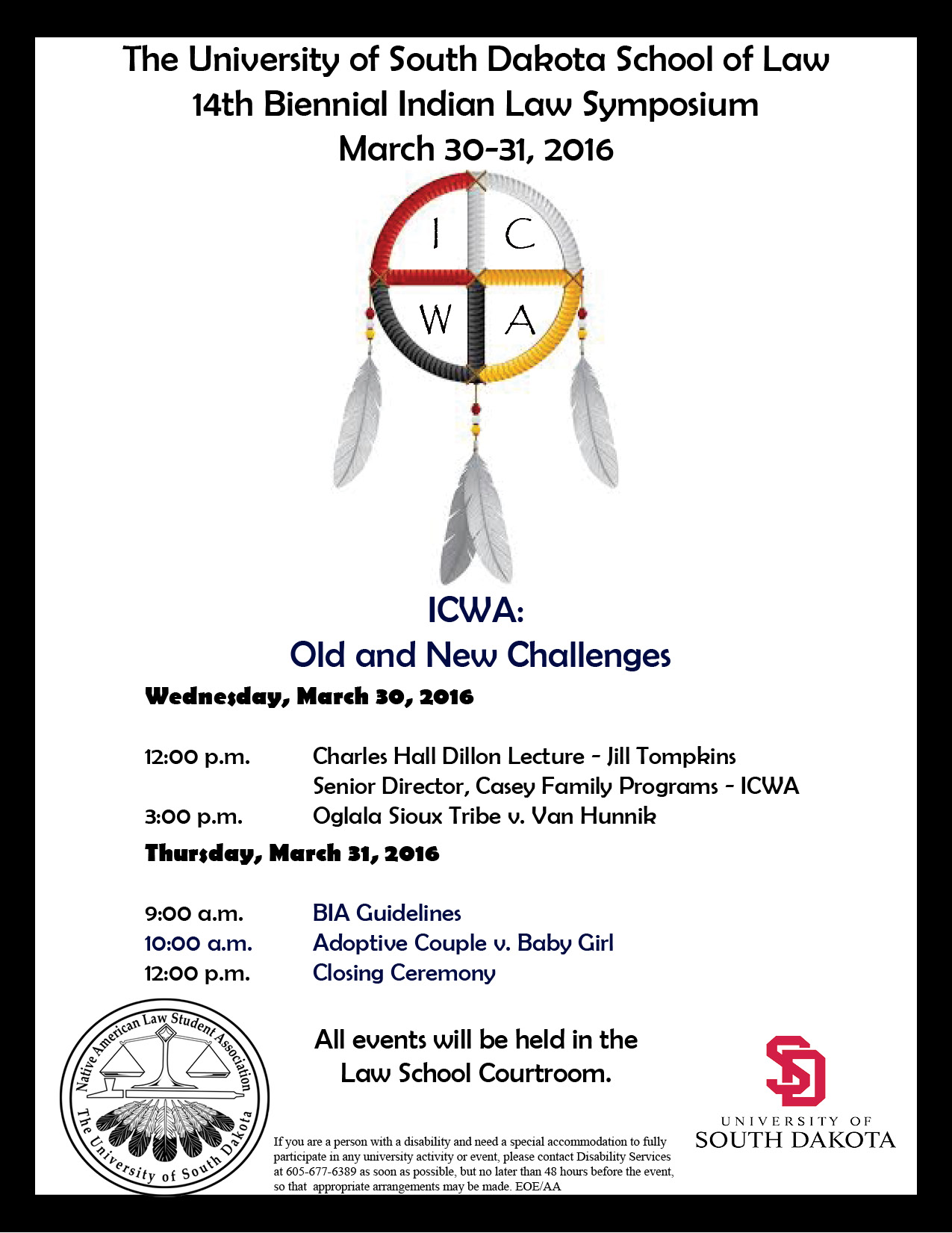
14th Biennial Indian Law Symposium at USD

ILS Poster 2016

Link to details and registration here.

The local NALSA chapter is hosting “Indian Child Welfare Act: Old and New Challenges” March 30-31 at the University of South Dakota.