Here is the unpublished opinion.
Briefs are here.
Here is the unpublished opinion.
Briefs are here.
Here.
Native youth have suffered the highest rate of caregiver loss from the pandemic—4.5 times higher than that of White children. This means that 1 of every 168 Native children have lost their primary caregivers to COVID, as compared with 1 of every 310 Black children, 1 of every 412 Hispanic children, and 1 in every 753 White children.
Thanks to Fred Fisher to sending this on to us.
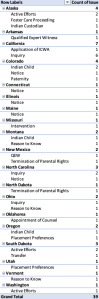
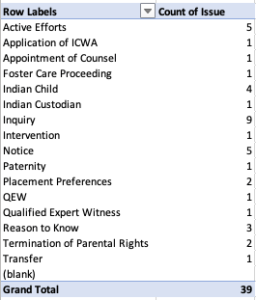
I’m still cleaning the data for the 2021 ICWA cases, but here are a few screen shots that might be interesting. Federal cases are excluded. This dataset is based on my reading of Lexis/Westlaw alerts as well as a few individual state alerts. Mistakes are mine.



The Colorado Court of Appeals analyzed the regs on the reason to know issue, a similar argument to the In re Z.J.G. case from Washington. And as in Z.J.G., the Department is arguing for a narrower interpretation. However, the Court of Appeals reasoned:
Recall that the federal regulation and the Colorado statute implementing ICWA’s “reason to know” component distinguish between information that the child is an Indian child, 25 C.F.R. § 23.107(c)(1); § 19-1-126(1)(a)(II)(A), and information indicating that the child is an Indian child, 25 C.F.R. § 23.107(c)(2); § 19-1- 126(1)(a)(II)(B). These two provisions cannot have the same meaning because that would make one superfluous.
***
As a result, divisions of this court have repeatedly recognized that, where a district court receives information that the child’s family may have connections to specific tribes or ancestral groups, the court has “reason to know” that the child is an Indian child — even where the information itself does not establish that the child fully satisfies the definition of an Indian child
NY Times Coverage here
The Canadian government announced Tuesday that it had reached what it called the largest settlement in Canada’s history, paying $31.5 billion to fix the nation’s discriminatory child welfare system and compensate the Indigenous people harmed by it.
Agreement in principle/press release here
For those who were following this case, it involves the First Nations Child and Family Caring Society, which is led by Cindy Blackstock. The settlement attempts to reform Child and Family Services and address Jordan’s Principle. This is a major settlement and significant milestone for Native children and families in Canada.
All the briefs are here. The Court will first consider the case at this Friday’s conference (1/7).
I’ve been watching the qualified expert witness decisions coming in that are finally starting to wrestle with both the Regulations and the Guidelines, and I think they are narrowing in on conflicting requirements that will likely make it increasingly difficult to find a QEW.
First, the purpose of the QEW is for the state to find a witness (hopefully in collaboration with the Indian child’s tribe) that agrees a child needs to go into foster care or agree with a termination of parental rights. This is an attempt to address state bias, obviously, in the removal of Native children. The law only requires the testimony of the QEW support the findings, and doesn’t specifically require magic language from the QEW. The Regulations are fairly thin on the requirements of a QEW but there are two major elements:
“A qualified expert witness must be qualified to testify regarding whether the child’s continued custody by the parent or Indian custodian is likely to result in serious emotional or physical damage to the child and should be qualified to testify as to the prevailing social and cultural standards of the Indian child’s Tribe.” 25 C.F.R. 23.122
This decision from New Mexico finds the QEW was qualified on the social and cultural standards, but was not on the serious emotional or physical damage to the child. There is a similar decision on this from Alaska, and really problematic language in the Guidelines that is leading to the focus on the specialized expertise of the witness regarding the ability to testify about continued custody and a de-emphasis on the social and cultural standards of the Tribe. I personally have mixed feelings about this, but I would advise practitioners to read this opinion especially as to laying the foundation for the testimony of the QEW. And I’d also reiterate my usual advice that Tribes can always introduce their OWN witness to address cultural tribal issues.
This case is also unreported, and not notable for any ICWA holding except for footnote 4, which highlights how ICWA is USUALLY challenged:
4 Again, DCS alleges Parents have waived this issue for failure to raise it below. Parents did argue to the juvenile court during closing argument that the standard of proof should be beyond a reasonable doubt. See Tr., Vol. 2 at 95. They did not, however, offer any basis for that assertion, least of all a state or federal constitutional basis. As DCS points out, in order to properly preserve an issue for appeal, “[a]t a minimum, a party must show that it gave the trial court a bona fide opportunity to pass upon the merits of the claim before seeking an opinion on appeal.” Endres v. Ind. State Police, 809 N.E.2d 320, 322 (Ind. 2004). The juvenile court did not have that opportunity below.
Although we consider Parents’ state due process claim notwithstanding waiver for the same reason we exercised our discretion to decide the jury trial issue, supra n.2, we decline to consider the waived federal equal protection claim. Parents’ equal protection argument is based on the fact that the Indian Child Welfare Act provides that parental rights of Native Americans may be terminated only upon evidence beyond a reasonable doubt. See 25 U.S.C. § 1912(f). The right to a jury in juvenile proceedings and the scope of the state due process clause are matters of settled law in Indiana. But Indiana courts have not had occasion to consider whether the differing state and federal standards violate equal protection, and we will not undertake that analysis when it was not developed at all in the juvenile court and is raised for the first time on appeal.
Waiver notwithstanding, we note that the United States Supreme Court has routinely rejected claims that laws that treat Native Americans as a distinct class violate the equal protection rights of non-Native Americans, see, e.g., United States v. Antelope, 430 U.S. 641, 646 (1977) (concluding “federal regulation of Indian affairs is not based upon impermissible classifications”), and states that have had occasion to consider whether their clear and convincing standard violates the equal protection clause have found no violation, see, e.g., Matter of M.K., 964 P.2d 241, 244 (Okla. Civ. App. 1998) (holding heightened burden of proof required for termination of Native American parental rights is “rationally tied to Congress’ responsibility for policy toward [Native American] families” and lower state standard did not violate non-Native American father’s right to equal protection).
In other words, the Non-Native parents would like to have the same protections ICWA provides Native families.
I get asked a lot–just last week, in fact–to address the claim that Native children are often ripped from loving foster homes where they have been for a long time because the Tribe wants something different. I think the fact pattern in this case is more usual–the child was in the home (an Indian foster home) for five months when the Tribe requested visitation between her and her grandmother. Within a year, the state child welfare department petitioned to move the child to her grandmother. The original placement was always a foster placement and ICWA applied to this child from very early on in the proceedings. Moving a child to a permanent relative home within a year is very fast for a child welfare case. And yet still, the foster family intervened and attempted to stop the transfer to tribal court and regain custody of the child.
The Court of appeals here affirmed the lower court’s decision to transfer.
This is part of a small collection of state court decisions (In re B.B., Utah, Bruce L., AK) interpreting ICWA’s paternity definition, and also applying ICWA to paternity proceedings. It also addresses the issue of biological father (required by ICWA) and presumed father (defined by the Uniform Parentage Act).
 Turtle Talk
You must be logged in to post a comment.