Here are the materials in Thorpe v. Borough of Thorpe (M.D. Pa.):
cultural resources
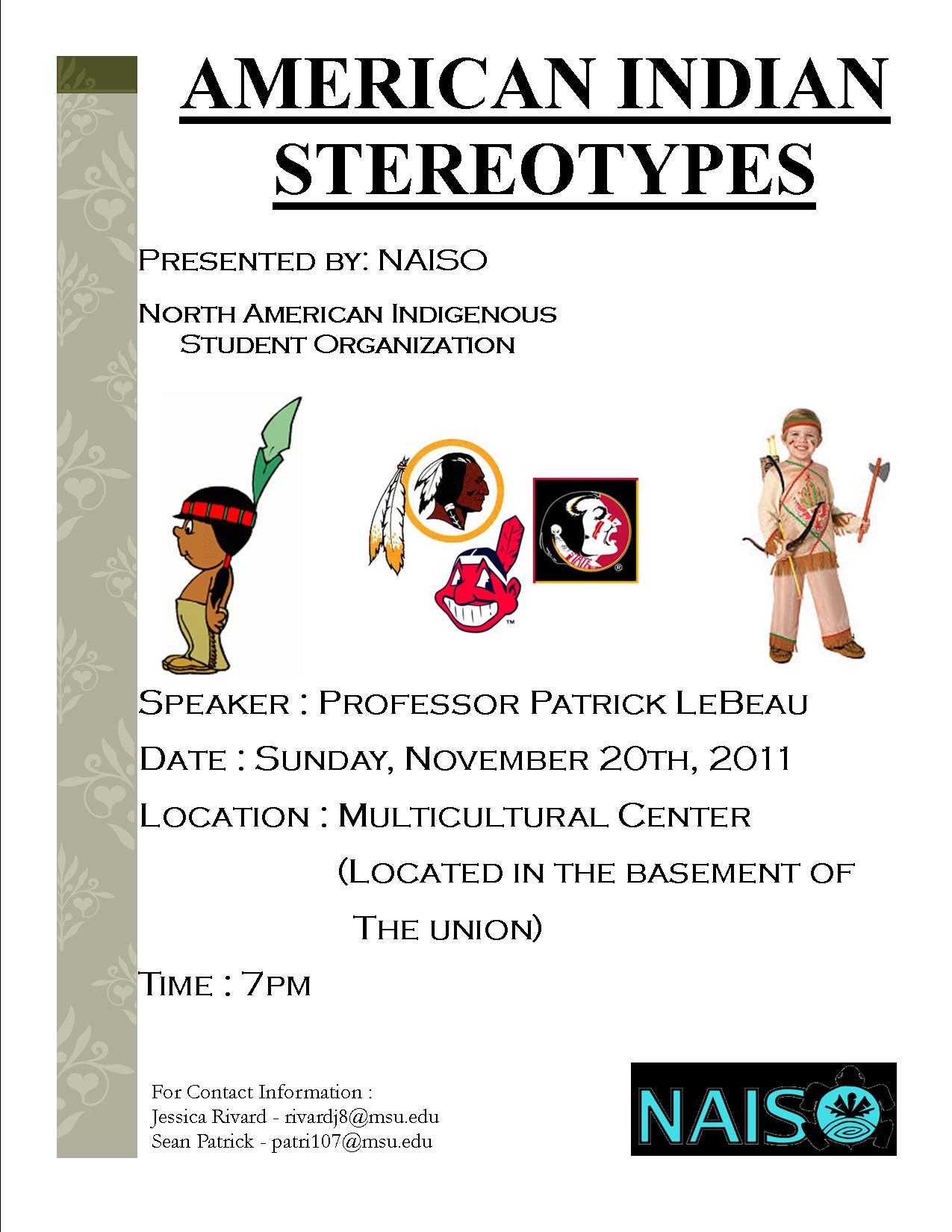
MSU Prof. Patrick LeBeau Talk on American Indian Stereotypes on Nov. 20, 2011
Recommended Garret Epps’ Paper on Employment Division v. Smith
Garrett Epps has posted his 1998 Arizona State Law Journal paper, “To an Unknown God: The Hidden History of Employment Division v. Smith.” He later expanded it into a powerful book, To an Unknown God: Religious Freedom on Trial. Both are highly recommended.
Here is the abstract:
The Supreme Court’s decision in Employment Division v. Smith, is once again the law of the land-and once again, “neutral, generally applicable laws may be applied to religious practices even when not supported by a compelling governmental interest.”
In City of Boerne v. Flores, the Court invalidated, at least as applied to State governments, the Religious Freedom Restoration Act (RFRA). RFRA was passed by Congress with the explicit aim of voiding Smith’s holding that “the right of free exercise does not relieve an individual of the obligation to comply with a ‘valid and neutral law of general applicability on the ground that the law proscribes (or prescribes) conduct that his religion prescribes (or proscribes).’ ”
The Smith doctrine was at least implicitly upheld by the six-Justice majority in Flores. The opinion not only restated the Smith rule, it further repeated the controversial “hybrid case” doctrine enunciated for the first time by Justice Scalia in Smith II: “The only instances where a neutral, generally applicable law had failed to pass constitutional muster, the Smith Court noted, were cases in which other constitutional protections were at stake.”
The Flores Court’s implied reaffirmation of Smith is remarkable because Smith was one of the most unpopular decisions in the Court’s recent history. Learned commentators have almost unanimously excoriated the Court’s result and rationale.” Journalistic commentators have been scathing. The United States Congress expressed its opinion of the decision in unmistakable terms by its passage of not one but two statutes purporting to void the result. Besides RFRA, which mentions Smith II by name, Congress in 1994 also passed amendments to the American Indian Religious Freedom Act that mandate an exemption from state and federal drug laws for religious use of peyote by Native Americans. Despite this repudiation, the Court has seemingly embraced Smith II once again. The time is more than ripe, therefore, for an examination of the case that has brought us to this point.
In 1994, I set out to find and document the actual people and decisions that created the case. The technique I used is familiar to historians – oral interviews designed to supplement and illuminate the written record.’ The use of “oral history” is designed to elicit the kind of information often omitted by those who prepare written documents.
Part II of this Article is a summary of Al Smith’s remarkable life, much of it in his own words; a brief profile of Galen Black, his Anglo co-claimant; and an account of the career of Smith’s tenacious adversary, Dave Frohnmayer. Part III provides an introduction to the legal and constitutional background in Oregon at the time the case arose, with emphasis on the violent encounter between the State and the religious commune in eastern Oregon known as Rajneeshpuram. Part IV details the dispute that led to the dismissal of Black and Smith. Parts V-VII consider the case in its first iteration through state courts and the U.S. Supreme Court. Part VIII details the extraordinary efforts at settlement of the case that took place shortly before oral argument in Smith II. Part IX describes oral argument from the point of view of the participants. Part X analyzes the response to Smith II, in Oregon and across the nation. In my Conclusion, I argue that the difficulties our legal system has had in dealing with Smith II are but a foretaste of coming religion cases, as our courts grapple with the Free Exercise Clause-our Constitution’s altar to an unknown god.
NPR: What Not to Do with the Last Great Wild Buffalo
Well, here is what the chief taxidermist, William Temple Hornaday, of the national museum did:
Buffalo can move fast: 35, 40 miles an hour; they can jump 6 feet vertically, and crash through thick brush, but Hornaday writes, “my horse carried me alongside my buffalo, and as he turned toward me I gave him a shot through the shoulder, breaking the fore leg and bringing him promptly to the ground.”
He shot the bull. After hobbling this giant, Hornaday went off to assist in the shooting of a cow…
I then rode back to the old bull. When he saw me coming he got upon his feet and a short distance, but was easily overtaken. He then stood at bay, and halting within 30 yards of him I enjoyed the rare opportunity of studying a live bull buffalo of the largest size on foot on his native heath. I even made an outline sketch of him in my note-book. Having studied his form and outlines as much as was really necessary, I gave him a final shot through the lungs, which soon ended his career.
So he shot him. Then he drew him. Then he killed him. Then he shot the rest of the herd. “We killed very nearly all we saw,” he wrote back to the Museum, “and I am confident there are not over thirty head remaining in Montana, all told. By this time next year the cowboys will have destroyed about all of this remnant. We got in our Exploration just in the nick of time, …”
Here is the article.
Reburial Ceremony for Saginaw Chippewa Ancestors Found in Flint
Here.
Spirit Lake Sioux Tribe ex rel. Committee of Understanding and Respect v. NCAA Complaint
Here: Complaint
Ok, so is this really the Spirit Lake Sioux Nation? What is the Committee of Respect and Understanding? They are the same people who sued the State of North Dakota (unsuccessfully — Davidson v. State) in the last couple years seeking the same relief from the State Board of Education. Paragraph 4 of the complaint alleges they are “authorized by the Spirit Lake Tribe to act on its behalf and proceed in any legal manner it deems appropriate to assure that the University of North Dakota (UND) shall remain known as the ‘Fighting Sioux.'” Here is a link to Dr. Erich Longie’s blog, “Dakota Hoksina,” that strongly suggests the Committee of Respect and Understanding represents very few people at Spirit Lake and Standing Rock — and perhaps not the Nation, either. He probably doesn’t represent anyone either, but seems to have about the same authority as the Committee.
And who is “tribal attorney” Reed Soderstrom? His only prior Indian law experience appears to be in foreclosing on the mortgage of a Turtle Mountain Chippewa member, and his vehicle (Gustafson v Poitra and Ford Motor Credit v Poitra).
ICT coverage here.
What’s going on????
Article III Standing Order in Sacred Sites Challenge to Chevron Energy Solutions Lucerne Solar Project
Here is the opinion in La Cuna De Aztlan Sacred Sites Prot. Circle Advisory Comm. v. United States DOI (C.D. Cal.):
NYRB: “The Racist Redskins”
Here. Subscription req’d.
DOJ Seeks Tribal Leader Input on Eagle Feathers
NYTs Article on Eskimo Whale Hunt
Here.
 Turtle Talk
You must be logged in to post a comment.